Finding the Butterflies: 5 Things to Do If You Think It’s Time for a Change

Finding the Butterflies: When to Make a Change in Your Teaching Career

I had an education professor when I was an undergrad who told us that going into the classroom should always make one a little nervous or even a little scared.

Not anxious and ready to throw up.

Not hyperventilating.

Just butterflies. A little tickle in your stomach. A hint of something new and exciting. A desire to make sure that you don’t fail the learners in front of you.

I don’t know when it happened, but at some point over the last two years, I lost the butterflies. I loved my job. My kids made me smile and amazed me every day. My colleagues were great. But it was all starting to feel routine.

Knowing It’s Time for a Change

I love teaching special ed and being a learning specialist because there are always interesting problems to solve. Looking for the how all aspects of who a student is and how they learn come together, and figuring out how to support the areas of challenge and leverage areas of strength in order to support the student in the classroom. How do we bridge the skills that the student does have with the skills they need to engage in what’s happening in the classroom? But it started to feel like the same problems over and over again. Even the novel problems started to feel like rote. They were variations on puzzles I had solved before.

I was doing my job (and I’d go so far as to say doing my job pretty well), but I was just doing my job. I wasn’t phoning it in. But I wasn’t growing as an educator in the way I wanted to. I was trying new things with my students, but doing new things didn’t spark my curiosity and imagination the way they once did. I’d read articles about burn-out. Burn-out wasn’t the problem. It was absolutely, without a doubt time for a change.

Making the Change

With the exception of two years as a K-6 Literacy Coach, I’ve done the same job almost my entire career: Middle School Learning Specialist. I’ve almost always focused on pull-out instruction with a smattering of push-in and coaching. It’s been primarily focused on reading and writing, with some executive functioning and math thrown in. I liked what I was doing, but as much as I loved teaching reading and writing, the math and executive functioning pieces were the most interesting.

A lot of my time last school year was spent figuring out what my next step would be.

Would it be:

  • Leadership?
  • Would it be to stay where I was and try to create new ways to work and new ways to grow?
  • The same thing somewhere else?
  • Teaching something new?
  • Leaving teaching entirely and go into ed tech?
  • Trying to find a Clinical Professor position and throw myself into teacher ed?

Honestly, that’s part of why I didn’t blog much last year. That type of self-reflection was better suited to non-public writing and thinking. And I was lucky that an opportunity appeared that was the change I was looking for–new grade-level, new challenges, new subject matter, and an administrator I knew I wanted to work with. It doesn’t always work out that way. I’m excited to be starting work in a few weeks as the K-4 Learning Specialist at my school’s lower school, developing their math intervention (RtI) program. I’m definitely excited for the change and I have absolutely found my butterflies (even if some of those butterflies are a little bit of worry that I’ll miss Middle School).

So, if you’re going back to school this fall and you’re realizing that you don’t feel those butterflies in your stomach, here are some things you can do.

1. Self-reflection is key

Self-reflection is one of the best ways that we have as educators to check in on our own practice.

I was in a good position. I liked my job and I didn’t need a change, but I wanted one and knew things would be better for me professionally if I had new challenges. That meant I could apply to jobs and carefully consider what I was doing. If I hadn’t been checking in with my own thoughts and feelings about my work, I might have been in a place where I absolutely needed to leave or had become burned out.

2. Take stock of your strengths, areas for growth, and goals

Really think about them. Journal. Make lists. Answer the questions honestly.

  • What are the things that still excite you about your job?
  • Where do you know you need to grow and how do you want to make those changes?
  • What new challenges would you like to embrace?

Knowing the answers to these questions will help you find the right position, make the changes you need to make in your current position, and have conversations about your next steps.

3. Talk to trusted colleagues, administrators, and mentors

Talk to people.

If you have administrators that will be supportive, talking to them can be very helpful. I was able to talk to my principal and assistant principal. They are definitely administrators who want to support their teachers’ growth and helped me to make that happen, even if their school wasn’t the right place to do it. I also talked options over with a mentor from graduate school and a few trusted colleagues. Talking to people who know you and know your field well can help you figure out what kind of change is the right kind of change.

4. Look at what’s out there

Looking isn’t the same as choosing to leave or deciding that change is a definite outcome. Looking at job options as they start to appear in late January and as the continue to pop up through the winter, and then sifting through the many options in the spring can help you to see what’s out there. It can also help you negotiate new responsibilities and duties that might be that challenge that you’re looking for.

5. Be kind to yourself

It’s easy to look at Education Twitter or education blogs or (especially) Teacher Instagram and think that everything is perfect for everyone else. We’re encouraged to share the victories and not always encouraged to share the struggles. Even in this post while I’m striving to be as honest as possible, there are still parts of the decision making process that I glossed over because they weren’t things I wanted to share publicly (and that’s OK–not everything needs to be published).

Everyone has times when they question where they are.

Everyone has been in a position where a teaching position just wasn’t working for them any more.

It’s OK. You’ll figure it out.

Are you feeling the butterflies as you prepare to go back to school? What challenges are you excited to embrace this year?


Teaching in Other Peoples’ Spaces #2: What About My Anchor Charts?

Where Have My Anchor Charts gone-

The second in a series of posts about how to adapt to teaching in other people’s spaces. For all of us pushing carts, lugging markers & chart paper, and scampering around the school to get to our classes.

I spent the summer coming up with all sorts of ideas for my English class.

  • A shelfie bulletin board to celebrate independent reading!
  • Using the whiteboard and/or chart paper to keep track of our movement through the writing process!
  • Strategies, strategies, strategies!

It was going to be awesome.

I also had ideas from two of my summer teacher books, Deliberate Optimism and Peer Feedback in the Classroom about how to develop a classroom culture that was supportive, welcoming, and respectful. Both books put a lot of emphasis on sharing who you are as person to help make a connection with your students. And a lot of that connection building revolved around sharing who you are through bulletin boards and other displays. Both authors also considered agreements central to developing a safe and respectful classroom space. I agree, but where do they go when you don’t have walls of your own? Or even the same walls every class?

Agreements

Figuring out the agreements was actually the easiest part. Kevin, my colleague in whose classroom I teach 2/3 of my English classes, offered me some wall space. Once my class and I had created agreements, we posted them there. Then I snapped a photo with my phone so I could project the image onto the screen in the other classroom. This has its challenges. For example, the agreements can’t be visible at the same time as other classroom media. This makes simply pointing to the agreements to indicate to students that they need to check in with the agreements and their own actions or behavior difficult. The best solution I’ve come up with so far is to have the picture on a separate desktop on my laptop and swipe to it when necessary.

Bulletin Boards

Here’s where technology becomes more helpful, at least in some sense. In general for this year I had envisioned interactive bulletin boards: Parking lots for questions, shelfie walls with information about independent reading progress, a wall where we track out movement through the writing process. I also knew exactly how each board would connect to the idea of building relationships and creating the kind of classroom environment I wanted. Knowing that I’d be in someone else’s space, I had planned to rotate them as necessary. My saving grace: Padlet and my school’s LMS.

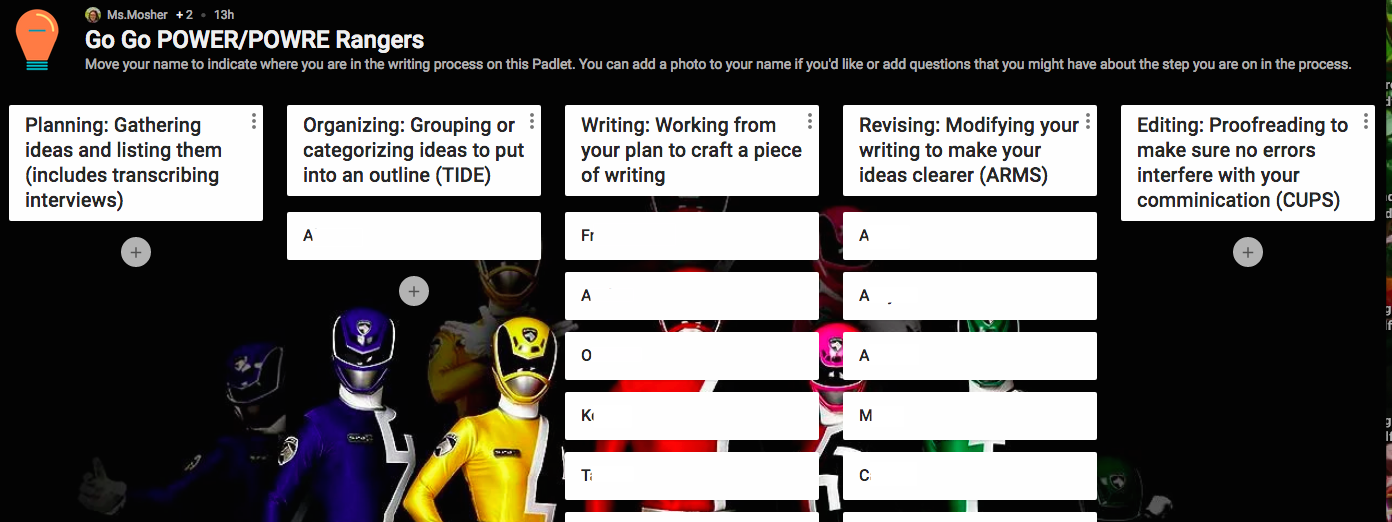
Padlet "Bulletin Board" for the moveable classroom.

I’ve gone Padlet crazy in the past month and a half. Padlet is, essentially, a digital wall or bulletin board where you can post ideas, files, and work collaboratively. I’ve used it many times before. I’ve created word sorts, used it for collaborative planning before shared writing, and, in a non-school use, to plan a trip to San Francisco. It seemed like the perfect tool for an interactive bulletin board. Kids could create posts to share information, they could comment on each other’s work (and we could work on digital citizenship!). We’re tracking independent reading and we’re tracking writing. Embedding the media into our LMS allows me to have it visible to students, and allows me to easily give feedback through rubrics, in addition to the comments I make on individual posts.

They made the Power Rangers connection. Hooray for student voice.

So far the kids are engaged, and rather than being a substitution for a traditional bulletin board, which is what I was initially looking for, it is an the tech is an augmentation of the interactive bulletin board. I’m definitely more engaged than I would be with a traditional interactive bulletin board. I’ve even created one for Romeo & Juliet (our next unit) where students can make connections between characters to help them understand who is who (something that’s been an issue for kids every time I’ve taught the text).

Anchor Charts

This is the one I still haven’t figure out. Anchor charts should be up on the wall so they can be referred to frequently. We come back to them and review them. Students can look at them while doing work. I have a few ideas. Perhaps ThingLink? I know I can embed them in my LMS, but will they be as visible when the students need them?

Any ideas? How do you deal with bulletin boards and anchor charts when you’re working in other people’s classrooms?

Teaching in Other People’s Spaces # 1: Classroom Seating & Set-up

Teaching in Other People's Spaces Part 1: Classroom Seating & Setup

I’m teaching English again for the first time in a while. Two years ago I cotaught with my friend and colleague Drew Murphy, but it’s been six years since I’ve had an English class all to myself. This year’s teaching doesn’t have much in common with previous years. The last time I taught English solo it was a totally different curriculum, at a totally different school, and with a totally different population of students. But it does have one major thing in common: I’m teaching in someone else’s space. Actually, I’m teaching in more than one someone’s space. This has posed a number of challenges both for the kind of classroom environment I want to create for my students and in terms of every day logistics, from classroom seating to anchor charts to setting routines for instruction.

I assumed since schools are frequently challenged for space, other people must have written about this. I asked Google. Shockingly, Google found nothing relevant (this could mean this series of posts will have a serious SEO challenge, or it’s just me and it means everyone will find me!) So here is the start of a series on how to teach classes in other people’s spaces. First up, classroom seating and set up.

Challenge: Arranging Spaces

I am currently teaching in two different classrooms. Thankfully, both of the teachers have been open and welcoming to me and my class. However, they each have a completely different size and shape. They have completely different classroom seating and furniture. The teachers in each room are teaching completely different subjects have completely different styles.

Classroom seating in a 5th grade math/science room

One is a 5th grade math and science classroom. It has soft, warm lighting and big windows that look out onto the river. Orange node chairs are arranged in a circle, and there’s a comfortable couch in one corner for independent reading. There is no teacher desk, just a stool next to a low cabinet that the teacher uses as a work station as needed.

The other is a health classroom where primarily 7th-10th graders have class. Folded up tables are pushed up to one side of the room. When unfolded and set up, the tables barely fit all of the students. Chairs are arranged in a circle to facilitate discussion, but don’t have a writing surface attached like the chairs in the other room. A large teacher’s desk dominates one corner of the room.

The bigger challenge was in the second room, where we would have to set up the room in a configuration where everyone could see the board, and everyone had space to write and take notes. We also had to do it as quickly as possible. And I had to run from a meeting on the other side of the building. Depending on which class it is, tables might be set up, and they might not be. This is a lot of variables for me, and definitely a lot of variables for a class of 22 eighth graders. We established a routine. If tables are not set up, they would take care of arranging them. Which has worked out well. I’m still trying to figure out the best configuration for the tables so that everyone has space. But we’re (slowly) getting there.

Challenge: Creating a Proactive Classroom Seating Plan

The set ups of the two rooms are so vastly different, so it was difficult to assign student seats. And in my experiences doing it before, doing so ended up being confusing for the students and for me. So I decided to let it go. We had a conversation about the responsibility of being an 8th grader. I told them that they were allowed to choose their own seats, but with the caveat that they needed to make good decisions about where they would work best. I had to set clear expectations for what “working best” looked like. There also had to be clear consequences for not working well. The biggest issue with setting expectations and agreements was not having wall space to hang up the agreement (see next week’s post for more on that topic).

So far, this is working for us. Reminders to students to sit where they can focus have been helpful, although I’ve had to be creative with how to work around not really having space to post agreements. So far, I’ve set an expectation and they’ve met that expectation. I am worried about the students who have preferential seating as an accommodation. However, we sit in a circle most of the time and my instruction isn’t all that teacher directed. But I do need to be more aware of those students as I’m teaching.

Have you ever had to teach in another teacher’s space? How did you work with other people’s set ups and classroom seating plans?

Next time: The challenge of not being able to have bulletin boards and anchor charts.

Flipped Classroom Mini-PLC

Image by DuEnLiJu; Creative Commons 1.0

This year I’m not in a classroom as much as I was last year. I’m not teaching a core content class, I’m only doing small group intervention. That means that I have more time to coach, but I still miss the classroom. A lot. So, when I went to a workshop about using flipped classroom methodologies along with mastery-based learning, I was really excited. But I was also really disappointed. Where could I possibly use this? Certainly not as a coach.

But then! A math teacher I work with, Robin, came to me with a problem: Her students had a wide range of abilities, and she had exhausted her toolkit of differentiation techniques and activities. We talked for a while about what she wanted her students to achieve, what she had tried already, and why she thought it wasn’t working. It came down to students being in very different places in terms of their content mastery. No matter what type of instruction Robin tried, someone always felt frustrated. Kids who got things quickly didn’t feel sufficiently challenged. The kids who struggled were overwhelmed by homework and needed more coaching and support to do things correctly. Jumping in and trying to put together a flipped classroom and looking at mastery learning seemed like a great idea.

Reading About the Flipped Classroom: Starting a Mini-PLC

Our first step was to do some research together. I had dabbled in using flipped classroom techniques, but had never done it fully. She had never done it before either. After some quality time with Google and looking through the resources that I had from the workshop, we settled on the book Flipped Learning for Math Instruction by Jonathan Bergman and Aaron Sams (ISTE, 2015). We each ordered a copy and agreed to read it over winter break.

If you are a math teacher and thinking about using the flipped classroom model, I can’t recommend this book highly enough. It is clear and concise, and gives plenty of real examples from classrooms. The book is organized in a helpful manner, taking a teacher through a logic progression of beginning to implement the flipped classroom model and all the way through extending the model to using it as a part of a mastery learning environment.

Taking The Next Steps for a Flipped Classroom

As Robin and I mapped out how she would implement the flipped classroom for math, I started thinking about how I could apply it to my own teaching. I’m still not sure if I can make it work for intervention, but I can try it out in my graduate class. So we’re trying it out together and supporting each other along the way. I’m excited to work together with Robin, even though we’re implementing the flipped classroom model in vastly different settings!

Yes Teachers, You Really Should Do a Conferenece Presentation

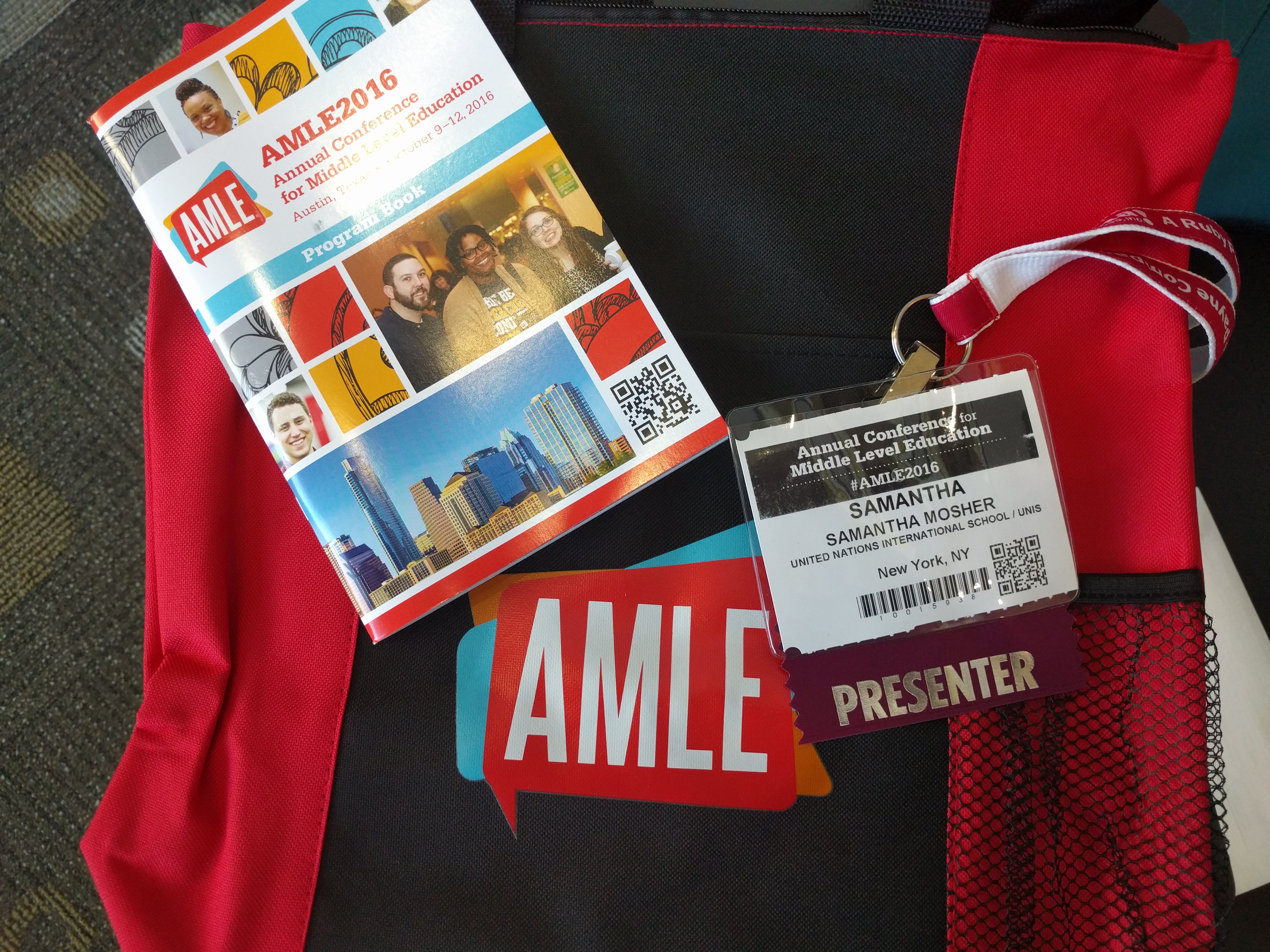
Excited for my conference presentation

I started blogging (albeit, inconsistently over the past year) to share what I was doing in my classroom. I wanted to throw the doors of my tiny room open wide to let people in and  learn from others, connecting with other teachers. Finding my “tribe”, as Marlena Gross Taylor calls them, that group of like-minded educators that I could share with, learn from, and grow with, was important to me.

However, even as I found and expanded my tribe online and shared my work through this blog, telling people about it in real life at at a big conference was something that I wanted to do, but didn’t really think  I could. After all, what I’m doing, I told myself, wasn’t anything special. No one really wants to hear what I have to say about what is basically just best practice, right? Besides, what if they shoot me down before I get started? What if they tell me what works for me will never work for them and for their students? Not just in a blog comment, but right to my face. Or they walk out of the room because my idea is so obvious that it just seems ridiculous.

I even presented at a few smaller conferences or in workshops that I helped set up. I did these presentations with varying levels of success. The issue wasn’t that what I was saying wasn’t good or interesting. It was that I was going in with the mindset that everyone already knew it, so they probably wouldn’t be interested.

Here’s the thing: I think as educators we frequently sell ourselves short. We’re a group of passionate people, and if we were looking for recognition or glory would have done something else. And yes, we know there are always one or two people who want to do things the way that they’ve always done them, but the majority of us are focused on honing our craft and making sure our students get the best education possible. I think sometimes because we’re so passionate, we forget that just because what we’re doing doesn’t seem earth-shattering to us, it doesn’t mean it won’t give someone else that “ah-ha” moment.

conference presentation 2
Before my conference presentation. Look how excited I am! (Fake it till you make it–totally felt like I was going to puke…)

Interlude: Everyone Is Worried About Their Conference Presentation

(Obviously paraphrased and based on our memory of the actual conversation, because I was quite nervous and it was almost a week ago)

Me (seeing David Hayward, who I had just taken a workshop, right before my session): Hey! I really enjoyed that. It was awesome.

David Hayward: Really? You kept nodding. I thought you knew everything already.

Me: I knew a lot of it. I kept nodding because you talked about things I knew, and then gave me ways to take it further. I got so many ideas!

David: Thanks (or something–I’m not sure. I was incredibly nervous.)

(I’m pretty certain after this I ran away because I was was nervous and worried I would vomit)

If an expert who gave an amazing presentation thinks this, does that mean we’re all worried about the same thing? Maybe.

Seriously, You Have Something to Teach People in a Conference Presentation

No matter how simple or basic you think what you’re doing might be, you’re doing it your way, with your own style. There’s also so much to know that we can’t possibly know it all. And even if others already know about what you’re going to talk about, they don’t do it the exact same way you do. Maybe they’ve heard about it, but haven’t heard someone who has the same passion you do. Maybe there’s one small thing that you do differently that will spark someones imagination and make them want to try it out for the first time.

The bottom line is: You have something to say. Start sharing it with others!

Have you ever presented at a conference? Thought about it and then not applied?

Gamification for My Writing Instruction

Gamification in the writing classroom: Level Up!

I had a problem this year.

My 5th graders:

  1. Hated to write;
  2. Hated to actually follow the writing process even more than they hated to write;
  3. All had writing goals.

What’s an intervention teacher to do?

If you’ve been reading this blog, you know I’m a huge fan of SRSD for writing instruction. It’s research validated. It’s easy to transfer. It’s easy to blend into almost any curriculum. It’s scalable. What more could you want from your instructional method? The problem was, even if I was jumping up and down trying to build excitement for the genre and trying to engage them in the writing process, they wanted to just get writing over with. They hadn’t learned the value of planning, and really didn’t want slow down in order to do it. And then it clicked: Gamification and SRSD are a match made in heaven. In her book Reality is Broken (2011), Jane McGonigal defines games as having four major characteristics: a goal, rules, a feedback system, and voluntary participation. It occurred to me that I had at least two with SRSD, and could easily weave in the others.

Gamification: What I Had

Goal

McGonigal defines a goal as an outcome that players want to achieve. That goal should be specific in order to provide a purpose for the game players (p 27). SRSD involves setting personal goals, but also the teacher setting a goal for her or his based on a preassessment. We know what the outcome is, and even have models that can show us where we need to go. Goals focus players’ attention in a game (McGonigal, p 27), just like I wanted to continually refocus and reorient my students toward the ultimate goal: a well crafted piece of writing. I also wanted them to make the connection that each step of the writing process was moving us toward our final goal and each part was equally important.

Feedback System

SRSD already has an excellent feedback system. Teachers create quantified rubrics with really specific criteria for proficiency. These rubrics often focus on the final outcome, but can be about specific portions of the writing process. I had generally just used to rubric for the end product, but I realized after observing some lessons taught by my fantastic colleague and SRSD master, Pooja Patel, (seriously guys, she wrote book and runs amazing workshops–go to one!) that if I made quantified rubrics for each part of the writing process, I would be much more successful. I could give my students more frequent feedback on their work, and in the process would create a set of mini-goals (or, dare I say, quests) that the students could achieve on their way to meeting the main goal of writing a well-structured paragraph. This is how I could provide more motivation for my students, remind them that each step of the process was important, and, as McGonigal says, be a promise that the goal is achievable. Calling each step of the process a different level also helped the students to see that the end was achievable (like a progress bar).

Gamification: What I Sort Of Had

Rules

Rules, according to McGonigal, not only place limits on how players can achieve the goal, but also unleash creativity and foster strategic thinking (p 27). SRSD is meant to build strategic thinking around writing through self-monitoring and self-talk, and even though going through the writing process isn’t really a revolutionary idea, each step of the process (POWER) is clearly defined and needs to be done in order to achieve the goal. But was this really enough to, as McGonigal says, “push players to explore previously uncharted possibility spaces” (p 27)? I’m not sure. I suppose it all depends on how we define “previously uncharted.” Since my students were so reluctant to engage in the writing process, perhaps this work really did get them to previously uncharted spaces.

Gamification: What I Had to Work Out

Voluntary Participation

Voluntary participation means, basically, that everyone playing the game buy into the rules, the feedback, and the goal (McGonigal, p 27). This is really the major issue I had with my instruction. Students didn’t really buy into the rules–that planning and organizing were an important part of the process, that each step needed to be followed. And only some of them really bought into the goal. And the feedback, well, they frequently ignored it. Not because they didn’t care, and not because it wasn’t clear, but because I wasn’t catching them in the moment–the big feedback came at the end, not throughout the process.

In addition, my group had a lot of difficulty with self-regulation, both in and out of the writing classroom. Building their own self-talk and their belief that they could be successful with writing was a barrier both to their voluntary participation in writing, and to their engagement in the activities that would help them improve their writing and feel successful. It was challenging to engage them in this critical piece of the work we were doing with writing. I thought that crafting a gamified system that was motivating and visually appealing would help them engage in the process so that they could apply these self talk skills became my way to get voluntary participation. And, for the most part, it worked.

More about how it worked out in my next post.

Have you ever tried to gamify your instruction? Has gamification worked for you?

Coteaching: What’s Going Well

I have my first semester of coteaching under my belt. So far, I think Drew and I are doing really pretty well. We’ve been navigating communicating and coplanning, and it feels like we have a good balance in the classroom. We both have our own areas of expertise and, I think, we’re becoming better at balancing those. There are, however, still areas we need to work on. I’m going to start with our stars (the things we do well) and follow up with a post about our next steps and how we’re going to improve.

Communication

The biggest issue people encounter in coteaching tends to be navigating the collaboration and communication piece. Drew and I have the advantage of requesting to work together to pilot a coteaching program where a Special Educator works with a General Educator, so we were both on board with the idea of coteaching and knew we had similar visions and a desire to work together. This is something a lot of coteachers don’t have. I know other special ed teachers who get thrown into classrooms with general ed teachers who don’t want them there. We also weren’t totally on our own in establishing a cotaught class. Our colleagues Pooja and Emily have already done great things coteaching as English and ELL teachers, so there were plenty of places to get advice.

We’ve become better at reading each other and are able to discuss things when one of us is uncomfortable with a strategy or technique the other wants to do. I know when to pull back or slow down when trying to infuse explicit strategy instruction or another technique, and I think Drew knows when I’m starting to feel uncomfortable with the more (as I call them) “loosey goosey” aspects of Readers’/Writers’ Workshop.

Coplanning

While I think there are things we can do to make our coplanning time more efficient, we’re generally doing a good job of always planning together and setting out a schedule for the week. We make sure to keep that time sacred and not schedule other meetings. The agreements and discussions we had before school started about how we wanted to structure our planning time were really useful, as was this planner from the book The Teacher’s Guide to Inclusive Education (Hammerkin, 2007). It helps keep us organized and on task.

Trust

There is an ease in how Drew and I interact in the classroom, and this seamlessness has helped out students to see us both as the teachers in the classroom. Not a teacher and an assistant. Not a boss and a supervisee. That’s partially because we have trust. We trust each other enough to try new things and fail. We’re willing to make mistakes, and know we’ll be corrected kindly. This trust is what makes our partnership work. We’re really lucky that we were able to choose each other for this work, but just because we chose to coteach, doesn’t mean we would be ready to be vulnerable. The biggest thing we did to foster this was talking things out at the beginning of the year: How we wanted the class to run, what we wanted things to be like. But we also shared who we are outside of school: talked about our likes and dislikes, shared pictures of our cats. And knowing each other better, both our school and out of school personas, really helps us to be open with each other. Because of the trust we’ve established we know it’s ok to say “I’m not ready to try that yet” or “I don’t understand” and knowing that the other person will still accept and work with us.

Of course, we’re not perfect. In my next post I’ll share our goals for the end of the school year and how we want to improve our practice.

Have you ever cotaught? How did you work together to establish a strong coteaching relationship?