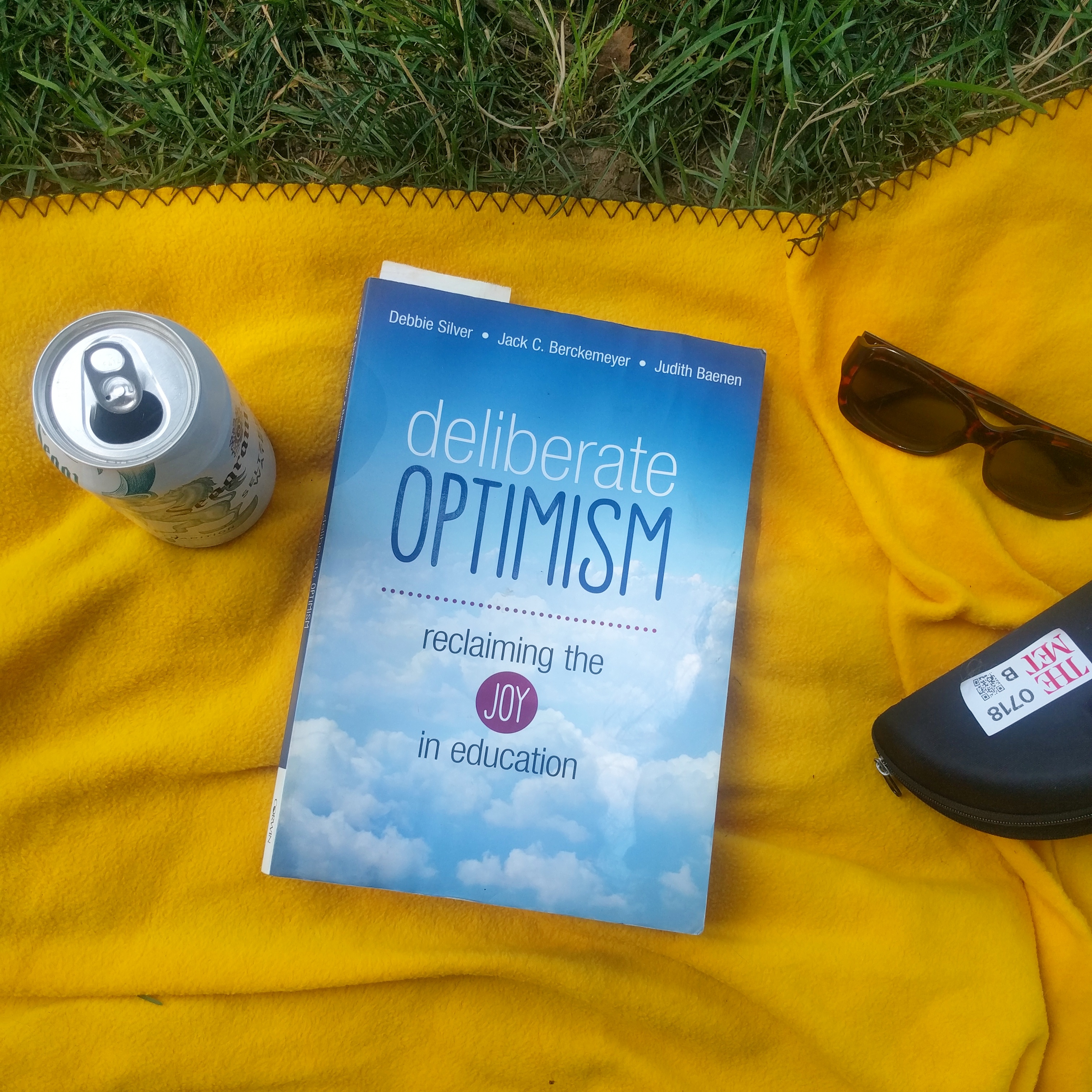
Summer Homework: Reconnecting with Optimism

Practicing self-care first so I can practice optimism this coming school year
Starting by practicing self-care first so I can practice optimism this coming school year

I’ve finally started my (self-assigned) summer homework. It took almost a month of reading books just for the sheer pleasure of reading, knitting, running, bike riding, pie baking, and relaxing on the beach for me to feel ready. By the end of this school year I was definitely feeling depleted and burned out. I actually missed most of the last week of school because I was so sick. My body basically yelled at me and told me to lay down and not move for a while.

During the last two months or so of school I could feel my fuse getting shorter, my focus getting weaker, and my ability to “leave it at the door” becoming almost nonexistent. I was frustrated by a lot of things both in and out of school. The specifics aren’t really what’s important. However, I spent most of the year focusing on the fact that things I had no control over were disrupting my work with students. When we get to that point, it’s easy for teachers to into a spiral of “everything is terrible” and to not embrace the kind of optimism that will help us to change the things we can control. This can wear us down and lead to burnout.

Choosing Optimism

Deliberate Optimism in the wild

I decided my first book that I would read for the summer would be Deliberate Optimism: Reclaiming the Joy in Education by Debbie Silver, Jack C. Berckemeyer, and Judith Baenen (Corwin, 2015). I picked up the book at AMLE this past October after hearing Dr. Silver speak. She was funny and engaging, so I picked up the book I knew it was something I needed to read. Even in October of last school year I could feel myself heading for burnout (this was probably a really bad sign). I picked it up again because I knew the book would help me figure out how to get out of the funk I had been in. It might also help me figure out where I could take action and what I could do better next year.

What I Learned About Optimism

Daria & Aunt Amy: My anti-optimism heroes

When I was in high school and through college my favorite television show was Daria. It might still be one of my favorite shows (I’ve rewatched it–it holds up). I identified with her cynicism. I still identify with her a bit (now I probably identify more with Aunt Amy, I’m in my mid-30s, after all). Optimism is hard for me. I didn’t just cultivate cynicism in adolescence because I thought Daria was an excellent role model. Cynicism is somewhat in my nature. However, I can get on board with the way the authors define optimism in this book.

I like that the authors define optimism as a choice (or a series of choices). Even more importantly, they differentiate between optimism and deliberate optimism. Deliberate optimism is different from the “peppy cheerleader” image of optimism I have in my head. The authors define deliberate optimism as having five principles:

  1. Gather as much information as possible before acting or reacting. Get that information from a variety of sources.
  2. Figure out what is beyond your control. Strategize how to minimize the impact of things that are beyond your control on your life.
  3. Figure out what you can control and look for ways to maximize your power in these areas.
  4. Actively do something positive to achieve this goal.
  5. Take ownership of your plan and take responsibility for your choices. (Silver, Berckemeyer & Baenen, 2015)

As someone who really likes clearly laid out procedures, I love this list. These are things that I can do. And the authors explain is great detail how to achieve each one. Yes, this is definitely a self-help book for teachers (and my inner Daria is inclined to mock such things). And, yes, these are things that I already know I should do. But I definitely needed the reminder this year, and know I might need it again. The idea that all of us have things that are within our control and can make actionable goals to change things within that sphere is powerful.

Throughout the remainder of the book, the authors apply these principles to various areas of teaching: interacting with colleagues, building relationships in school with both students and colleagues, creating a positive school culture, and self-care. These explicit connections to struggles that we all have at school make the principles in the book feel easier to take on. And I think I’m ready.

How I’ll Implement Deliberate Optimism

I have a few close friends at work that I’m going to reach out to. I’m going to ask them to read the book as well so we can support each other in implementing the five principles, and call each other out when we’re not disrupting our old patterns.

My biggest goal for this year is going to be to differentiate between what I can and can’t control, and then focus on the things that are within my control. I got too hung up on what was beyond my control this year, and it made me, if I’m totally honest, not a great teacher or a great colleague sometimes. I didn’t like it and tried to change things, but didn’t know how. Now that I have a plan, I’m confident I can keep things on track.

Deliberate Optimism: Should You Read It?

Definitely. If you’re a teacher who’s feeling a bit overwhelmed or burned out this summer or gets stuck focusing on things that are beyond your control, this book is definitely for you. A caveat though: Two of the three authors describe themselves as humorists, and my inner Daria was doing a lot of eye rolling at some of the jokes. They kept the somewhat heavy subject matter a bit lighter, but they weren’t really my thing. That said, the book offered easy to follow, concrete advice about how to bring joy back into your teaching practice. We could all likely use a bit of that.

How will you bring deliberate optimism into your practice next school year?

Adventures in Teacher Education

Teacher education: Student feelings about assessment
My students share their experiences with assessment during one of our initial classes.

I spend most of my time teaching middle schoolers, but I’ve moonlighted in teacher education for nearly 6 years. I started out teaching one course in the program where I got my Master’s degree. Then I was presented with a new opportunity to participate in teacher education. A professor at another local university reached out to me and asked if I was interested in teaching a 5 week summer course in assessment for Special Education over the summer. The course was for students in an alternative certificate program here in NYC. I was thrilled to try something new, but there were challenges that I hadn’t anticipated. Working in a different kind of teacher education this summer really challenged a lot of beliefs and assumptions that I had about education. Particularly the idea that learning is scalable.

Learning is scalable is one of the CGC principles that really resonated with me. What it means is that our beliefs about teaching and learning for children in a classroom should be able to scale up to a whole school level, to professional development (and, by extension, teacher education), and even to how we run our schools. In theory, if I truly believe that learning is scalable, the same beliefs about education should apply whether I’m working in a middle school or in teacher eduction.

I know that with my middle schoolers I believe that work should be able to be revised as many times as possible until a student demonstrates the knowledge, skill, or understanding that I’m expecting. Basically, I believe in mastery grading and not punishing students for taking longer to understand things than their peers. I don’t really believe in penalizing students for late work, but I found myself more frustrated with graduate students who turned work in late without an email or a request for an extension. I found myself feeling that I shouldn’t be offering students the opportunity to rewrite things because they should “know how to do this by now.” I found it really hard to reconcile my belief that graduate students should possess a particular skill set with my belief in everything above. Was it my responsibility to teach them those things? Or, did they need to ask questions, pull themselves up by their bootstraps, and figure it out. Did I really believe, as my Ed Psych professor in college said, that in “grade school you have teachers who teach, and in college you have professors who profess–get used to taking in information and figuring things out.” When I really examine my beliefs, I don’t believe that at all. But I also am not sure I have the time to teach them all of that.

A summer course means less time. It means less time to revise work, so that means less time for students to “get” everything before the end of the term. There is also less time for questions and discussions about assignments, and fewer assignments. There’s less time for me to write substantial feedback on the assignments I do get, so there are fewer assignments. There’s also less time for student-professor contact outside of class. I hope I did a good job of building relationships with these adult students, but I’m not sure.

If I teach this course again, I want to make sure I spend more time getting to know my students. I also want to spend more time practicing what I preach: using formative assessments to figure out what skills I need to teach before a major assignment is due. And now that I’ve taught the course once, I’ll be better able to adjust assignments and content to make time.

What are your experiences with teacher education, either as a student or as an instructor?

Mapping Our Common Ground

Everybody Learns--Common Ground Collaborative
Image from The CGC website

Last week I was privileged to be able to spend three days with a group of passionate, dedicated, international school educators in Miami to talk about a new curriculum initiative, the Common Ground Collaborative. As you saw last week, there was homework and reflection that happened beforehand, and now I’m trying to wrap my head around all of the things that I learned and to figure out what all of my take-aways are.

The Common Ground Collaborative is the closest thing to a grass-roots curriculum movement that I’ve ever had experience with.  It’s a group of educators who saw a need for changing the way teaching and learning happens, and set to work to make that change. I was really struck by how the standards and curriculum framework value all learners and values learners as whole people. Students engage in critical thinking, problem solving (or tackling dilemmas, as Kevin asked us to think of it), and delve deeply into concepts, while simultaneously learning how to learn, and connecting all of this to character development and common ideas and themes that are relevant to all people, called Human Commonalities.

Over the course of three days, we listened to Kevin Bartlett and Simon Gillespie explain the curriculum, engaged in activities and discussions with other educators, both about the theory behind the CGC curriculum, how we can convince our colleagues to get on board, and how, exactly, one makes change happen in a school. We wrote, we talked, we tweeted (although, apparently our hashtag is shared by a Christian youth rally…so you may have to scan through a bit). It was invigorating, intellectually stimulating, and exhausting. I’m so glad to have gone.

As I’ve been thinking through all of this I keep coming back to a couple of key ideas: reframing how we teach, the difference between an authoritative curriculum and an authoritarian curriculum, and, just generally, that change is hard.

Reframing Teaching and Learning
The Triple Helix--Common Ground Collaborative
The Triple Helix. Image Source.

One of the biggest things we discussed was a shift in teaching and learning. The CGC curriculum is a model that says all students can and will learn. This is something I am very passionate about. This is accomplished through defining learning before we design our curriculum. Schools need to have a common understanding of what learning means before we can decide what to teach and how to teach it. CGC defines learning with eight principles (see my responses to those here) and those principles can be distilled into CGC’s tagline: Everyone Learns. I find these principles to be the perfect map for an inclusive school that embraces differentiation and personalization of learning to make school relevant to students.

Instruction is centered on “The 3 Cs” or the “Triple Helix”: conceptual learning, competency learning, and character learning. By defining these three types of learning, and then defining how they are interconnected and spiraled throughout schooling, CGC gives a map not just for defining and designing learning, but for delivering it as well. I want to talk mostly about conceptual and competency learning, but if you want to read more about character learning, see Jen Munnerlyn’s blog post for TIE.

Right now, many schools focus on content (learning facts) rather than focusing on big ideas, or concepts, that cross over multiple disciplines and choosing particular examples to illustrate these concepts. Are the American or French revolutions the only examples of  the concept of “revolution” or “change” that we have? Do they need to be taught for children to understand that concept? Probably not. We can choose any number of revolutions depending on our purposes and where we are. Then, once students have built their understanding of that concept, they’re prepared to understand any number of revolutions and make connections between the concept and new event or piece of knowledge. Focusing our learning on concepts rather than isolated pieces of knowledge, and connecting these concepts to the 8 Human Commonalities defined by the CGC, makes the curriculum relevant to students’ lives.

I get really excited about conceptual learning, but I get even more excited about teaching students how to learn and teaching them skills in an authentic, relevant context. As a Learning Specialist, I see one of the biggest strengths of the CGC curriculum as being the competency learning is embedded in the curriculum. In my experience, most kids need to be taught basic learning skills: research, note taking, genre writing, reading for information, but the kids that end up in my program more so than others. Sure, we learn these things best when we’re able to apply them to an authentic, meaningful task or project, but that doesn’t mean that students will absorb it just by doing it. They need purposeful, sequential instruction that is embedded in these larger tasks. The only way this can happen is if we are teaching a concept (understanding) driven curriculum rather than a content (knowledge) driven curriculum. If we as teachers are focused on covering a curriculum jam-packed with facts, we don’t have time to teach these competencies, these learning skills. This is why all of the stands of the triple helix are essential. They work together to create the space where everybody learns.

Authoritative vs. Authoritarian Curriculum

We often use the words authoritative and authoritarian to talk about classroom management, but as my time with the Common Ground Collaborative in Miami went on, these words kept coming to mind as we discussed the curriculum. I hear from a lot of friends who work in public schools that the curriculum that comes from their school or district often feels prescriptive. “Teacher proof”. They feel like they don’t have the opportunity to do what they do best–deliver instruction to a group of kids, and modify it to meet the needs of that group. Or that there is a particular curriculum put in place and, as Kevin joked, it becomes more like a religion than a curriculum. Because of this, I often hear that curriculum would be better if it were put back in the hands of teachers. That’s why when the idea was presented that teachers shouldn’t be writing curriculum, I was a little taken aback.

There was a great deal of discussion about the fact that Gordon Eldridge (the other mind behind the curriculum) and Kevin outsourced the designing of content standards to experts in the field. The biology conceptual standards, for example, were designed by experts at Sheffield University. My knee-jerk reaction when this idea was that sure, biologists have the best understanding of the concepts, but do they know what’s developmentally appropriate? I’m sure we’ve all experienced curricula that seem to have floated down from some ivory tower without any connection to kids. But when Kevin talked about the back and forth that happened between the experts in content and concepts and a group of teachers, I was impressed. Authorities on a subject matter and authorities on student learning and the delivery of content having a conversation and engaging in a revision process together. Suddenly I realized I was seeing the smart way of creating a curriculum. And even more importantly, a great way of creating a curriculum that teachers and schools can trust, as well as a curriculum that implies a trust of teachers and their expertise.

Rather than being a disconnected, top-down, “do this or else”, “take our test to prove you learned/taught” authoritarian curriculum, CGC has developed a curriculum that has the authoritative weight of experts in content and concepts, and has left the decision about how to deliver the curriculum to those who do it best. Teachers. In particular teachers with a shared understanding of what learning means. Schools and teachers can choose to tweak modules to make them relevant to their learners, connecting different pieces of knowledge to the concepts in the curriculum. It’s a curriculum that’s all about doing what’s best for our students.

Change Is Hard

grumpy change

I think a lot of time was also spent talking about how to get everyone on board. I think almost everyone in the room was in. But how do we get everyone else in? I think that many of us were coming from schools where a lot of the faculty sounds like that Grumpy Cat picture above. Change is scary. It’s sometimes easier to complain about the way things are instead of taking the next steps.

What we need to remember is that change is a slow process. It happens in baby steps. In fits and starts. We start with the tiny changes that will lead to improvements in student learning and student engagement. All of those tiny changes, along with buy-in and accountability from the faculty, will add up to something great.

Maybe I’m too much of an idealist right now– you know, that post-conference or workshop high when everything about education has a rosy glow. But I think we can do it. It will take work to bring the CGC curriculum to life in our school and to get everyone on board with the philosophy. It won’t be easy, but what comes out of it will be great for our students. And that’s what we’re all here for, right?

Being a Reflective Educator: Doing My PD Homework

By Antonio Litterio [CC-BY-SA-3.0], via Wikimedia Commons
By the time I post this, I’ll be heading to Miami for the CGC Mapping Our Common Ground conference/workshop. As I’m writing this, I’m working on my PD homework. It’s not that I’m not enjoying it–I am. It’s useful, it’s interesting, I can see how it applies to what we’ll be doing at the conference. But  it’s hard to put down The False PrinceSeriously.

There were some articles to read, but there was also a “So What?” activity to complete. A “So What?” activity is a reflection activity that asks participants to think about particular ideas or concepts (What) connect to prior learning and their own experiences (So What?–CGC actually did this part for us, explaining a common definition of each “What”), and then figure out what they will do with these concepts (What Next?). In this case, we were given a list of CGC’s guiding principles with explanations and then we had to reflect on what this meant for ourselves and our school. How can we get there? What do we need to do? What’s the action plan?

I work hard at being a reflective educator, but sometimes it is hard to put in the time during the school year. I reflect on the basics–how my lessons went and how students responded; my interactions with teachers in coaching situations or meeting about students I teach, but the big questions take a the downtime provided by summer to really delve into. I’ve learned a lot by doing this activity and wanted to share some of my reflections with you, since I’m working on not just being a reflective educator, but a connected educator too.

The portions below in regular type are from the CGC “So What” activity. The portion in italics is my reflections on how it relates to my own practice. It was difficult, because this is a conference focused on curriculum planning and development, following a specific learning ecosystem developed by CGC. Since most of my work involves intervention or work with teachers, it was a challenge to think about how

We need to define our learning terms.

“Before we can teach for learning, we need common understandings, simply and practically expressed, about what actually happens when we learn. We believe learning includes conceptual understanding, mastery of competencies and development of character traits and have defined each of these components. We support schools in designing learning based on these definitions.”

My teaching focuses on scaffolding understandings and reteaching to help students master competencies. Helping the school to articulate these competencies and then create plans to help students meet them will be extremely important. 

People can learn how to learn.

The most important advantage we can give students is to support them to become proficient, self-directed learners. Through our Learning Standards, we support the explicit teaching of the competencies that underpin learning, supporting students in becoming the owners and directors of their own learning.

My job is primarily teaching students how to learn, but I want to work to be more transparent about the process, both with students and with my colleagues. What are the gaps that exist and need to be filled in order to teach students to be learners? How do I assess to find the gaps and then create an intervention plan? How to I instill a love of learning while teaching students to learn? I think the last one becomes the most difficult, because often I am asking my students to work on what is hardest for them, and perhaps connecting that to an assignment that doesn’t meet their particular learning needs. However, I really don’t want to use how others are constructing their curriculum for not making changes that need to be made. I’m just not quite sure what to change yet or how to do it.

Learning happens best in rich, relevant contexts.

Learning is more enduring in authentic contexts in which students can engage with issues, dilemmas and perspectives in settings that are meaningful to them. We support embedding the learning of concepts, competencies and character traits in relevant contexts in order to close the gap between the world of curriculum and the world our students actually inhabit.

This is something I struggle with…I do intervention/remediation work. It is largely skills based. The concepts are things like “how do patterns help us make sense of our world”, and lessons largely connect back to what’s happening in the classroom. It makes it difficult to do this, but I know I want to do more. I have been toying with the idea of creating a bunch of broad Learning Lab Essential Questions (like the patterns question above) to help students make connections between what they do in my class and what happens in their other classes. I’m not sure, however, how well this accomplishes making the context “rich and relevant”.

In learning, less really is more.

Content coverage does not equal learning. To learn conceptually, students need to inquire, think and theorize. They need the space to make meaningful connections between ideas. That means selecting sufficient content to support deep, sustained engagement with our three kinds of learning….and no more than that.

How can I create this space in an intervention classroom? Often it means taking a step back from my natural inclination to explain, and the worry that if, in my small group setting, if I’m not up and talking and constantly working with students rather than letting them work somehow I am not doing my job (or others won’t think I’m doing my job–and yes, this has happened and does happen) I think this also means that I need to try to shift teachers’ perspectives of what I do—if a student works on a project with me, I’ll provide guidance, additional scaffolding, graphic organizers, etc, but this doesn’t mean the work will be perfect, and it doesn’t mean I’m constantly hovering over her to make sure she’s getting work done. If I’m doing that it’s my work and not her work.

Learning is personal.

Individuals have different starting points, different interests and will follow different learning pathways. We support personalizing learning to the maximum extent possible, including the provision of appropriate levels of challenge and choice, and the provision of timely, constructive, personalized feedback, along with opportunities to act on that feedback.

My instruction is largely personalized, but how can I make it more so? I think integrating the International Learning Plan (ILP) into the program this year is going to help a lot with that. Last year was my first year, and yes, I assessed and set goals, but without a formal system to track those goals and the progress, I did tend to gravitate toward activities I could do with the whole group, rather than individualizing. I also would like to start harnessing the power of our 1:1 laptop environment to do this as well. I started a bit last year, but would like to do more.

 Everyone has a right to learn.

All people, no matter their learning differences or economic circumstances, should have optimal opportunities to learn. We support inclusive international education and concerted, collaborative efforts among our schools to contribute to the improvement of learning and teaching in locations where there is an expressed need.

Reading this I pretty much did a happy dance and jumped up and down. This is what I want to happen in our school–in all schools. Not that I’m always pro full-inclusion (e.g. is there more harm than good done if one does intensive phonics work with a 5th grader in the class when the rest are well past that or is it better to pull the student out?); however, I think a more inclusive environment puts the responsibility for the success of all students on all teachers.

I need to make more of an effort to work with teachers on how to reach all of the students at our school. This also means beginning to rethink how the school works with students who are having learning differences as well, and look at what is most appropriate for each student. Creating more opportunities for coaching teachers on how to differentiate and discussing students with specific teams (because we’ll have teams next year!) are really important. I’m still working on how to implement this, but I’m excited to try.

Learning is scalable.

The principles that apply to student learning apply also to adult learning and organizational learning. We support schools in applying this belief, bringing consistency and common meaning to processes such as professional learning and organizational change management.

This is a big one for me next year. I get to somewhat be a part of the PD process, since our focus next year is differentiated instruction. I really believe that schools need to make a bigger effort to differentiate their PD. I’ve been working on creating a self-assessment where teachers can rate their level of comfort with specific aspects of differentiation and use that to help guide them toward appropriate PLCs, in-house workshops, and PD experiences outside of school.

Learning is a social activity

While invaluable learning comes from personal reflection and moments of personal insight, we remain a social species. We support schools in creating cultures of sense-making through substantive conversation, encouraging planned, focused team learning and providing opportunities for students to lead learning conversations with their peers.

I really want to create more opportunities for students in my intervention classes to work together. I’ve done things like peer teaching, having a student who grasps a concept well teach another, and I often do group discussions about why particular strategies are effective, but how can I go beyond this? I tried something new this past year when I was teaching persuasive writing and added debate, having the students closely read an article together and then construct an argument as a group on an assigned POV, then the groups tried to persuade the other. Afterward the students planned and wrote their persuasive paragraphs for the side that they thought was the most convincing. I want to spend some time thinking about where I can integrate more of this. Writing is a natural point in intervention work to make this happen, but where else can I create space for learning that is social?

I’m really excited for a few days of collaboration, learning, and looking for deeper answers to these questions, and I’m can’t wait to share all of the new ideas and learnings that I’m sure will come from the conference.

How do you work at being a reflective educator?

Any answers to the questions above? Advice for me as I try to make my ideas into reality?

Summer Sabbatical (Not Just Vacation)

Last Summer at Long Bech, photo by Samantha Mosher
I may get a view like this occasionally, but most days I’ll be hard at work.

As a teacher you always hear from friends, family, and even complete strangers you just happen to be chatting with at a gym or at a barbecue: “Wow. A teacher’s summer vacation. That must be really nice. It must be your favorite part of the job.” I think it’s this misconception about teachers’ summer vacation that lead Justin Tarte to post this, which I adored. It got me thinking, do we as educators need to reframe how we talk to others about summer vacation? We know all the time we spend prepping and learning for, or just plain sitting and thinking or daydreaming about, our next school year. All the time we spend learning both teaching skills and content that we’ll pass on to our students, or having experiences out in the world that we can turn into amazing classroom experiences for our kids. Teachers’ summer vacations aren’t vacations. They’re sabbaticals, where we learn and grow as professionals and prepare for the next school year. I think the point Justin Tarte was making in his post is that sometimes we focus on the other benefits of summer vacation, rather than the other aspects and it could give others the wrong impression.

This teacher's summer vacation means fresh baked scones for breakfast
ah, the luxury of baking scones for breakfast

And, you know what, I’m not ashamed to admit that  teachers’ summer vacations are nice. I can wake up when my body tells me it’s time, instead of when my alarm starts blaring around 5:30 AM. I can exercise more frequently, and have the occasional leisurely breakfast (like the one to the right) or go wait in line for Shakespeare in the Park tickets, and maybe, like Justin Tarte suggested, I guilty of talking about those things and giving others the wrong impression of what teachers do in the summer. I definitely spend a good portion of my summer, like most teachers, working. It may not be the same summer camp and summer school jobs I took early in my career to make ends meet, but I am working nonetheless. It is different work than during the school year, but it’s good work and necessary work.

Most teachers love to learn, and during the summer I get to indulge my inner learner full-time. Don’t get me wrong, during the school year I am constantly learning from my colleagues, from my students, from research I’m doing to improve my own practice, but summer moves at a different pace and my learning can be more self-directed and I have the time to follow all of those ideas down various rabbit holes where I don’t have the time to go during the school year.

I generally set goals to keep myself on track. This summer I’m hoping to take my professional learning–my summer sabbatical–to new places by becoming a more connected educator, both through this blog and through other platforms like Twitter. But in addition to the blogging and tweet-chatting I really hope to:

Read all of the books I bought at ASCD 2014 (and then some)
Summer reading
All of the books…

I have quite an ambitious list. I don’t know if I’ll get through them all, but I’m excited to try. The first set on my list are:

  • The ASCD Aria Self-Regulated Learning for Academic Success by Catherine Germeroth and Crystal Day-Heiss. I’m a big fan of the SRSD writing approach and want to start including more self-regulation work in my classes across subject areas (and especially in math).
  • Memory at Work in the Classroom by Francis Bailey and Ken Pransky: Memory is often an area where students who I teach struggle, and I always feel like I don’t have enough strategies for them. I’m hoping this will help me.
  • Close Reading of Informational Texts  by Sunday Cummins: I’ve been reading a lot about the potential close reading has for improving reading comprehension with struggling students and I’m hoping to add more of it to my practice next year.
Learn a lot about curriculum design at the CGC conference

I was really excited when my principal selected me to be one of the school’s representatives at the Common Ground Collaborative‘s conference in Miami in July. This group includes teachers and administrators from international schools who are working to create a more inclusive, understanding-based curriculum. I’m even more excited now that I’ve started doing some of my homework.

Rethink my classroom design

This past school year was my first year at my school. I didn’t love the way I ended up setting up my small intervention classroom/office. I’m not sure if it’s conducive to the type of work I want to do with students (and I certainly am not set up to store all of this).

Make the two day summer workshop happen!

My friend and colleague Pooja Patel and I proposed this idea last year (well, Pooja came up with the idea and asked if I was interested and then let me propose it with her): to run a summer institute for teachers who are graduates of our program to summarize the latest research and methods in literacy instruction, assessment, and intervention. And over a year later, it has been brought to life: Cutting Edge Reading & Writing Instruction for Teachers. If you’re in NYC in late July, you should come.

Rethink the sequence and delivery of the curriculum for my graduate class

This is going to be a process. Class doesn’t start up again until January, but I really want to get my students thinking more diagnostically and using more observational data to decide where to go next in their interventions. I’d like to spend some time chatting with other teacher educators and reflecting a bit more on what worked and what didn’t this past year. May was not a time when this could happen, but June and July are.

Of course, I may get to a beach and I’m definitely headed out of town for a wedding or two and to visit family. Maybe I’ll take a few hikes and knit up some sweaters for the fall, but I can’t wait to start my summer sabbatical and engage in some professional learning.

How do you use your summers? Any interesting professional learning lined up?