Teaching in Other Peoples’ Spaces #2: What About My Anchor Charts?

Where Have My Anchor Charts gone-

The second in a series of posts about how to adapt to teaching in other people’s spaces. For all of us pushing carts, lugging markers & chart paper, and scampering around the school to get to our classes.

I spent the summer coming up with all sorts of ideas for my English class.

  • A shelfie bulletin board to celebrate independent reading!
  • Using the whiteboard and/or chart paper to keep track of our movement through the writing process!
  • Strategies, strategies, strategies!

It was going to be awesome.

I also had ideas from two of my summer teacher books, Deliberate Optimism and Peer Feedback in the Classroom about how to develop a classroom culture that was supportive, welcoming, and respectful. Both books put a lot of emphasis on sharing who you are as person to help make a connection with your students. And a lot of that connection building revolved around sharing who you are through bulletin boards and other displays. Both authors also considered agreements central to developing a safe and respectful classroom space. I agree, but where do they go when you don’t have walls of your own? Or even the same walls every class?

Agreements

Figuring out the agreements was actually the easiest part. Kevin, my colleague in whose classroom I teach 2/3 of my English classes, offered me some wall space. Once my class and I had created agreements, we posted them there. Then I snapped a photo with my phone so I could project the image onto the screen in the other classroom. This has its challenges. For example, the agreements can’t be visible at the same time as other classroom media. This makes simply pointing to the agreements to indicate to students that they need to check in with the agreements and their own actions or behavior difficult. The best solution I’ve come up with so far is to have the picture on a separate desktop on my laptop and swipe to it when necessary.

Bulletin Boards

Here’s where technology becomes more helpful, at least in some sense. In general for this year I had envisioned interactive bulletin boards: Parking lots for questions, shelfie walls with information about independent reading progress, a wall where we track out movement through the writing process. I also knew exactly how each board would connect to the idea of building relationships and creating the kind of classroom environment I wanted. Knowing that I’d be in someone else’s space, I had planned to rotate them as necessary. My saving grace: Padlet and my school’s LMS.

Padlet "Bulletin Board" for the moveable classroom.

I’ve gone Padlet crazy in the past month and a half. Padlet is, essentially, a digital wall or bulletin board where you can post ideas, files, and work collaboratively. I’ve used it many times before. I’ve created word sorts, used it for collaborative planning before shared writing, and, in a non-school use, to plan a trip to San Francisco. It seemed like the perfect tool for an interactive bulletin board. Kids could create posts to share information, they could comment on each other’s work (and we could work on digital citizenship!). We’re tracking independent reading and we’re tracking writing. Embedding the media into our LMS allows me to have it visible to students, and allows me to easily give feedback through rubrics, in addition to the comments I make on individual posts.
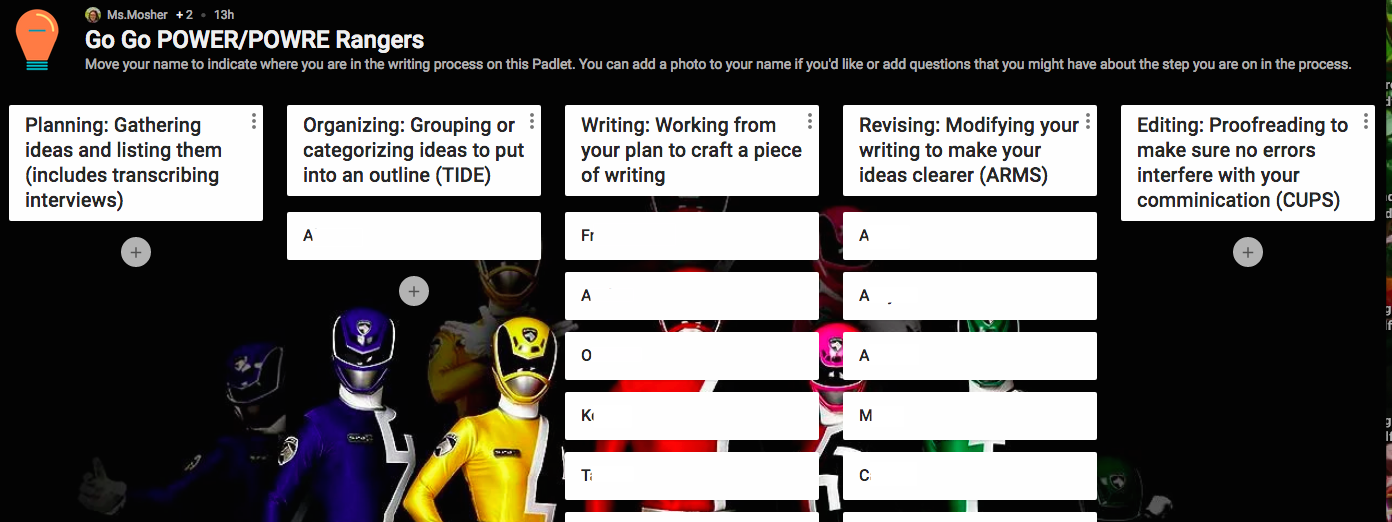
They made the Power Rangers connection. Hooray for student voice.

So far the kids are engaged, and rather than being a substitution for a traditional bulletin board, which is what I was initially looking for, it is an the tech is an augmentation of the interactive bulletin board. I’m definitely more engaged than I would be with a traditional interactive bulletin board. I’ve even created one for Romeo & Juliet (our next unit) where students can make connections between characters to help them understand who is who (something that’s been an issue for kids every time I’ve taught the text).

Anchor Charts

This is the one I still haven’t figure out. Anchor charts should be up on the wall so they can be referred to frequently. We come back to them and review them. Students can look at them while doing work. I have a few ideas. Perhaps ThingLink? I know I can embed them in my LMS, but will they be as visible when the students need them?

Any ideas? How do you deal with bulletin boards and anchor charts when you’re working in other people’s classrooms?

Student Centered IEP Meetings in Action


I am so very proud of all of my students. With the exception of a few, they all participated in their end-of-year ILP meetings, and most of them led or co-led their meetings. Some were nervous. Some became embarrassed or flustered and needed to use our agreed upon signal to have me take over. But most of them were rock stars (yes, this is a clinical term). I am declaring student centered IEP meetings (with the help of our digital portfolios) a success, even if there are a few things I’d change next year.

Based on what I saw during the student centered IEP meetings and some responses I got to the survey I did after the meetings were done, I came to a few conclusions:

  • The 6th graders definitely did better than the 7th graders with leading the meetings
  • Students who made digital portfolios and practiced self-reflection all year did better than those classes where I didn’t try out the digital portfolio
  • The better the students understood the purpose of their digital portfolios, the better they did at the meetings
  • Preparing for the meetings helped students to be able to both identify and understand their goals
  • The kids who are the most outgoing weren’t necessarily the ones who were the most comfortable in the meetings.
Digital Portfolios to Support the Meetings

While my 6th graders are, in general, a more self-reflective group than my 7th graders, I really think that the digital portfolios helped to support their self-reflection. This helped them to have more successful student centered IEP meetings. My 6th graders spoke confidently about their goals and their progress, showing examples from their digital portfolios. They were able to describe why we decided on their new goals and where they wanted to be the following year. Next year, I plan on doing digital portfolios with all of my students, and the other Learning Specialist will do the same. I’ve even convinced a few of the ELL teachers to try them with their students as well.

Skills for Public Speaking, Especially with Adults

I tried to scaffold the presentation portion of it as much as possible, but I think it was still a little intimidating to present to a room full of adults. All of my students have done some work with public speaking, but most of it has been in front of peers, rather than adults. For the most part, students found the organizers that we used to prepare for the meetings helpful, but I think I need to structure the other preparation activities differently. We tried role playing, but it tended to get a little silly. I think next year I need to set up very specific expectations about behavior and participation. I also made the mistake of assuming that the talkative, outgoing students wouldn’t need as much support in presenting to their parents and teachers. For these students, while they may be very comfortable with talking, talking about themselves and their progress can be daunting. I need to give all of my students more support next year.

Understanding Goals

It was pretty shocking to me how little understanding most of my students had their specific goals and why they existed. Most of my students told me at the end of the year that they knew what their new goals were and knew some ways we’d be working towards them next year. At the beginning of this past year, most of my students couldn’t identify their goals and couldn’t tell me why they had specific goals. Now that they’re more informed, I’m hoping that they’ll be more motivated to participate in actively working to achieve their goals.

I’m excited to plan for implementing digital portfolios and student centered IEP meetings next year and I’m sure it will be even more successful now that I’ve tried it out once.

Planning for Student Centered IEP Meetings

Student centered IEP meeting prep
A student working on self-evaluating her progress toward her goals

Over the next few weeks I’m going to have parents come into my room to discuss their child’s learning plan for next year. And I’m going to turn the meeting over to the student. It’s the first time I’ve ever done student centered IEP meetings (or ILP–Individual Learning Plan–meetings as they’re called in my school). And I’m terrified. But I’m also very excited.

Step 1: Completing Digital Portfolios for the Year

I took the first step toward having students self-reflect more and take more responsibility for their own learning when I tried out digital portfolios with my M2 students this year. For me, the logical next step was to have students do a final self-reflection at the end of the year that led to them evaluating their own progress, and then helping to lead their own student centered IEP meetings. I’m also trying this with my M3 students, who, as you may remember,don’t go in for all that touchy-feely nonsense” like self-reflection and growth mindset. We’ll see how that goes.

Step 2: Self-Evaluation and Setting New Goals

After my students completed their portfolio work, they evaluated their progress on a more global level in order to prepare them to help lead their student centered IEP meetings: How do all of these examples of various skills within a broader goal to show progress? What do I still have left to learn? What’s the next step? How can I continue to improve next year?

Student centered IEP meeting goal setting
A student working on goal setting for his student centered IEP meeting

The students filled out the form below, describing their goal, choosing evidence from their portfolio to demonstrate their progress, rating their progress, explaining the rating, and then, with some guidance from me, setting a new goal.

Student-centered IEP meeting goal self-evaluation sheet
The goal reflection/self-evaluation sheet for our student-centered IEP meeting planning.

For the most part, they were able to evaluate their own progress. There were some students who were really hard on themselves. Those students needed redirection to focus on their progress as an individual, rather than comparing themselves to others. There were also some who immediately said they had met all of their goals, without evaluating their progress in their portfolios. These tended to be the same students who didn’t want to complete portfolio work when it was scheduled. Next year, I’d like to spend more time modeling how to evaluate progress toward a goal. I thought that the amount of evaluation we did when working on portfolios would be enough, but it really wasn’t.

Step 3: Evaluating Accommodations

Next, we moved on to evaluating how well accommodations worked and what new accommodations we should try for next year.

Student centered IEP meeting: evaluating accommodations
Student working on evaluating his accommodations (clearly keyboarding is one of them)

Here it became clear to me that even though I thought I had done a good job empowering my students to be advocates for their own learning, the students didn’t really understand their accommodations. When we went through them their response was often “teachers don’t really do that.” This, of course, may not be totally accurate, because a lot of these things happen behind the scenes. It was concerning, though, that the students weren’t always aware of what their accommodations were. I think next year at the beginning of the year, we’ll review the learning plans again so that students know what their accommodations are, and maybe have a few specific lessons on how to self-advocate.

Personal butlers are not IEP accommodations. Sorry.
This kid was really disappointed that a personal butler was not a possible accommodation.

I also (see above) should really spend a little more time discussing what accommodations are and aren’t. Wanting a personal butler notwithstanding, I was surprised that many students didn’t understand why they got specific accommodations. I expected to have to explain what was possible, but didn’t realized I would have to explain what their accommodations meant. I remember doing it earlier in the year. Maybe it’s a matter of revisiting throughout the year.

Step 4: Prepare for the Student-Centered IEP Meeting

Our last step was to prep for the meeting. Students completed an organizer where they decided how they might introduce themselves, their parents, and me, and how they would explain the purpose of the meeting. We talked about how much leadership each student was comfortable with taking, and decided on signals they could use if they needed me to take over. Then, each student took turns role playing their meeting.

I’m really excited by how confident and empowered my students seem while we’re going through this process. I really hope that they’ll feel successful when they complete their meetings and that next year they’ll take more ownership of their goals as we work on them. I’ll follow up soon with how these student centered IEP meetings went and what I’d like to do differently next year.

Have you ever done a student centered IEP meeting? What were your experiences?

Student Voice and SRSD

IMG_20141217_090628

I use SRSD (Self-Regulated Strategy Development)  as my primary way of teaching writing to my students. There are a lot of reasons why I love it. It’s research validated. It connects easily to whatever type of writing instruction is happening in their classrooms–workshop models, process writing, etc.–so the skills they learn are easily transferred. It provides just the right amount of structure for students who need it, while not being constricting for students who don’t (check out the article in AMLE Magazine by Pooja Patel & Leslie Laud for more info). The best part, though, is that it’s flexible. We’ve been working on close reading for a while and I’ve asked students, as part of Sunday Cummins‘s model of close reading, to follow up their reading with a written response. Of course, I used the familiar TIDE organizer that we’ve been using all year, but the results weren’t what I had hoped.

We had done everything right. We had discussed the strategy. I worked with them to develop their background knowledge, and made connections between our work with close reading and our work with using TIDE to help us plan and organize paragraphs. We set goals. I modeled, both by looking for the parts of the paragraph in a model piece of writing and by using the active board to model writing a response. I modeled my own positive self-talk as I wrote. And I provided supports and scaffolds. Their writing still didn’t make the connections and inferences I wanted them to make, so I decided to turn it over to them. And they took me somewhere really amazing.

students creating a poster for writing about close reading

I asked them to make a poster that would teach someone else about how to write about close reading, and to use a metaphor to do it (an idea I got from Pete Hall at the BTCFS workshop). Writing about close reading, they said, was like an iceberg. Above the water, they said, is the main idea, supported by the “pasta words” (what Cummins calls the important details). Under the water, they told me, was the synthesis–the conclusions they draw that can’t be found directly in the text. After they made their iceberg, they added images to help them. A boat called the S.S. Annotation to remind them to use what they had written on the text to help them identify the pasta words and to remind them to use their “I wonder…” annotations to help them make connections and draw conclusions. They also added an airplane (with flaming jet engines, of course), where they wrote what makes a good main idea. They added post-its to explain all of the parts, and then explained their new strategy to a colleague of mine from the ELL department who happened to be walking by the classroom.

Using SRSD with close reading

The next class when we went to work on writing, it was a huge change. They had ownership of the type of writing I was asking them to do, and of the strategy I had asked them to employ. When we went through the modeling and practice, and the results were so much better than the first time. All because they took over defining the parts of the text themselves. They had the background knowledge, I just needed to find a way to empower them make the connections between the two topics that would help them take ownership of their writing.

close reading & SRSD


They really came up with something great.

How do you empower your students to make connections and take ownership of their learning?