Teaching in Other Peoples’ Spaces #2: What About My Anchor Charts?

Where Have My Anchor Charts gone-

The second in a series of posts about how to adapt to teaching in other people’s spaces. For all of us pushing carts, lugging markers & chart paper, and scampering around the school to get to our classes.

I spent the summer coming up with all sorts of ideas for my English class.

  • A shelfie bulletin board to celebrate independent reading!
  • Using the whiteboard and/or chart paper to keep track of our movement through the writing process!
  • Strategies, strategies, strategies!

It was going to be awesome.

I also had ideas from two of my summer teacher books, Deliberate Optimism and Peer Feedback in the Classroom about how to develop a classroom culture that was supportive, welcoming, and respectful. Both books put a lot of emphasis on sharing who you are as person to help make a connection with your students. And a lot of that connection building revolved around sharing who you are through bulletin boards and other displays. Both authors also considered agreements central to developing a safe and respectful classroom space. I agree, but where do they go when you don’t have walls of your own? Or even the same walls every class?

Agreements

Figuring out the agreements was actually the easiest part. Kevin, my colleague in whose classroom I teach 2/3 of my English classes, offered me some wall space. Once my class and I had created agreements, we posted them there. Then I snapped a photo with my phone so I could project the image onto the screen in the other classroom. This has its challenges. For example, the agreements can’t be visible at the same time as other classroom media. This makes simply pointing to the agreements to indicate to students that they need to check in with the agreements and their own actions or behavior difficult. The best solution I’ve come up with so far is to have the picture on a separate desktop on my laptop and swipe to it when necessary.

Bulletin Boards

Here’s where technology becomes more helpful, at least in some sense. In general for this year I had envisioned interactive bulletin boards: Parking lots for questions, shelfie walls with information about independent reading progress, a wall where we track out movement through the writing process. I also knew exactly how each board would connect to the idea of building relationships and creating the kind of classroom environment I wanted. Knowing that I’d be in someone else’s space, I had planned to rotate them as necessary. My saving grace: Padlet and my school’s LMS.

Padlet "Bulletin Board" for the moveable classroom.

I’ve gone Padlet crazy in the past month and a half. Padlet is, essentially, a digital wall or bulletin board where you can post ideas, files, and work collaboratively. I’ve used it many times before. I’ve created word sorts, used it for collaborative planning before shared writing, and, in a non-school use, to plan a trip to San Francisco. It seemed like the perfect tool for an interactive bulletin board. Kids could create posts to share information, they could comment on each other’s work (and we could work on digital citizenship!). We’re tracking independent reading and we’re tracking writing. Embedding the media into our LMS allows me to have it visible to students, and allows me to easily give feedback through rubrics, in addition to the comments I make on individual posts.
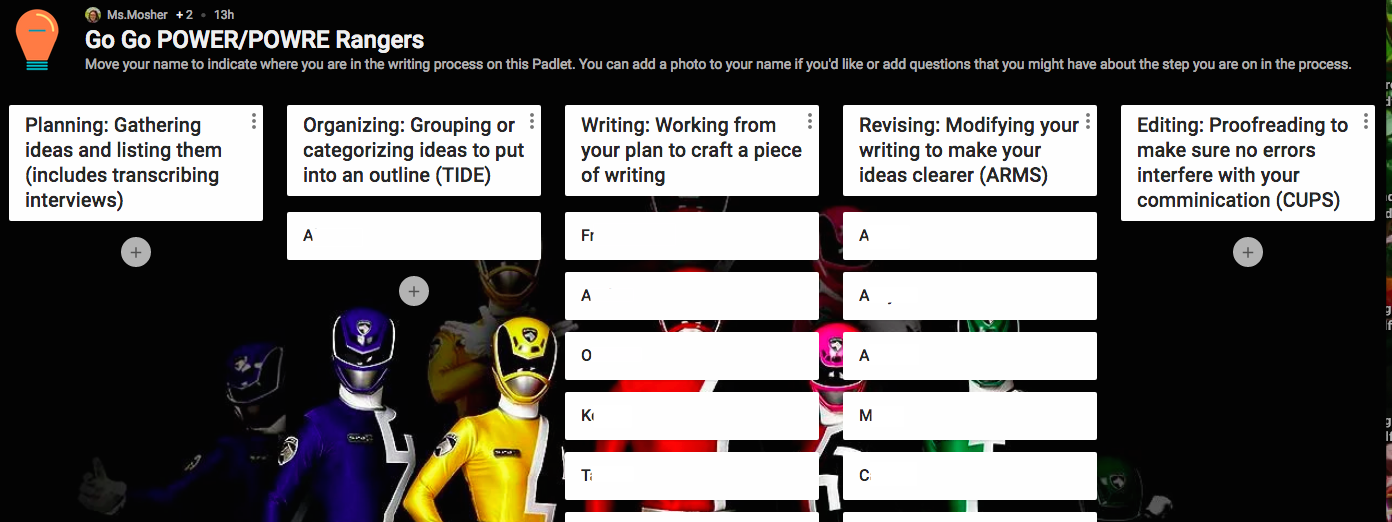
They made the Power Rangers connection. Hooray for student voice.

So far the kids are engaged, and rather than being a substitution for a traditional bulletin board, which is what I was initially looking for, it is an the tech is an augmentation of the interactive bulletin board. I’m definitely more engaged than I would be with a traditional interactive bulletin board. I’ve even created one for Romeo & Juliet (our next unit) where students can make connections between characters to help them understand who is who (something that’s been an issue for kids every time I’ve taught the text).

Anchor Charts

This is the one I still haven’t figure out. Anchor charts should be up on the wall so they can be referred to frequently. We come back to them and review them. Students can look at them while doing work. I have a few ideas. Perhaps ThingLink? I know I can embed them in my LMS, but will they be as visible when the students need them?

Any ideas? How do you deal with bulletin boards and anchor charts when you’re working in other people’s classrooms?

Flipped Classroom Mini-PLC

Image by DuEnLiJu; Creative Commons 1.0

This year I’m not in a classroom as much as I was last year. I’m not teaching a core content class, I’m only doing small group intervention. That means that I have more time to coach, but I still miss the classroom. A lot. So, when I went to a workshop about using flipped classroom methodologies along with mastery-based learning, I was really excited. But I was also really disappointed. Where could I possibly use this? Certainly not as a coach.

But then! A math teacher I work with, Robin, came to me with a problem: Her students had a wide range of abilities, and she had exhausted her toolkit of differentiation techniques and activities. We talked for a while about what she wanted her students to achieve, what she had tried already, and why she thought it wasn’t working. It came down to students being in very different places in terms of their content mastery. No matter what type of instruction Robin tried, someone always felt frustrated. Kids who got things quickly didn’t feel sufficiently challenged. The kids who struggled were overwhelmed by homework and needed more coaching and support to do things correctly. Jumping in and trying to put together a flipped classroom and looking at mastery learning seemed like a great idea.

Reading About the Flipped Classroom: Starting a Mini-PLC

Our first step was to do some research together. I had dabbled in using flipped classroom techniques, but had never done it fully. She had never done it before either. After some quality time with Google and looking through the resources that I had from the workshop, we settled on the book Flipped Learning for Math Instruction by Jonathan Bergman and Aaron Sams (ISTE, 2015). We each ordered a copy and agreed to read it over winter break.

If you are a math teacher and thinking about using the flipped classroom model, I can’t recommend this book highly enough. It is clear and concise, and gives plenty of real examples from classrooms. The book is organized in a helpful manner, taking a teacher through a logic progression of beginning to implement the flipped classroom model and all the way through extending the model to using it as a part of a mastery learning environment.

Taking The Next Steps for a Flipped Classroom

As Robin and I mapped out how she would implement the flipped classroom for math, I started thinking about how I could apply it to my own teaching. I’m still not sure if I can make it work for intervention, but I can try it out in my graduate class. So we’re trying it out together and supporting each other along the way. I’m excited to work together with Robin, even though we’re implementing the flipped classroom model in vastly different settings!

Gamification for My Writing Instruction

Gamification in the writing classroom: Level Up!

I had a problem this year.

My 5th graders:

  1. Hated to write;
  2. Hated to actually follow the writing process even more than they hated to write;
  3. All had writing goals.

What’s an intervention teacher to do?

If you’ve been reading this blog, you know I’m a huge fan of SRSD for writing instruction. It’s research validated. It’s easy to transfer. It’s easy to blend into almost any curriculum. It’s scalable. What more could you want from your instructional method? The problem was, even if I was jumping up and down trying to build excitement for the genre and trying to engage them in the writing process, they wanted to just get writing over with. They hadn’t learned the value of planning, and really didn’t want slow down in order to do it. And then it clicked: Gamification and SRSD are a match made in heaven. In her book Reality is Broken (2011), Jane McGonigal defines games as having four major characteristics: a goal, rules, a feedback system, and voluntary participation. It occurred to me that I had at least two with SRSD, and could easily weave in the others.

Gamification: What I Had

Goal

McGonigal defines a goal as an outcome that players want to achieve. That goal should be specific in order to provide a purpose for the game players (p 27). SRSD involves setting personal goals, but also the teacher setting a goal for her or his based on a preassessment. We know what the outcome is, and even have models that can show us where we need to go. Goals focus players’ attention in a game (McGonigal, p 27), just like I wanted to continually refocus and reorient my students toward the ultimate goal: a well crafted piece of writing. I also wanted them to make the connection that each step of the writing process was moving us toward our final goal and each part was equally important.

Feedback System

SRSD already has an excellent feedback system. Teachers create quantified rubrics with really specific criteria for proficiency. These rubrics often focus on the final outcome, but can be about specific portions of the writing process. I had generally just used to rubric for the end product, but I realized after observing some lessons taught by my fantastic colleague and SRSD master, Pooja Patel, (seriously guys, she wrote book and runs amazing workshops–go to one!) that if I made quantified rubrics for each part of the writing process, I would be much more successful. I could give my students more frequent feedback on their work, and in the process would create a set of mini-goals (or, dare I say, quests) that the students could achieve on their way to meeting the main goal of writing a well-structured paragraph. This is how I could provide more motivation for my students, remind them that each step of the process was important, and, as McGonigal says, be a promise that the goal is achievable. Calling each step of the process a different level also helped the students to see that the end was achievable (like a progress bar).

Gamification: What I Sort Of Had

Rules

Rules, according to McGonigal, not only place limits on how players can achieve the goal, but also unleash creativity and foster strategic thinking (p 27). SRSD is meant to build strategic thinking around writing through self-monitoring and self-talk, and even though going through the writing process isn’t really a revolutionary idea, each step of the process (POWER) is clearly defined and needs to be done in order to achieve the goal. But was this really enough to, as McGonigal says, “push players to explore previously uncharted possibility spaces” (p 27)? I’m not sure. I suppose it all depends on how we define “previously uncharted.” Since my students were so reluctant to engage in the writing process, perhaps this work really did get them to previously uncharted spaces.

Gamification: What I Had to Work Out

Voluntary Participation

Voluntary participation means, basically, that everyone playing the game buy into the rules, the feedback, and the goal (McGonigal, p 27). This is really the major issue I had with my instruction. Students didn’t really buy into the rules–that planning and organizing were an important part of the process, that each step needed to be followed. And only some of them really bought into the goal. And the feedback, well, they frequently ignored it. Not because they didn’t care, and not because it wasn’t clear, but because I wasn’t catching them in the moment–the big feedback came at the end, not throughout the process.

In addition, my group had a lot of difficulty with self-regulation, both in and out of the writing classroom. Building their own self-talk and their belief that they could be successful with writing was a barrier both to their voluntary participation in writing, and to their engagement in the activities that would help them improve their writing and feel successful. It was challenging to engage them in this critical piece of the work we were doing with writing. I thought that crafting a gamified system that was motivating and visually appealing would help them engage in the process so that they could apply these self talk skills became my way to get voluntary participation. And, for the most part, it worked.

More about how it worked out in my next post.

Have you ever tried to gamify your instruction? Has gamification worked for you?

How Shakespeare Helped Me Get My Groove Back

How Shakespeare helped me get my groove back.
He totally is…

This school year brought a lot of new responsibilities and a lot of changes to my position. I was sharing a room. I was doing more math intervention, which is an interesting challenge, but definitely isn’t my strength. I was teaching a pull-out intervention class to 5th graders. Fifth graders are cute, but definitely not my favorite grade. I felt like I wasn’t making progress with any of my students. I could feel myself slipping into a pattern with my math interventions where I would learn about new strategies for math intervention, try them once or twice, and then slip back into what I was used to (yes, I am absolutely a Conscious Stage teacher when it comes to math intervention). I knew it was happening, but felt powerless to stop the cycle. For the life of me, I couldn’t figure out the best way to manage the behaviors of my 5th graders–all of whom had different needs, both academically and social-emotionally–and it was definitely making it difficult to deliver appropriate interventions. They weren’t making progress and I was worried I wasn’t supporting them.

I just felt frustrated and stuck.

I was also coteaching for the first time. I liked my time in the classroom and I love my coteacher Drew. But the unit we were working on at the beginning of the year wasn’t something either of us was really excited about and neither of us felt like we had a voice in the planning process. Honestly, I wasn’t sure what we wanted out students to know, understand, and do, and was just doing my best to infuse appropriate writing skills instruction into the unit.

And then, Shakespeare showed up. Specifically, Romeo and Juliet. Drew had done a Folger Ed workshop (taught by another amazing colleague, Gina) over the summer and was really excited to teach Shakespeare through performance. I was nervous. Because, you guys, R&J is really dirty. And we’re teaching 8th grade English. I also had to unexpectedly fly solo for the intro lesson. I was terrified.

But it turned out great:

And all of a sudden, I was feeling that high that comes from a great lesson with a room full of engaged students.

I stood in class trying to keep a straight face as kids began asking questions like “Mr. Murphy, what’s a maidenhead?”

Or:

“When he says ‘thrust maids to the wall’ he means…”

“Exactly what you think he means.”

“Ohhhhhhh…”

And then started having amazing, deep conversations about the role of women during Shakespeare’s time and how awful it was that Samson and Gregory weren’t really worried about raping Montague women, but were terrified of getting into an argument with Montague men. Because the second one is the thing that will get them hung.

They were interested and excited. And so was I.

They were engaging in close reading of Shakespeare without eye rolling.

They were on their feet and acting and directing.


Up on our feet performing and directing Shakespeare

And I was walking into school with a much more positive outlook. I was looking forward to English class, to planning with Drew. I was even looking forward to grading paragraphs about Romeo and his take on love in Act 1.

Now I’m even ready to dive into researching math interventions and trying out new strategies for my 5th graders. It’s amazing what one unit can do.

Have you had a time when you felt burned out and like you weren’t accomplishing what you wanted to in the classroom? How did you get your teaching groove back?

Student Centered IEP Meetings in Action


I am so very proud of all of my students. With the exception of a few, they all participated in their end-of-year ILP meetings, and most of them led or co-led their meetings. Some were nervous. Some became embarrassed or flustered and needed to use our agreed upon signal to have me take over. But most of them were rock stars (yes, this is a clinical term). I am declaring student centered IEP meetings (with the help of our digital portfolios) a success, even if there are a few things I’d change next year.

Based on what I saw during the student centered IEP meetings and some responses I got to the survey I did after the meetings were done, I came to a few conclusions:

  • The 6th graders definitely did better than the 7th graders with leading the meetings
  • Students who made digital portfolios and practiced self-reflection all year did better than those classes where I didn’t try out the digital portfolio
  • The better the students understood the purpose of their digital portfolios, the better they did at the meetings
  • Preparing for the meetings helped students to be able to both identify and understand their goals
  • The kids who are the most outgoing weren’t necessarily the ones who were the most comfortable in the meetings.
Digital Portfolios to Support the Meetings

While my 6th graders are, in general, a more self-reflective group than my 7th graders, I really think that the digital portfolios helped to support their self-reflection. This helped them to have more successful student centered IEP meetings. My 6th graders spoke confidently about their goals and their progress, showing examples from their digital portfolios. They were able to describe why we decided on their new goals and where they wanted to be the following year. Next year, I plan on doing digital portfolios with all of my students, and the other Learning Specialist will do the same. I’ve even convinced a few of the ELL teachers to try them with their students as well.

Skills for Public Speaking, Especially with Adults

I tried to scaffold the presentation portion of it as much as possible, but I think it was still a little intimidating to present to a room full of adults. All of my students have done some work with public speaking, but most of it has been in front of peers, rather than adults. For the most part, students found the organizers that we used to prepare for the meetings helpful, but I think I need to structure the other preparation activities differently. We tried role playing, but it tended to get a little silly. I think next year I need to set up very specific expectations about behavior and participation. I also made the mistake of assuming that the talkative, outgoing students wouldn’t need as much support in presenting to their parents and teachers. For these students, while they may be very comfortable with talking, talking about themselves and their progress can be daunting. I need to give all of my students more support next year.

Understanding Goals

It was pretty shocking to me how little understanding most of my students had their specific goals and why they existed. Most of my students told me at the end of the year that they knew what their new goals were and knew some ways we’d be working towards them next year. At the beginning of this past year, most of my students couldn’t identify their goals and couldn’t tell me why they had specific goals. Now that they’re more informed, I’m hoping that they’ll be more motivated to participate in actively working to achieve their goals.

I’m excited to plan for implementing digital portfolios and student centered IEP meetings next year and I’m sure it will be even more successful now that I’ve tried it out once.

Digital Portfolios Go To Parent-Teacher Conferences

Digital Portfolios Go to Parent-Teacher Conferences
A student’s entry into he digital portfolio showing how she’s using a specific strategy to help improve her writing.

One of my goals when I started using digital portfolios in my 6th grade class was to improve communication with parents, and though I have my students email their parents every time they add an update, I’m not sure how often they look at them. Parent-teacher conferences seemed like a great time to show off the work and reflection that my students have been doing this year, and I’ve had some of the best conferences ever because of it.

Concrete Examples of Learning

Each students’ digital portfolio contains artifacts: videos, embedded Google docs, snapshots of the learning process, student-created image slideshows that show the steps in the process up to creating a final product. We try to use all the digital tools at our disposal to document the learning process. With these, we’re able to demonstrate a student’s growth and learning in ways that just weren’t possible with traditional portfolios. The portfolios contained mostly qualitative data (although some quantitative was included, like spelling assessments), so artifacts of the learning process that aren’t final, completed projects are included. For example, students have chosen to add snapshots of anchor charts in the classroom and used these as one piece of evidence that they are starting to implement a strategy, along with a snapshot of an annotated reading passage. My favorite example is a student included a video of himself attempting (and failing) to explain his process for solving a problem (complete with the student recording it in the background saying “Dude–I don’t think guess and check is a valid strategy here”), and then explaining how he can improve in his reflection.  Not only did this provide parents with concrete examples of the learning process, they also provided a glimpse into their child’s self-reflection and growth. During the conferences, I was able to use these artifacts to discuss progress with parents and demonstrate student learning and growth.

Promoting a Growth Mindset for Students and Parents

When I talk to colleagues about trying to promote a growth mindset amongst their students, parental expectations are often a hurdle. By setting up our digital portfolios so they were a documentation of students’ growth and progress over time toward specific goals, I was able to communicate to parents the importance of perseverance, self-reflection, and positive self-talk in the learning process. Rather than the conversation focusing on what the student wasn’t doing, the conversation was focused on what they were doing and the progress that they had made, however incremental it might have been, toward their goals. That shift in conversation, I think, relates to the transparency that comes from the digital portfolio. Parents have access to artifacts of student learning, as well as what the students learned from the experience (in their own words). That’s a pretty powerful combination.

Overall, I think that the digital portfolios made for a better set of parent-teacher conferences this year, both because of what my students created and what parents were able to take from them.

How have you used your digital portfolios to facilitate communication with parents?

Tiny Successes

Channel R at the English language Wikipedia [GFDL, GFDL or CC-BY-SA-3.0], from Wikimedia Commons
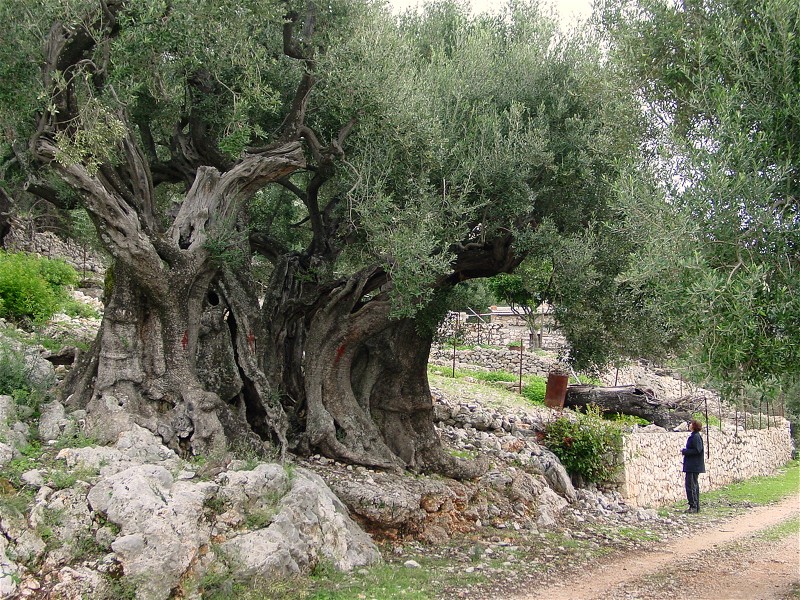
My first teaching job was in a Catholic school for low-income girls on the Lower East Side. My boss, Connie, who was one of the co-founders the school in the early 90s (back when she was still a nun), was an amazing woman. She taught me a lot about teaching and about building relationships with students. But one of the most important things I learned from her was about success. “We’re growing olive trees, not marigolds,” she would frequently say. She said it a faculty meetings, to members of the board, to parents, to the principal as she agonized over our test scores. She said it with the same fervor and faith with which she read 1 Corinthians chapter 12 on the first day of school every year. She said it with the voice of a true believer. And she made me believe it too: That success isn’t only measured in huge leaps, in fast growth and quick, dramatic changes; it is also measured in tiny, incremental steps forward. Growth you don’t even notice or successes that are so small, you could miss them if you weren’t on the lookout. Growth that takes time, but makes something amazing, sturdy, and enduring.

I’ve had several of these moments in the past two weeks and it reminded me how important it is to celebrate the small successes, not just the large ones, and that tiny steps toward growth are just as important as big ones.

When a student stops in to ask for help on an assignment that is a perfect match for a strategy we’ve been working on for weeks and then asks for help with it–even if he’s not employing the strategy independently or hasn’t really tried to use it–that’s a success.

When a teacher who has been resistant to working with me on differentiation invites me into her classroom “just to see a bit”, that’s a success.

When a student chooses to showcase a tiny change she’s noticed in her writing in her portfolio, that’s a success.

When a student writes down his homework in his planner (even if he doesn’t get it done), that’s a success.

When a grad student who seems to have been ignoring feedback on lessons makes one small change that shows she’s starting to get it, that’s a success.

Sometimes teaching can be really overwhelming, especially when you’re teaching students who struggle. Growing olive trees is hard work. You care for them, and you try to provide the right climate and the right food, but it could be a long time before they bear fruit. When we notice the tiny successes in our students, those small, but important, steps forward, we notice our students and their efforts. When we notice those tiny steps, we’re reminded that when we acknowledge tiny successes, they can feel like huge leaps forward.

What tiny successes have you seen recently?