
Finding the Butterflies: 5 Things to Do If You Think It’s Time for a Change

Finding the Butterflies: When to Make a Change in Your Teaching Career

I had an education professor when I was an undergrad who told us that going into the classroom should always make one a little nervous or even a little scared.

Not anxious and ready to throw up.

Not hyperventilating.

Just butterflies. A little tickle in your stomach. A hint of something new and exciting. A desire to make sure that you don’t fail the learners in front of you.

I don’t know when it happened, but at some point over the last two years, I lost the butterflies. I loved my job. My kids made me smile and amazed me every day. My colleagues were great. But it was all starting to feel routine.

Knowing It’s Time for a Change

I love teaching special ed and being a learning specialist because there are always interesting problems to solve. Looking for the how all aspects of who a student is and how they learn come together, and figuring out how to support the areas of challenge and leverage areas of strength in order to support the student in the classroom. How do we bridge the skills that the student does have with the skills they need to engage in what’s happening in the classroom? But it started to feel like the same problems over and over again. Even the novel problems started to feel like rote. They were variations on puzzles I had solved before.

I was doing my job (and I’d go so far as to say doing my job pretty well), but I was just doing my job. I wasn’t phoning it in. But I wasn’t growing as an educator in the way I wanted to. I was trying new things with my students, but doing new things didn’t spark my curiosity and imagination the way they once did. I’d read articles about burn-out. Burn-out wasn’t the problem. It was absolutely, without a doubt time for a change.

Making the Change

With the exception of two years as a K-6 Literacy Coach, I’ve done the same job almost my entire career: Middle School Learning Specialist. I’ve almost always focused on pull-out instruction with a smattering of push-in and coaching. It’s been primarily focused on reading and writing, with some executive functioning and math thrown in. I liked what I was doing, but as much as I loved teaching reading and writing, the math and executive functioning pieces were the most interesting.

A lot of my time last school year was spent figuring out what my next step would be.

Would it be:

  • Leadership?
  • Would it be to stay where I was and try to create new ways to work and new ways to grow?
  • The same thing somewhere else?
  • Teaching something new?
  • Leaving teaching entirely and go into ed tech?
  • Trying to find a Clinical Professor position and throw myself into teacher ed?

Honestly, that’s part of why I didn’t blog much last year. That type of self-reflection was better suited to non-public writing and thinking. And I was lucky that an opportunity appeared that was the change I was looking for–new grade-level, new challenges, new subject matter, and an administrator I knew I wanted to work with. It doesn’t always work out that way. I’m excited to be starting work in a few weeks as the K-4 Learning Specialist at my school’s lower school, developing their math intervention (RtI) program. I’m definitely excited for the change and I have absolutely found my butterflies (even if some of those butterflies are a little bit of worry that I’ll miss Middle School).

So, if you’re going back to school this fall and you’re realizing that you don’t feel those butterflies in your stomach, here are some things you can do.

1. Self-reflection is key

Self-reflection is one of the best ways that we have as educators to check in on our own practice.

I was in a good position. I liked my job and I didn’t need a change, but I wanted one and knew things would be better for me professionally if I had new challenges. That meant I could apply to jobs and carefully consider what I was doing. If I hadn’t been checking in with my own thoughts and feelings about my work, I might have been in a place where I absolutely needed to leave or had become burned out.

2. Take stock of your strengths, areas for growth, and goals

Really think about them. Journal. Make lists. Answer the questions honestly.

  • What are the things that still excite you about your job?
  • Where do you know you need to grow and how do you want to make those changes?
  • What new challenges would you like to embrace?

Knowing the answers to these questions will help you find the right position, make the changes you need to make in your current position, and have conversations about your next steps.

3. Talk to trusted colleagues, administrators, and mentors

Talk to people.

If you have administrators that will be supportive, talking to them can be very helpful. I was able to talk to my principal and assistant principal. They are definitely administrators who want to support their teachers’ growth and helped me to make that happen, even if their school wasn’t the right place to do it. I also talked options over with a mentor from graduate school and a few trusted colleagues. Talking to people who know you and know your field well can help you figure out what kind of change is the right kind of change.

4. Look at what’s out there

Looking isn’t the same as choosing to leave or deciding that change is a definite outcome. Looking at job options as they start to appear in late January and as the continue to pop up through the winter, and then sifting through the many options in the spring can help you to see what’s out there. It can also help you negotiate new responsibilities and duties that might be that challenge that you’re looking for.

5. Be kind to yourself

It’s easy to look at Education Twitter or education blogs or (especially) Teacher Instagram and think that everything is perfect for everyone else. We’re encouraged to share the victories and not always encouraged to share the struggles. Even in this post while I’m striving to be as honest as possible, there are still parts of the decision making process that I glossed over because they weren’t things I wanted to share publicly (and that’s OK–not everything needs to be published).

Everyone has times when they question where they are.

Everyone has been in a position where a teaching position just wasn’t working for them any more.

It’s OK. You’ll figure it out.

Are you feeling the butterflies as you prepare to go back to school? What challenges are you excited to embrace this year?
 

Summer Homework: Reconnecting with Optimism

Practicing self-care first so I can practice optimism this coming school year
Starting by practicing self-care first so I can practice optimism this coming school year

I’ve finally started my (self-assigned) summer homework. It took almost a month of reading books just for the sheer pleasure of reading, knitting, running, bike riding, pie baking, and relaxing on the beach for me to feel ready. By the end of this school year I was definitely feeling depleted and burned out. I actually missed most of the last week of school because I was so sick. My body basically yelled at me and told me to lay down and not move for a while.

During the last two months or so of school I could feel my fuse getting shorter, my focus getting weaker, and my ability to “leave it at the door” becoming almost nonexistent. I was frustrated by a lot of things both in and out of school. The specifics aren’t really what’s important. However, I spent most of the year focusing on the fact that things I had no control over were disrupting my work with students. When we get to that point, it’s easy for teachers to into a spiral of “everything is terrible” and to not embrace the kind of optimism that will help us to change the things we can control. This can wear us down and lead to burnout.

Choosing Optimism

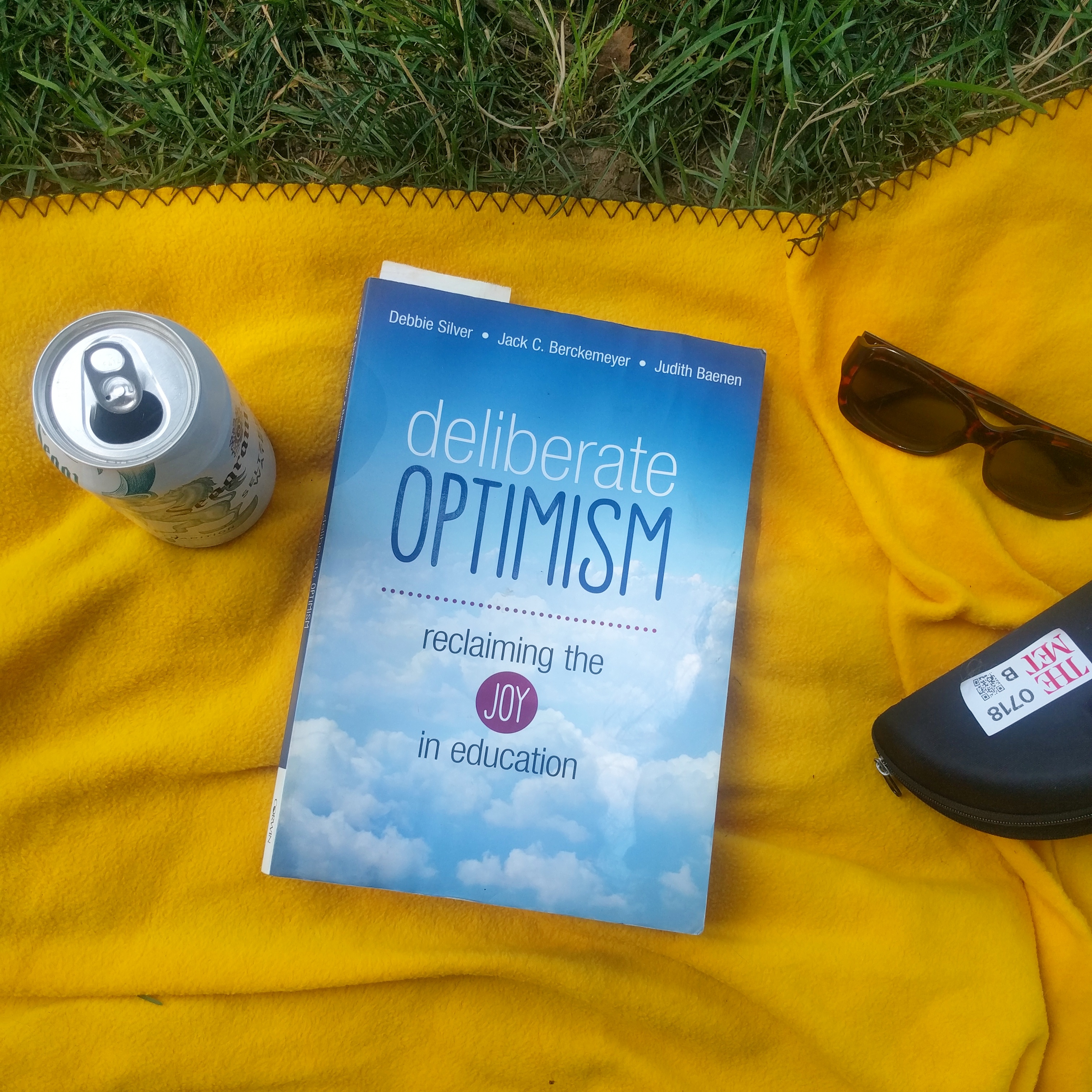
Deliberate Optimism in the wild

I decided my first book that I would read for the summer would be Deliberate Optimism: Reclaiming the Joy in Education by Debbie Silver, Jack C. Berckemeyer, and Judith Baenen (Corwin, 2015). I picked up the book at AMLE this past October after hearing Dr. Silver speak. She was funny and engaging, so I picked up the book I knew it was something I needed to read. Even in October of last school year I could feel myself heading for burnout (this was probably a really bad sign). I picked it up again because I knew the book would help me figure out how to get out of the funk I had been in. It might also help me figure out where I could take action and what I could do better next year.

What I Learned About Optimism

Daria & Aunt Amy: My anti-optimism heroes

When I was in high school and through college my favorite television show was Daria. It might still be one of my favorite shows (I’ve rewatched it–it holds up). I identified with her cynicism. I still identify with her a bit (now I probably identify more with Aunt Amy, I’m in my mid-30s, after all). Optimism is hard for me. I didn’t just cultivate cynicism in adolescence because I thought Daria was an excellent role model. Cynicism is somewhat in my nature. However, I can get on board with the way the authors define optimism in this book.

I like that the authors define optimism as a choice (or a series of choices). Even more importantly, they differentiate between optimism and deliberate optimism. Deliberate optimism is different from the “peppy cheerleader” image of optimism I have in my head. The authors define deliberate optimism as having five principles:

  1. Gather as much information as possible before acting or reacting. Get that information from a variety of sources.
  2. Figure out what is beyond your control. Strategize how to minimize the impact of things that are beyond your control on your life.
  3. Figure out what you can control and look for ways to maximize your power in these areas.
  4. Actively do something positive to achieve this goal.
  5. Take ownership of your plan and take responsibility for your choices. (Silver, Berckemeyer & Baenen, 2015)

As someone who really likes clearly laid out procedures, I love this list. These are things that I can do. And the authors explain is great detail how to achieve each one. Yes, this is definitely a self-help book for teachers (and my inner Daria is inclined to mock such things). And, yes, these are things that I already know I should do. But I definitely needed the reminder this year, and know I might need it again. The idea that all of us have things that are within our control and can make actionable goals to change things within that sphere is powerful.

Throughout the remainder of the book, the authors apply these principles to various areas of teaching: interacting with colleagues, building relationships in school with both students and colleagues, creating a positive school culture, and self-care. These explicit connections to struggles that we all have at school make the principles in the book feel easier to take on. And I think I’m ready.

How I’ll Implement Deliberate Optimism

I have a few close friends at work that I’m going to reach out to. I’m going to ask them to read the book as well so we can support each other in implementing the five principles, and call each other out when we’re not disrupting our old patterns.

My biggest goal for this year is going to be to differentiate between what I can and can’t control, and then focus on the things that are within my control. I got too hung up on what was beyond my control this year, and it made me, if I’m totally honest, not a great teacher or a great colleague sometimes. I didn’t like it and tried to change things, but didn’t know how. Now that I have a plan, I’m confident I can keep things on track.

Deliberate Optimism: Should You Read It?

Definitely. If you’re a teacher who’s feeling a bit overwhelmed or burned out this summer or gets stuck focusing on things that are beyond your control, this book is definitely for you. A caveat though: Two of the three authors describe themselves as humorists, and my inner Daria was doing a lot of eye rolling at some of the jokes. They kept the somewhat heavy subject matter a bit lighter, but they weren’t really my thing. That said, the book offered easy to follow, concrete advice about how to bring joy back into your teaching practice. We could all likely use a bit of that.

How will you bring deliberate optimism into your practice next school year?

Coteaching: What’s Going Well

I have my first semester of coteaching under my belt. So far, I think Drew and I are doing really pretty well. We’ve been navigating communicating and coplanning, and it feels like we have a good balance in the classroom. We both have our own areas of expertise and, I think, we’re becoming better at balancing those. There are, however, still areas we need to work on. I’m going to start with our stars (the things we do well) and follow up with a post about our next steps and how we’re going to improve.

Communication

The biggest issue people encounter in coteaching tends to be navigating the collaboration and communication piece. Drew and I have the advantage of requesting to work together to pilot a coteaching program where a Special Educator works with a General Educator, so we were both on board with the idea of coteaching and knew we had similar visions and a desire to work together. This is something a lot of coteachers don’t have. I know other special ed teachers who get thrown into classrooms with general ed teachers who don’t want them there. We also weren’t totally on our own in establishing a cotaught class. Our colleagues Pooja and Emily have already done great things coteaching as English and ELL teachers, so there were plenty of places to get advice.

We’ve become better at reading each other and are able to discuss things when one of us is uncomfortable with a strategy or technique the other wants to do. I know when to pull back or slow down when trying to infuse explicit strategy instruction or another technique, and I think Drew knows when I’m starting to feel uncomfortable with the more (as I call them) “loosey goosey” aspects of Readers’/Writers’ Workshop.

Coplanning

While I think there are things we can do to make our coplanning time more efficient, we’re generally doing a good job of always planning together and setting out a schedule for the week. We make sure to keep that time sacred and not schedule other meetings. The agreements and discussions we had before school started about how we wanted to structure our planning time were really useful, as was this planner from the book The Teacher’s Guide to Inclusive Education (Hammerkin, 2007). It helps keep us organized and on task.

Trust

There is an ease in how Drew and I interact in the classroom, and this seamlessness has helped out students to see us both as the teachers in the classroom. Not a teacher and an assistant. Not a boss and a supervisee. That’s partially because we have trust. We trust each other enough to try new things and fail. We’re willing to make mistakes, and know we’ll be corrected kindly. This trust is what makes our partnership work. We’re really lucky that we were able to choose each other for this work, but just because we chose to coteach, doesn’t mean we would be ready to be vulnerable. The biggest thing we did to foster this was talking things out at the beginning of the year: How we wanted the class to run, what we wanted things to be like. But we also shared who we are outside of school: talked about our likes and dislikes, shared pictures of our cats. And knowing each other better, both our school and out of school personas, really helps us to be open with each other. Because of the trust we’ve established we know it’s ok to say “I’m not ready to try that yet” or “I don’t understand” and knowing that the other person will still accept and work with us.

Of course, we’re not perfect. In my next post I’ll share our goals for the end of the school year and how we want to improve our practice.

Have you ever cotaught? How did you work together to establish a strong coteaching relationship?

How Shakespeare Helped Me Get My Groove Back

How Shakespeare helped me get my groove back.
He totally is…

This school year brought a lot of new responsibilities and a lot of changes to my position. I was sharing a room. I was doing more math intervention, which is an interesting challenge, but definitely isn’t my strength. I was teaching a pull-out intervention class to 5th graders. Fifth graders are cute, but definitely not my favorite grade. I felt like I wasn’t making progress with any of my students. I could feel myself slipping into a pattern with my math interventions where I would learn about new strategies for math intervention, try them once or twice, and then slip back into what I was used to (yes, I am absolutely a Conscious Stage teacher when it comes to math intervention). I knew it was happening, but felt powerless to stop the cycle. For the life of me, I couldn’t figure out the best way to manage the behaviors of my 5th graders–all of whom had different needs, both academically and social-emotionally–and it was definitely making it difficult to deliver appropriate interventions. They weren’t making progress and I was worried I wasn’t supporting them.

I just felt frustrated and stuck.

I was also coteaching for the first time. I liked my time in the classroom and I love my coteacher Drew. But the unit we were working on at the beginning of the year wasn’t something either of us was really excited about and neither of us felt like we had a voice in the planning process. Honestly, I wasn’t sure what we wanted out students to know, understand, and do, and was just doing my best to infuse appropriate writing skills instruction into the unit.

And then, Shakespeare showed up. Specifically, Romeo and Juliet. Drew had done a Folger Ed workshop (taught by another amazing colleague, Gina) over the summer and was really excited to teach Shakespeare through performance. I was nervous. Because, you guys, R&J is really dirty. And we’re teaching 8th grade English. I also had to unexpectedly fly solo for the intro lesson. I was terrified.

But it turned out great:

And all of a sudden, I was feeling that high that comes from a great lesson with a room full of engaged students.

I stood in class trying to keep a straight face as kids began asking questions like “Mr. Murphy, what’s a maidenhead?”

Or:

“When he says ‘thrust maids to the wall’ he means…”

“Exactly what you think he means.”

“Ohhhhhhh…”

And then started having amazing, deep conversations about the role of women during Shakespeare’s time and how awful it was that Samson and Gregory weren’t really worried about raping Montague women, but were terrified of getting into an argument with Montague men. Because the second one is the thing that will get them hung.

They were interested and excited. And so was I.

They were engaging in close reading of Shakespeare without eye rolling.

They were on their feet and acting and directing.


Up on our feet performing and directing Shakespeare

And I was walking into school with a much more positive outlook. I was looking forward to English class, to planning with Drew. I was even looking forward to grading paragraphs about Romeo and his take on love in Act 1.

Now I’m even ready to dive into researching math interventions and trying out new strategies for my 5th graders. It’s amazing what one unit can do.

Have you had a time when you felt burned out and like you weren’t accomplishing what you wanted to in the classroom? How did you get your teaching groove back?

Student Centered IEP Meetings in Action


I am so very proud of all of my students. With the exception of a few, they all participated in their end-of-year ILP meetings, and most of them led or co-led their meetings. Some were nervous. Some became embarrassed or flustered and needed to use our agreed upon signal to have me take over. But most of them were rock stars (yes, this is a clinical term). I am declaring student centered IEP meetings (with the help of our digital portfolios) a success, even if there are a few things I’d change next year.

Based on what I saw during the student centered IEP meetings and some responses I got to the survey I did after the meetings were done, I came to a few conclusions:

  • The 6th graders definitely did better than the 7th graders with leading the meetings
  • Students who made digital portfolios and practiced self-reflection all year did better than those classes where I didn’t try out the digital portfolio
  • The better the students understood the purpose of their digital portfolios, the better they did at the meetings
  • Preparing for the meetings helped students to be able to both identify and understand their goals
  • The kids who are the most outgoing weren’t necessarily the ones who were the most comfortable in the meetings.
Digital Portfolios to Support the Meetings

While my 6th graders are, in general, a more self-reflective group than my 7th graders, I really think that the digital portfolios helped to support their self-reflection. This helped them to have more successful student centered IEP meetings. My 6th graders spoke confidently about their goals and their progress, showing examples from their digital portfolios. They were able to describe why we decided on their new goals and where they wanted to be the following year. Next year, I plan on doing digital portfolios with all of my students, and the other Learning Specialist will do the same. I’ve even convinced a few of the ELL teachers to try them with their students as well.

Skills for Public Speaking, Especially with Adults

I tried to scaffold the presentation portion of it as much as possible, but I think it was still a little intimidating to present to a room full of adults. All of my students have done some work with public speaking, but most of it has been in front of peers, rather than adults. For the most part, students found the organizers that we used to prepare for the meetings helpful, but I think I need to structure the other preparation activities differently. We tried role playing, but it tended to get a little silly. I think next year I need to set up very specific expectations about behavior and participation. I also made the mistake of assuming that the talkative, outgoing students wouldn’t need as much support in presenting to their parents and teachers. For these students, while they may be very comfortable with talking, talking about themselves and their progress can be daunting. I need to give all of my students more support next year.

Understanding Goals

It was pretty shocking to me how little understanding most of my students had their specific goals and why they existed. Most of my students told me at the end of the year that they knew what their new goals were and knew some ways we’d be working towards them next year. At the beginning of this past year, most of my students couldn’t identify their goals and couldn’t tell me why they had specific goals. Now that they’re more informed, I’m hoping that they’ll be more motivated to participate in actively working to achieve their goals.

I’m excited to plan for implementing digital portfolios and student centered IEP meetings next year and I’m sure it will be even more successful now that I’ve tried it out once.

Planning for Student Centered IEP Meetings

Student centered IEP meeting prep
A student working on self-evaluating her progress toward her goals

Over the next few weeks I’m going to have parents come into my room to discuss their child’s learning plan for next year. And I’m going to turn the meeting over to the student. It’s the first time I’ve ever done student centered IEP meetings (or ILP–Individual Learning Plan–meetings as they’re called in my school). And I’m terrified. But I’m also very excited.

Step 1: Completing Digital Portfolios for the Year

I took the first step toward having students self-reflect more and take more responsibility for their own learning when I tried out digital portfolios with my M2 students this year. For me, the logical next step was to have students do a final self-reflection at the end of the year that led to them evaluating their own progress, and then helping to lead their own student centered IEP meetings. I’m also trying this with my M3 students, who, as you may remember,don’t go in for all that touchy-feely nonsense” like self-reflection and growth mindset. We’ll see how that goes.

Step 2: Self-Evaluation and Setting New Goals

After my students completed their portfolio work, they evaluated their progress on a more global level in order to prepare them to help lead their student centered IEP meetings: How do all of these examples of various skills within a broader goal to show progress? What do I still have left to learn? What’s the next step? How can I continue to improve next year?

Student centered IEP meeting goal setting
A student working on goal setting for his student centered IEP meeting

The students filled out the form below, describing their goal, choosing evidence from their portfolio to demonstrate their progress, rating their progress, explaining the rating, and then, with some guidance from me, setting a new goal.

Student-centered IEP meeting goal self-evaluation sheet
The goal reflection/self-evaluation sheet for our student-centered IEP meeting planning.

For the most part, they were able to evaluate their own progress. There were some students who were really hard on themselves. Those students needed redirection to focus on their progress as an individual, rather than comparing themselves to others. There were also some who immediately said they had met all of their goals, without evaluating their progress in their portfolios. These tended to be the same students who didn’t want to complete portfolio work when it was scheduled. Next year, I’d like to spend more time modeling how to evaluate progress toward a goal. I thought that the amount of evaluation we did when working on portfolios would be enough, but it really wasn’t.

Step 3: Evaluating Accommodations

Next, we moved on to evaluating how well accommodations worked and what new accommodations we should try for next year.

Student centered IEP meeting: evaluating accommodations
Student working on evaluating his accommodations (clearly keyboarding is one of them)

Here it became clear to me that even though I thought I had done a good job empowering my students to be advocates for their own learning, the students didn’t really understand their accommodations. When we went through them their response was often “teachers don’t really do that.” This, of course, may not be totally accurate, because a lot of these things happen behind the scenes. It was concerning, though, that the students weren’t always aware of what their accommodations were. I think next year at the beginning of the year, we’ll review the learning plans again so that students know what their accommodations are, and maybe have a few specific lessons on how to self-advocate.

Personal butlers are not IEP accommodations. Sorry.
This kid was really disappointed that a personal butler was not a possible accommodation.

I also (see above) should really spend a little more time discussing what accommodations are and aren’t. Wanting a personal butler notwithstanding, I was surprised that many students didn’t understand why they got specific accommodations. I expected to have to explain what was possible, but didn’t realized I would have to explain what their accommodations meant. I remember doing it earlier in the year. Maybe it’s a matter of revisiting throughout the year.

Step 4: Prepare for the Student-Centered IEP Meeting

Our last step was to prep for the meeting. Students completed an organizer where they decided how they might introduce themselves, their parents, and me, and how they would explain the purpose of the meeting. We talked about how much leadership each student was comfortable with taking, and decided on signals they could use if they needed me to take over. Then, each student took turns role playing their meeting.

I’m really excited by how confident and empowered my students seem while we’re going through this process. I really hope that they’ll feel successful when they complete their meetings and that next year they’ll take more ownership of their goals as we work on them. I’ll follow up soon with how these student centered IEP meetings went and what I’d like to do differently next year.

Have you ever done a student centered IEP meeting? What were your experiences?

Digital Portfolios Go To Parent-Teacher Conferences

Digital Portfolios Go to Parent-Teacher Conferences
A student’s entry into he digital portfolio showing how she’s using a specific strategy to help improve her writing.

One of my goals when I started using digital portfolios in my 6th grade class was to improve communication with parents, and though I have my students email their parents every time they add an update, I’m not sure how often they look at them. Parent-teacher conferences seemed like a great time to show off the work and reflection that my students have been doing this year, and I’ve had some of the best conferences ever because of it.

Concrete Examples of Learning

Each students’ digital portfolio contains artifacts: videos, embedded Google docs, snapshots of the learning process, student-created image slideshows that show the steps in the process up to creating a final product. We try to use all the digital tools at our disposal to document the learning process. With these, we’re able to demonstrate a student’s growth and learning in ways that just weren’t possible with traditional portfolios. The portfolios contained mostly qualitative data (although some quantitative was included, like spelling assessments), so artifacts of the learning process that aren’t final, completed projects are included. For example, students have chosen to add snapshots of anchor charts in the classroom and used these as one piece of evidence that they are starting to implement a strategy, along with a snapshot of an annotated reading passage. My favorite example is a student included a video of himself attempting (and failing) to explain his process for solving a problem (complete with the student recording it in the background saying “Dude–I don’t think guess and check is a valid strategy here”), and then explaining how he can improve in his reflection.  Not only did this provide parents with concrete examples of the learning process, they also provided a glimpse into their child’s self-reflection and growth. During the conferences, I was able to use these artifacts to discuss progress with parents and demonstrate student learning and growth.

Promoting a Growth Mindset for Students and Parents

When I talk to colleagues about trying to promote a growth mindset amongst their students, parental expectations are often a hurdle. By setting up our digital portfolios so they were a documentation of students’ growth and progress over time toward specific goals, I was able to communicate to parents the importance of perseverance, self-reflection, and positive self-talk in the learning process. Rather than the conversation focusing on what the student wasn’t doing, the conversation was focused on what they were doing and the progress that they had made, however incremental it might have been, toward their goals. That shift in conversation, I think, relates to the transparency that comes from the digital portfolio. Parents have access to artifacts of student learning, as well as what the students learned from the experience (in their own words). That’s a pretty powerful combination.

Overall, I think that the digital portfolios made for a better set of parent-teacher conferences this year, both because of what my students created and what parents were able to take from them.

How have you used your digital portfolios to facilitate communication with parents?