Close Reading for Intervention

Close reading guided practice
Guided practice with close reading on the interactive whiteboard

I mentioned in some earlier posts that this summer I did a workshop with Pooja Patel on integrating close reading strategies with writing from sources. One of the great things about doing presentations like this is the amount of research one does beforehand (especially when one has the opportunity to just say “I want to learn more about this. I’l do a presentation). I had dabbled in close reading, the way you do in a middle school English class, but mostly in large group settings, but hadn’t really approached it in a systematic way. In order to prep for the presentation, I delved further into the book Close Reading of Informational Texts by Sunday Cummins and into the article from  Journal of Adolescent and Adult LiteracyClose Reading as an Intervention for Struggling Middle School Students by Douglas Fisher and Nancy Frey. Before reading these texts, I didn’t really see how close reading could benefit everyone. I had focused on it as a strategy for general education classes, rather than one that could have significant benefits for ELLs and students with LD. Now that I’m implementing it, my struggling readers have really taken to the strategy, and are beginning to synthesize what they read.

I started the year by slowly and intentionally introducing and then integrating the strategies that Dr. Cummins discusses in her book: accessing and applying prior knowledge of text structure and content vocabulary, setting a purpose for reading, self-monitoring for meaning, determining importance, and synthesizing. I’ve just introduced students to determining importance, and we’re working our way toward some explicit instruction in synthesis. We’re working on reading through our first short texts integrating these skills now. I thought they would be more resistant to repeated readings, but they have been enjoying reading about unusual animals and keep getting more out of the text each time they read.

Close Reading Skill: Questioning

After the quick overview of synthesis Dr. Cummins recommends, I began by teaching questioning as a way to support students’ self-monitoring skills. I decided to deviate from her sequence for a number of reasons, but most importantly, because self-monitoring was a skill that came up over and over again in my students’ IILPs (like IEPs, but for International Schools), and I noticed from my initial assessments that students experienced difficulty differentiating between explicit and implicit questions. After an introduction to QAR and a great deal of guided practice with asking, classifying and answering questions, students were beginning to use questioning to help them monitor their own comprehension. A few even transferred (!) the strategy to classes outside of learning support.

Close Reading Skill: Previewing
Using TELL to preview a text before close reading
Anchor chart for the TELL strategy (Cummins, 2013)

We used the strategy TELL (Cummins, 2013) to help students tap into their knowledge of text structure and to help set a purpose for reading. Both skills were taught explicitly in separate lessons. I’ve used previewing strategies before and have spent time with struggling students teaching text structures, but teaching it with the goal of close reading in mind opened up the strategies in ways I hadn’t considered. Students aren’t just using text features and structures as a guide to help them build schema and organize facts from the informational text, they’re actually starting to have conversations about why authors would choose specific text features or formats. For example, in a text by Nic Bishop that we read, they pointed out that it seemed like a journal because there were dates in the subheadings. As we read, they even asked a really insightful question: “Why does the author use I instead of writing it like a ‘normal book’?” After some discussion they decided that the author wanted to let us know that he had really experienced these things, and that maybe he had wanted to draw the reader in and make him or her more curious about animals.

Students are also better able to set purposes for reading after previewing, which helps them to decide what is important. They made their predication about what the text would be about individually and then we discussed the different predications and came up with one that worked for all of us (see below). Using this, we were able to set a purpose for reading as a group.

Close Reading Strategy: Determining Importance
Close reading guided practice
Our close reading guided practice hanging on the wall.

Our most recent lesson focused on determining importance. I love Dr. Cummins’ introductory lesson about separating the “pasta” words from the “water” words. It actually worked quite well with my students. Using our purpose as a jumping off point, I modeled how to pick out the important information (see above). Today, students worked on finding it independently and we shared our annotations on the interactive whiteboard and made our first try at composing a summary. Again, I found it really interesting the things that showed up in their summaries. We’ve worked on summarizing before, but this is the first time that they’ve  written in response to a text that contains more synthesis than summary. Their description of the glass frog was peppered with statements like “We wonder how it eats moths and flies if it is only the size of a bean,” and “We think it developed this adaptation to hide from predators.” Granted, this was a scaffolded, guided task, but I’m seeing changes in the way they look at texts.

Have you used close reading with your classes? What advice would you have for next steps?

Pausing to Reflect: Self-Reflection on Teaching Self-Reflection

Image by David Whelan via Flickr CC BY-SA 2.0

Self-reflection is an important part of growth and learning. I’m trying to ask my students to do more of it this year. I’m asking my M2 (grade 6) students to create digital portfolios (more on them soon..check out Matt Renwick’s book though!) where they track their progress toward goals they’ve set for themselves, as well as the goals that I’ve created for them for the learning plans or IEPs. Within the SRSD writing framework I’m asking students to evaluate their own work, reflect on their progress, and set new goals for themselves. Many of them enjoy these activities, but I have had several students who were resistant. The most interesting response that I got was that it was “tacky” to do self-reflections. I still haven’t figured out what she actually meant. But given that resistance I thought I should practice what I preach and figure out what went wrong.

Clearly something was making this student uncomfortable, even if she was having difficulty articulating it. Did she mean that the task–write a note to your parents that I would share with them at parent-teacher conferences telling them how you thing you’re doing meeting your goals–felt inauthentic and maybe a little weird? I suppose I can’t actually argue with her there. It might not have been able to come up with something a little more authentic. Is “tacky” for this kid like Holden Caufield’s “phony”? Had she just been asked to do the same exercise in all of her other classes and it was just enough? I realized that in addition to all of those possibilities, I hadn’t ever actually made reflection something real–something that I engage in both at work and in my day-to-day life. I didn’t let her know about all the ways reflection happens in the real life of an adult. And, yes, none of them involve a letter to my mom…

  • When I’m teaching I ask myself whether lessons went well and why or why not, including how I interacted with students, and I do some self-reflection in writing on this blog;
  • When I improvise a recipe I reflect on cooking techniques and ingredient choices and I make notes for what I’ll do if I try it again;
  • When I bake bread I take a bite of the finished  loaf and reflect on my technique and the choices I made about rising time and liquid-to-flour ratios;
  • When I finish I run I ask myself if I’m tired and whether I could have pushed myself to run faster or farther;
  • When I finish knitting a sweater I look at how it fits and make notes about how I might change things the next time I knit a sweater so that it will fit even better.

As much as I am philosophically all for letting kids know why what I’m asking them to do is important to their lives–not just their lives as students, but their lives as human beings–sometimes I don’t do a great job of remembering to tell them that these are things that I’m not just telling them that people do, but that I do. And because I’ve learned that this helps me to be successful, I think it’s important to teach my students. Maybe I need to look into ways to making my self-reflection practices more transparent to my students, the same way I talk about what I’m reading or ways that I used math that day.

How do you make skills that seem like “school” things, but are a actually a part of your everyday life as an adult, feel relevant to your students? How do you make self-reflection activities authentic?

Tests, Tests, Tests

Tests, Tests, Tests
Students working on their tests in the Learning Lab.

We’ve hit that point in the year when the first units are starting to wrap up and all of my students are starting to panic about tests. Most of them have no reason to panic: They know what they need to do, but they have some sort of test anxiety. Many students, however, don’t really know how to study, which increases this anxiety. They spend most of their time working on what they already know how to do and not enough working on what they don’t know. Most likely they do this because they’re just not sure how to study what they don’t know or understand.

This year I decided to try to explicitly teach these skills, starting with knowing what to study. I created a study guide for the students in my learning support class. It’s essentially a self-assessment rubric that lists the various topics on the test and allows students to sort themselves into one of three categories: Got it!Working on it!, or I need more practice. Each category is defined (see below–it’s not pretty, but it did the job). What made me really excited was that when I shared it with the general ed math teachers, they all chose to use it with their classes.

Once the student completed the form, we looked at the areas that they thought were the weakest and created plans for how they would study. My original idea was to have them actually make a plan using their studybook or a calendar with activities they would do in order to study for each of the concepts they were unsure of, but it became clear pretty quickly that my students we they not sure what to study, they also weren’t sure how to study. We had to do a lesson about how to study, and how to study for math tests in particular.

We discussed that the best way to study for math was to practice doing problems that are similar to what will be on the test and discussed places to find questions with answers (our textbook being the main source). The other important piece was making sure to refer to notes and other sources either while completing a problem (if you are having difficulty remembering the steps) or after completing a problem. Because note taking is another area we’re working on, I created these checklists to help students practice.

Practice for tests with checklists

I laminated copies of the checklist for each student so that they could use a dry-erase marker to check off the steps as they completed them. As they worked with the checklists, they became more confident in their abilities and were able to practice the steps of the process. Eventually, I’d like to get them to the point where they can make their own checklists from their notes, but before that can happen we need to work on note taking skills.

The last step in this whole process is going to be reflection. Once students have taken the test, they will be allowed to do corrections. I created this test corrections sheet and shared it with the math teachers.

I like this test corrections sheet because it asks students to think about what might have gone wrong during an assessment, whether it is careless errors or really not understanding a concept or a process. I’m hoping that this will help us with reteaching and intervention, and that maybe we can offer students another opportunity to show what they know after reteaching in the form of a retest or another assignment.

How do you teach study skills? What do you do about test corrections or retakes? What opportunities do you offer students to demonstrate mastery of a topic after the assessment is done?

Games for Learning

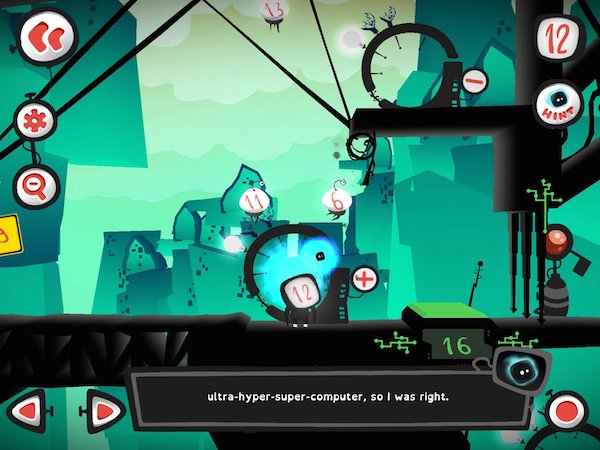
Twelve a Dozen Screenshot via Game Revolution

This is what I’ve found this year: It is easy to add games to my classroom. It’s not, however, easy to use games for learning, either to support student learning as an intervention or to extend student learning. More importantly, it’s not easy to teach students to learn from games. Or at least the students I am teaching this year.

What I’m noticing is that many of my students are used to being passive consumers of game entertainment. They are mostly casual gamers, but some of them use systems like the X-Box to play FIFA Soccer. Otherwise they play games like Angry Birds and Fruit Ninja. Not that there’s anything wrong with either of these games. They’re fun, and can involve strategy. I even know someone who does a physics project that’s entirely centered on Angry Birds. But, the tack my students have taken on these games is, as they call it, “spray and pray”. They seem to lack the patience and problem solving skills that many of my friends who play RPGs or puzzle games seem to have cultivated, and that I even noticed in my youngest sister when she started gaming in middle school (I was in grad school at this point). When playing games like Dragon Box 12+ or Twelve a Dozen, my students quickly give up and try to sneak over to play 2048 or decide to take some selfies. However, I have another group of students who become totally immersed in these games. They stop by at lunch and ask if they can borrow my iPad to play Twelve again. They discuss strategy. They’re enthralled by Dragon Box and have even started making connections between the game and algebra tasks. What’s the difference between these two groups?

I know my approach hasn’t been different with them. I introduced the games in the same way, gave the same preview, and provided similar supports when they asked questions. Perhaps it is that one group is 7th graders and one is 6th graders, but I have a second 7th grade group where a majority of the students are more like the 6th grader group–engaged and interested in solving problems. It could have something to do with learned helplessness. It could also have something to do with the students’ respective understandings of what games are, and how their particular learning styles interact with the characteristics of my chosen games, and how my students’ experiences with school frame their educational gaming experiences.

According to Jane McGonigal in her book Reality is Broken, games are defined by four characteristics: a goal, rules, a feedback system, and voluntary participation (p 26). Each of these characteristics impacts a person’s engagement with a game–whether it’s  a board game, a puzzle, an iPad app, or a complex MMORPG.

A Goal

McGonigal defines a goal in a game as the specific outcome a player wants to achieve. This goal, she says, is what gives the player a sense of purpose. In Twelve the goal to get the main character, 12, home after an explosion in the city of Dozonopolis that destroyed the super-computer. In Dragon Box it’s to help the dragon hatch–it will only come out of the box to eat when it is alone on one side of the screen. But the idea of a goal becomes more complex when we’re talking about using games for learning. For example, I have a goal for my students beyond the explicit goal of the game. I want them to sharpen skills and begin to develop answers to our essential questions: How do patterns in the world help us to make meaning and become better learners?, How can I use known information to figure out new information?, and What strategies can I use to work through a problem when I’m stuck? I chose these games specifically because, in addition to having an engaging explicit goal, the implied goals of the games (the learning goals) matched up with my goals for my students. But are the explicitly stated goals of the game enough to give my students a sense of purpose? Sometimes yes, sometimes no. But if they don’t understand the implicit goals, will they be actively engaged with the game enough to achieve the implicit goals? This is where I’m getting stuck.

Rules

I really like McGonigal’s definition of game rules: They place limitations on how one can achieve the goal of the game, forcing gamers to think creatively and apply problem solving skills. This is another point where my students start to get stuck. I posted a while ago about how being comfortable with being uncomfortable, confused, or not knowing was an important skill for students to learn. In both of these games, the rules and obstacles reveal themselves slowly and new rules are added as the games progress. For students who aren’t comfortable with working their way through confusion, these games can be very frustrating. I don’t want to choose different game though. I chose these two specifically because I wanted my students to work on answering essential questions that lead them toward being comfortable with working their way through confusion to be problem solvers. Not having the skills or understanding of problem solving techniques to work their way through this, however, is making it difficult. This is another spot where using games for learning gets tricky.

We often think of games and gamification as a way to pull in reluctant or struggling learners, but as games become more than just a fun way to practice math drills (who around my age that’s reading this didn’t relish the opportunity to play Math Blaster?) or spelling words, some of these students end up at a disadvantage again. And it’s not because they can’t do what’s being asked. Many of these students are proficient problem solvers in other areas: video games, skateboarding, soccer, building go-karts, designing art projects, planning events. It’s possibly because they aren’t comfortable with the possibility of failure and trying again in school. Even if the gaming environment is supposed to be a safe one for making mistakes and for trying and retrying, as McGonigal asserts, the other difficulties many of these students have encountered in school is making these games for learning something that doesn’t connect them to the problem solving that they’re used to, but brings them back to school where they may have learned that not getting it the first time is failure.

The question now becomes: How do I pull these kids in? How do I scaffold this before and during game play so that they can use the games to help build their capacity for problem solving and their tolerance for working through the unknown? Perhaps I should be modeling game play more and talking through how I work my way through obstacles. Maybe we just need more time with non-digital games (which I use a great deal as well and have actually experienced similar challenges with), so I can do more of that modeling. I can also do more to model how in-game supports can help me work through problems and figure out how to work within the rules of the game. For example, Dozen has a hint button, and Duolingo (a gamified language learning app) will translate words for you as you’re going through practice mode if you tap them. I, wrongly, assume that as frequent game players my students understand these types of supports or know to look for them, but that’s not necessarily the case. I think we also need more conversations about growth mindset and about positive self-talk in order to improve their self-regulation skills.

A Feedback System

Feedback systems tell us how close we’re getting to the goal. It can be something as simple as a progress bar or points, to more complex forms of feedback like text or voice feedback. Feedback keeps us engaged in games because it tells us how we’re doing and lets us know if we’re breaking the rules. One thing I have noticed is that the students who are less engaged in the games haven’t necessarily picked up on the feedback that’s being provided. In some cases, it seems like there’s a genuine mismatch between the student’s learning style and the type of feedback they’re receiving. But in others, it seems like I need to do a better job of teaching them how to use the feedback that’s being provided.

I have one student who struggled with Twelve a Dozen. This game has a narrator that gives feedback on your performance, ranging from informing you of new rules or obstacles to overcome to telling the player that it’s time to rewind and try again. The narration is also captioned. The narrator serves several purposes: reconnecting the player to the goal during a long term game, explaining rules, and giving feedback. Since it serves so many functions, it is important to listen to, even if it is a little annoying (think of the Paperclip from older versions of Word, crossed with a fussy British nanny, with a dash of dorky mathematician humor). This child turned off the sound (because he found the narrator annoying and thought it was unnecessary) and didn’t read the captioned version, so he had no idea that he was getting feedback on the way he was trying to solve the problem (“Maybe we should rewind and try something different”). There are also more subtle forms of feedback that my students miss that involve changes in color on the screen or a simple “Yuck” from the dragon in Dragon Box. Players have to be closely attending to a game and be an active participant in the game in order to realize why the dragon is saying “yuck” instead of “yum” and adjust their game-play appropriately.

I’m not sure if the difficulties my students are having using feedback for determine what they’ve learned and what they need to do next is something that they’ll learn through experience, or something I’ll have to teach them. Either way, it seems that in order to learn from gaming, they need to be able to read and take in feedback from the games.

Voluntary Participation

This final characteristic of games is, I think, one of the most important when we want to use games for learning. Being a voluntary participant in a game, according to McGonigal, means that you buy into all of the above and are agreeing to the goal and the rules. And as I said above, my goal for having a student play a game (and the implied goal of the game) may not match up with why a student is playing a game. When that happens, can learning happen? I think so, but it’s more challenging. I think games really have the power to draw learners in and engage them in difficult work in a fun way. But I think we also need to start scaffolding their abilities to engage with the goal, the rules/obstacles and the feedback system in order for them to truly be voluntary participants and use games as tools for learning.

Nearly 2000 words later, I’m still in the same place that I started. I know that games are a powerful tool for learning and that I think they have great potential for engaging my students, but I’m not entirely sure how to make that happen. I think the most helpful thing I can do for them is to keep working with them to build their perseverance and their problem solving skills, as well as do more modeling of how I engage with games and learn from them.

How do you use games for learning in your classroom? Any advice for how to help students become active participants in game play, rather than passive consumers of game entertainment?

Self-Regulation Strategies in the Classroom

Self-regulation strategies: Positive self-talk
Positive self-talk, and important part of self-regulation. Source

One of my goals for this summer that I wrote about in my first post was to look for ways to expand my use of self-regulation strategies in my classroom next year. This summer I’ve been doing a bit of reading and exploring about that topic and thinking about how to include more of it in my class.  And, as I discussed in last week’s post, I think that confusion and struggle with material can be productive, but only if we have really taught our students how to work through that confusion. Teaching self-regulation strategies is a good way to do this.

What is Self-Regulation?

Self-regulation is our ability to manage ourselves: our bodies, our emotions, our focus and our attention. When reading about self-regulation, the first thing that usually pops into my head is “This sounds like executive functioning”, and they are related.  In order to self-regulate, we need to rely on and coordinate a number of executive functioning skills. Self-regulation is how we actively control our behaviors and our emotions. I wanted to get a better idea of what teaching self-regulation entails outside of reading and writing, so I read the book Self-Regulated Learning for Academic Success by Carrie Germeroth and Crystal Day-Hess, which I picked up at ASCD in March. It’s a good, quick read (only 45 pages) that gives a great overview of self-regulated learning and provides usable strategies.

SRSD for Reading and Writing

When I talk about self-regulation, I’m generally talking about Self-Regulated Strategy Development (SRSD). I have been using these strategies for writing since graduate school. I’m a big believer in the power of SRSD. I’ve seen how well they work with students of all ability levels. It’s also a strategy that’s been researched quite well. I even include it as a part of my graduate course for reading teachers. I don’t have the time or the space here to give SRSD it’s due in explaining it, but check out Think SRSD for a full explanation and free resources or the book Powerful Writing Strategies for All Students. There are two components of the program that I really want to discuss: goal setting and positive self talk, because these are the aspects of SRSD that I want to try to pull into other parts of my teaching practice.

Goal Setting

Goal setting is a key component for SRSD and something that Germeroth and Day-Hess focus on as an important skill to teach to middle and high school students. When student are trying something new or working on something that is difficult for them, goal setting helps to break tasks down into manageable chunks and helps them focus their attention on one area in need of improvement (it also helps the rest of us in every day life, from work related tasks, to things we do for pleasure). When we set goals and reflect on our progress toward them, we are able to create action plans to help us achieve these goals. If we use SMART goals (Specific, Measurable, Achievable, Relevant, and Time-bound), we can even graph our progress toward a goal.

With my M1 (grade 5) group last year I had students with a number of different writing needs. I could rarely teach whole group lessons. So I had them self-assess their writing (with frequent modeling and scaffolding from me), and then set one goal for themselves helped me to teach them appropriate strategies and develop interventions to help them reach their goals. When I created graphic organizers for them based on our SRSD mnemonics, I always included a line for a goal, I always asked them to rewrite it at the top of their rough draft, and there was always a line for their goal on the revising and editing checklists that we used, so the goal was always in mind. They tracked their progress both through graphing progress–we decided together what a strong example of what they were trying to do would look like, an “almost there”, and a “keep trying” so they could rate their own performance–and through an online writing portfolio that we created using Google Sites, where they reflected on their progress and then created new goals. This worked really well, and I’d like to do this again if I have a group that needs writing intervention. What was key, though, was explicitly teaching them the learning skills that they needed, or helping to teach the missing skills they needed in order to achieve these goals. Making the process of achieving the goal transparent is what made the learning relevant and what helped teach them why it was important to set goals.

I’d like to spend more time with goal setting this year and use it for areas other than writing. I think it will help students to understand the purpose of the interventions we do and take more ownership of their learning. While we set goals last year, I think aside from that M1 group, I didn’t do a good enough job of keeping the goals at the forefront of what we were doing–we discussed them at the beginning of the school year, and maybe set new ones at the midpoint, but we didn’t really go back and revisit as often as we should. I’d like to use more goal setting sheets like these. And perhaps make a classroom display about goal setting where we could share our goals. I think I’d like to keep progress personal though. Otherwise it feels too much like a data wall to me. I also want to publicly acknowledge when students have made progress. It’s a tricky spot and I’m still working through it.

Positive Self-Talk

Part of the goal of any special education program should be teaching for independence and generalization of strategies. I’ve noticed in the past year that I’ve been at my school that most of the students I teach have a lot of trouble with positive self-talk and without positive self-talk, it’s hard to get through those times where we’re stuck working toward our goal or when something is just difficult or confusing. They do well when taking tests in my room when I can remind them that they have the strategies to tackle a tough math question, but they have difficulty with that internal monologue that successful problem solvers have–positive self-talk. That positive self-talk is what helps to get students through to their goal–what they need to say to themselves to remind themselves to use the strategies they’re learning. I really liked the idea below that was tweeted by someone participating in an SRSD workshop with Think SRSD in Tennessee.

Self-Regulation Strategies: Positive Self-Talk
Image from @lookforsun on Twitter

I’m wondering if this is a better way to go–rather than publicly tracking progress toward the goal, maybe we can surround the posted goal with speech bubbles filled with the positive self-talk the student needs to engage in to help achieve the goal. I like that it helps to focus the students on the process of achieving a goal. The outcome is important, but what I’m really trying to teach them is how to set a goal, create a plan to achieve it, apply strategies, and then persevere to achieve the goal. I could even apply technology…maybe use Aurasma to connect their goal to video or audio clips of the student or someone that they consider a cheerleader or supporter in their life reminding them of their positive self-statements. That way the positive self-statements that connect with the goal aren’t static things on my wall, but living things they can take with them.

Doing more to really teach and model how to engage in positive self-talk to get through tricky spots in reading and writing, through difficult math problems, or while test taking is going to be one of my teaching goals for next year. It’s so important and I have such a hard time doing it. Modeling it often feels fake to me, and I’m not sure why. I use positive self-talk all the time. When I’m at work, at the gym, knitting, trying to execute the perfect lattice-top for a pie. I think the times I was most successful in doing this last year was when before I modeled using positive self-talk in academic settings, I talked about how I use it outside of school. We talked about planks. (Somehow, I always come back to Pilates, don’t I?)

Planks are hard, but the only time they’re impossible is if you spend the entire time telling yourself that you can’t do it. I talked about doing plank, why it was hard, and how it became easier when I stopped focusing on what I couldn’t do, and focused on telling myself that I could do it, and if I fell down, I told myself it was OK and that I could try again. Then we all did it. For most of my students, the idea that we need to be kind to ourselves when we’re doing something difficult and that positivity well help us to persevere really stuck. There are others that I still need to figure out how to reach. Even with the explicit connection to how we all use positive self-talk outside of school–“Do you always do every trick in skateboarding perfectly the first time? What do you do when you fall?”–they’re still not making the connection. These are the kids I’m still working on figuring out how to reach.

What’s Next?

I spent the some time this summer looking at other ways to include self-regulation strategies, particularly positive self-talk and goal setting, in other areas of my instruction. I just finished reading an article by Bell & Pape published in Middle School Journal (2013) that’s all about using self-regulation strategies in the math classroom. I’d really like to start using it more with the students I’m working with in math, and I’m hoping to convince some of the math teachers to integrate it into their classrooms too. We’re using Bridges in M1 math this year, and they actually have posters with problem solving questions to ask when you’re stuck. I love that idea, and would like to put those in my room too. I think that both goal setting and positive self-talk will be really beneficial for the students that I work with in math. Most of them have experienced so much failure and have such a negative view of themselves as math students, that small successes and little bursts of positivity can have a huge effect.

The real struggle, however, is getting other teachers on board. Teaching kids these strategies in the bubble of my intervention room is fine, but if I want them to apply the strategies elsewhere with any sort of consistency, I need other teachers to see the value of the work I’m doing with these kids. To encourage them to use their positive self-statements, to understand the goals these kids are working toward and really celebrate their progress. But how to do that? It can be overwhelming for a classroom teacher with little experience dealing with students with disabilities to keep all of this in mind, and I want to be a supporter rather than piling one more thing on their plates. We all want the best for our students and I need to figure out a way to make it easy for teachers to incorporate these ideas and support the students I work with.

How do you incorporate goal setting and positive self-talk into your classrooms? Any advice for coaching/consulting in these tough situations?