Student Voice and SRSD

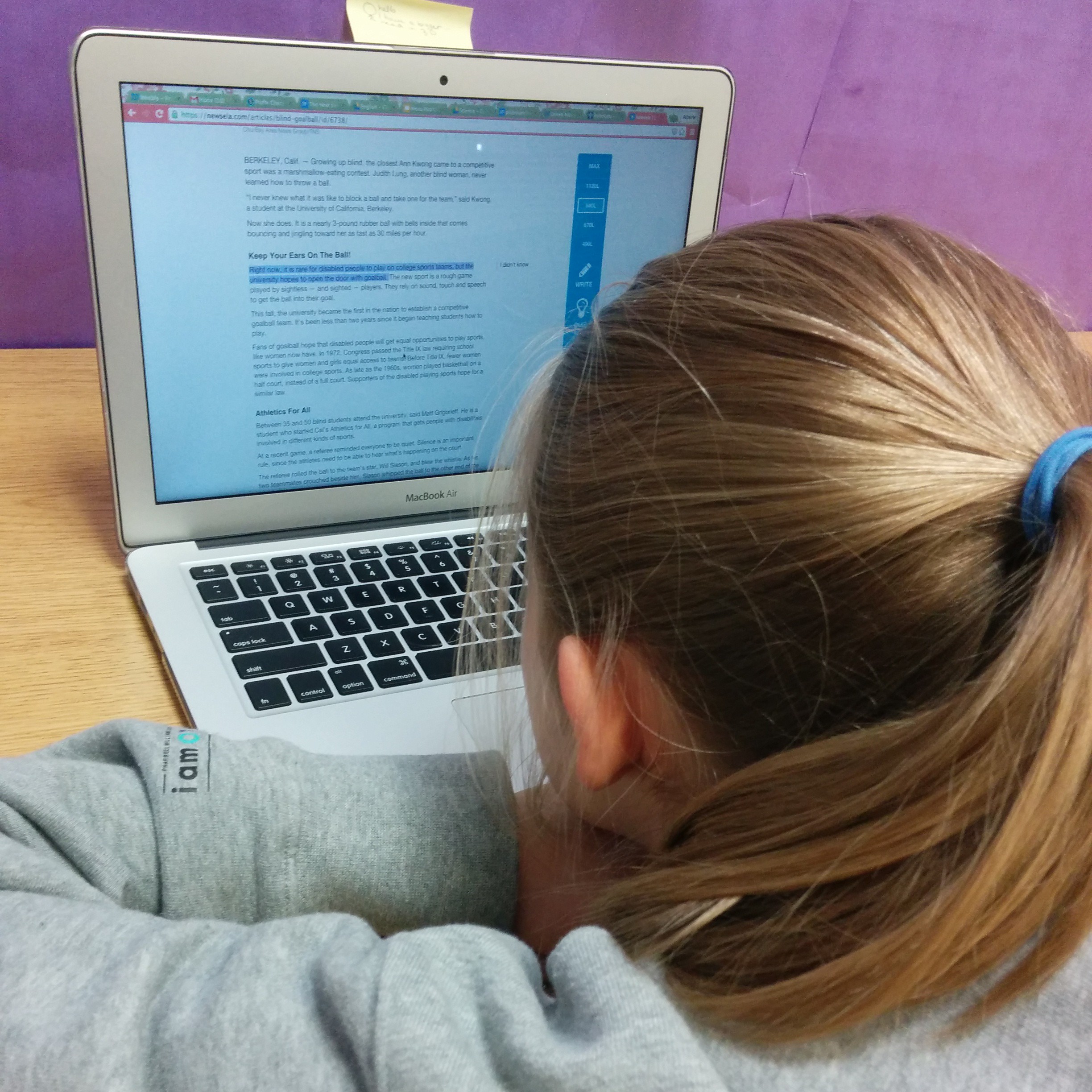
IMG_20141217_090628

I use SRSD (Self-Regulated Strategy Development)  as my primary way of teaching writing to my students. There are a lot of reasons why I love it. It’s research validated. It connects easily to whatever type of writing instruction is happening in their classrooms–workshop models, process writing, etc.–so the skills they learn are easily transferred. It provides just the right amount of structure for students who need it, while not being constricting for students who don’t (check out the article in AMLE Magazine by Pooja Patel & Leslie Laud for more info). The best part, though, is that it’s flexible. We’ve been working on close reading for a while and I’ve asked students, as part of Sunday Cummins‘s model of close reading, to follow up their reading with a written response. Of course, I used the familiar TIDE organizer that we’ve been using all year, but the results weren’t what I had hoped.

We had done everything right. We had discussed the strategy. I worked with them to develop their background knowledge, and made connections between our work with close reading and our work with using TIDE to help us plan and organize paragraphs. We set goals. I modeled, both by looking for the parts of the paragraph in a model piece of writing and by using the active board to model writing a response. I modeled my own positive self-talk as I wrote. And I provided supports and scaffolds. Their writing still didn’t make the connections and inferences I wanted them to make, so I decided to turn it over to them. And they took me somewhere really amazing.

students creating a poster for writing about close reading

I asked them to make a poster that would teach someone else about how to write about close reading, and to use a metaphor to do it (an idea I got from Pete Hall at the BTCFS workshop). Writing about close reading, they said, was like an iceberg. Above the water, they said, is the main idea, supported by the “pasta words” (what Cummins calls the important details). Under the water, they told me, was the synthesis–the conclusions they draw that can’t be found directly in the text. After they made their iceberg, they added images to help them. A boat called the S.S. Annotation to remind them to use what they had written on the text to help them identify the pasta words and to remind them to use their “I wonder…” annotations to help them make connections and draw conclusions. They also added an airplane (with flaming jet engines, of course), where they wrote what makes a good main idea. They added post-its to explain all of the parts, and then explained their new strategy to a colleague of mine from the ELL department who happened to be walking by the classroom.

Using SRSD with close reading

The next class when we went to work on writing, it was a huge change. They had ownership of the type of writing I was asking them to do, and of the strategy I had asked them to employ. When we went through the modeling and practice, and the results were so much better than the first time. All because they took over defining the parts of the text themselves. They had the background knowledge, I just needed to find a way to empower them make the connections between the two topics that would help them take ownership of their writing.

close reading & SRSD


They really came up with something great.

How do you empower your students to make connections and take ownership of their learning?
When We Say a Student Can’t Learn

Via Saved by the Bell Hooks (the site might be the best thing ever)

Teaching is a profession that can be both extraordinarily rewarding and extraordinarily frustrating–sometimes simultaneously. Sometimes we’re tempted to throw our hands up in the air and proclaim that this student just can’t learn. And sometimes we do.

And when we as educators say that a student can’t learn, we’re saying a lot of other things, even if they’re not things we really mean or believe. It’s such a tiny statement–a throwaway line when we’re frustrated–and, yet, it has a million connotative meanings that don’t even occur to us as the words escape our lips.

When we say a student can’t learn, we’re saying that we’ve given up on her.

When we say a student can’t learn, we’re saying that his needs as a learner are not a priority.

When we say a student can’t learn, we might mean we don’t know how to teach her, but we’re saying that she needs to shape up and get with the program.

When we say a student can’t learn, we’re saying that we’ve tried all the tricks in our toolbox and are afraid to ask for help. Someone might judge us, might say we’re a bad teacher, might tell us that if we were more competent, built better relationships, went to this PD, we’d be fine. Look at the teacher down the hall. She’s fine.

When we say a student can’t learn, we’re saying “I’m not a bad teacher. I’m doing everything I know how.”

When we say a student can’t learn, we’re saying that we’re scared.

When we say a student can’t learn, we’re saying “I don’t know how to help this kid and the 24 others in my class.”

When we say a student can’t learn, we’re saying we don’t care about her.

When we say a student can’t learn, we’re saying that we are tired.

When we say a student can’t learn, we’re saying he’s not my problem.

When we say a student can’t learn instead of “I don’t know what to do, and…”, “I’ve tried everything I know how, but…” or “I don’t know how to teach her, so…” we’re saying that it’s easier to put the responsibility for making sure everyone learns on the student rather than on ourselves.

When we say those words, we’re saying so many things. Deciding what we really mean and taking action will determine how successful we are in teaching that student.

When we hear someone else say those words, we need to take a step back and withhold judgement and offer our support as colleagues to help turn the discussion toward something proactive and helpful. In order to try to build a school culture where people feel safe saying “I don’t know what to do” and asking for help, we need to offer that help and support freely and without judgement. We can’t look at our colleagues and say “This teacher can’t learn,” either.

Leveraging 1:1 Laptops for Assistive Tech

Leveraging 1:1 Laptops for Assistive Tech

Assistive tech is a huge topic. We can find all sorts of solutions for students: “no-tech”, low-tech, or high-tech, ranging from free to prohibitively expensive. The best assistive tech tools, though, are the ones that students can transition with and that will lead to independence. In special education and intervention, our goals are almost always transfer and independence. When we start leveraging the technology and resources that are already in a student’s possession, we can encourage that transfer. I’ve found a number of tools that have worked well for my students (generally students with mild to moderate LD) that are either built-in accessibility features or free apps or plug-ins. So far they’ve been working really well for us. These are a few of the tools we’ve been using for reading and writing. In a future post I’ll talk about some organizational tools and some other accessibility features and apps.

(Note: These are just things that are currently working in my classroom. I’m getting no compensation of any kind from any of these programs. I’m just sharing what’s working of my students and for me right now)

Assistive Tech for Reading

There are two different options we’ve been using for text-to-speech in order to assist students who have reading difficulties. One is a Chrome plug-in called SpeakIt, and the other is just the accessibility feature found in Acrobat Reader.

Speak It

SpeakIt is a Chrome extension that reads text on websites, including within Google Drive. It’s free and easy to use. Students can easily customize the reading voice, which includes options that are much more natural sounding and more fluid than the ones available through the accessibility features within Chrome. It is also available as an iOS app as well. Students have really enjoyed using this app to help them access more difficult texts on websites that have been assigned for class reading, when doing research online, and, I think the best application we’ve found, to have their written work read back to them in Google Docs. This is actually a use that was discovered by a student. We had been talking about how important it is to read your own writing. Realizing that he often missed his own mistakes, this student decided that he would use the extension to have his computer read his writing to him, and then used what he heard to correct commonly confused words and other spelling and usage errors. It was pretty amazing. The one limitation of this extension is that it doesn’t read PDFs that are embedded into websites (like those on our school’s LMS), so those need to be downloaded and read to the student using Adobe Reader.

Acrobat Reader

The other program students have been using, Acrobat Reader, has accessibility features that will read the text of a PDF document (as long as it hasn’t been uploaded using a scanner or camera to PDF app). Students can have an entire document read to them, or select particular sections the voice is definitely not as natural sounding as the voices in SpeakIt, but it works. The only issue I can see is with reading academic texts. For example, one of my students used the text-to-speech function to help him read a textbook entry about the beginnings of Islam. The program had more than a little difficulty with non-English words, but the 7th grader I was working with had enough background knowledge from class to figure out that the pronunciations weren’t correct. It’s not as good as using a program like Kurzweil or Read & Write Gold, but it’s free and a great way to test out if this type of assistive tech will be useful for a student.

Assistive Tech for Writing

My students generally have pretty good keyboarding skills, and we’ve done a lot of work on organization and planning this year, but they really struggle with editing their own work, particularly when it comes to commonly confused words. While text-to-speech is quite helpful for many of them, speech-to-text is a bit too much support. As a group, my students have been very excited by the Chrome extension, Ginger.

Ginger

Ginger is not your typical spell checker. It looks for commonly confused words (like homophones or words with very similar spellings), and even makes suggestions for comma usage and grammar. It is a Chrome extension and can also be downloaded as a keyboard app for Android and iOS, as well as desktop version that integrates with Word. Unfortunately for us, it’s only available for PC in that form. I’ve found it to work much better than the spell-check that is integrated into Chrome. It has the option to correct one word in the sentence, the entire sentence, or ignore the suggestions. AND I can tell Ginger that, yes, my last name (or other words that I use frequently that spell-checkers don’t recognize, like “metacognitive” or “multisyllabic”) is indeed spelled correctly. And it will remember. Which is not just amazing for me, but also for my students who are from around the world and often have names that aren’t recognized by spell-check (and, being middle schoolers, are often offended by this). I also like that it highlights possible errors in blue, rather than with a red underline, which seems to make my kids anxious (especially if they experience a lot of difficulty with spelling). It’s not perfect, but I’ve found its suggestions to be much better than most. It’s great for when we’re working on our digital portfolios in Weebly. What’s not great is that it doesn’t seem to work within Google Drive. Students can copy and paste their text into a Ginger window, but most of my students aren’t going to take that step (mostly because they’re worried that they’ll accidentally delete the entire thing). I would love it even more if we could integrate it with one of the word processing programs (Word or Docs) that we already use.

What programs to you use to assist your students with reading and writing?

The Power of Our Words

I’ve been thinking a lot lately about how we, as teachers, talk about students amongst ourselves. Quick conversations in the hall, longer ones in the staff room or in a classroom. In full-fledged meetings with our colleagues. The more I think about it, the stronger my feeling that not only does what we say matter, but how we say it matters even more.

The words we use have power. They can color the perception that we, or others we are talking to, have about the student.

And, in the moment we’re having a conversation, we have a choice. And it’s a choice we need to make every time we have a conversation about a student.

We can refer to a student who just plagiarized an assignment as “slick” and ask for him to have 1:1 supervision during the next assessment.

Or we can say we’re worried that a 6th grader felt the need to cheat and ask what’s going on with him. We can ask our colleagues. And we can ask the student.

We can label a student as lazy.

Or we can ask why she’s choosing to do the minimum work required. Are her skills low? Does the assignment not interest her? Is she afraid of failing or putting herself out there?

We can call a student emotional.

Or we can remember that the student is 12, and the mess of hormones that flow through a 12 year old’s body and all the changes those hormones cause makes it hard to regulate emotions. Then we can look for ways to embed social-emotional learning into our curriculum.

We can call a student a know-it-all.

Or we can talk to colleagues about ways to channel that student’s enthusiasm into something that will give them more positive responses from teachers and peers and help make the student a part of the classroom community.

All of that said, I’m by no means innocent of this. We all get frustrated and we’ve probably all at one point or another labeled a student in a way we wish we hadn’t. We’ve complained about a student’s behaviors and attitudes, rather than looking for the best way to help him or her. As teachers, we need to make an effort to shift our mindsets from deficit-focused to solutions-focused. And for those of us who are actively working on that, we need the courage and the grace to offer other perspectives when our colleagues talk about students in ways that may make if difficult to find a way for that student to be successful.

How do you talk to teachers who may be discussing students in ways that you’re uncomfortable with?

Reading Voice vs Thinking Voice

Reading Voice vs Thinking Voice anchor chart
Reading Voice and Thinking Voice Anchor Chart (note: sometimes we misspell things and our students find it hilarious. Seriously. These kids have pointed it out to every adult who walks into the room. Of course, now I’m putting it on the internet.)

I’ve been working a lot with my 6th graders on close reading for the past few months. We’ve been previewing, reading, annotating, rereading, synthesizing. Or, at least trying. Some of my students took to the approach right away, surprising me with how much they really got that we reread to understand more deeply and annotate to document our thinking or point out specific ideas. But others just thought it was a waste of their time. For these kids, reading wasn’t necessarily about making meaning, it was about getting things done.

Getting to the end.

Getting the questions answered.

Getting on to the next thing.

Getting it all done, so I can do something better.

This is a mindset that reading teachers struggle to change. There are definitely things that help–increasing independent reading time, helping students to choose reading material that they’ll really love, high-interest texts for instruction, authentic tasks–but when you’ve tried all of those and your students who just run a little too fast and are speeding their way through things, having a discussion about reading voice vs thinking voice can be very helpful.

I first encountered the idea of explicitly teaching about reading voice vs thinking voice, was when I read Cris Tovani’s book I Read It But I Don’t Get It very early in my career (probably my first year). This book is an amazing resource for anyone who teaches striving readings in middle or high school. In grad school, we always talked about self-monitoring and using fix-up strategies as one of the keys to strong reading comprehension, but the tools  I left with were pretty limited (I am a bit worried this is still the case now that I’m teaching the class, but I’m working on it!). Really, I had one. It was called “The Critter” and it came from one of the course texts from my first semester practicum. It involved drawing an odd looking creature that the students would use to personify their thinking voices. I’m sure you can imagine how this strategy goes over with most middle schoolers. I’ve used and modified Cris Tovani’s lesson over and over again and I’ve had a lot of success with it.

The biggest thing that hooks kids is that I talk about a strategy that I really do use in real life. I can explain, quite vividly, how it works for me. When I’m reading I know that I’m not paying attention if the only thing I hear is my Reading Voice–the words going by in my head with no questions or connections popping up, I’m not engaged in reading and I’m not comprehending. But, if I’m making too many connections… You know how that goes: one connection leads to another and soon I’m thinking about what I’m going to eat for dinner later, or that one time I went to the beach in North Carolina…I’m not reading at all anymore. Well, my eyes are moving along the page, but the only voice I hear is my thinking voice. But, when my reading voice and thinking voice work together, that’s when you’re a reader who is actively engaged in comprehending a text.

After discussing and modeling, I ask students to add post-its to the anchor chart with examples of their reading voices and thinking voices to the anchor chart using post-its. I prompt them to add more information after they’ve done a few sessions of independent reading. It’s amazing what they begin to notice. I’m hoping we can keep revisiting this strategy, especially for my students who would really rather that reading was over with as soon as possible.

How do you teach self-monitoring and other metacognitive skills when you teach reading?

Checking-in in the New Year

Skyview Atlanta
The second-best picture I took in Atlanta. Again, there’s a metaphor here. I’m sure of it.

At the beginning of the school year I set goals for myself as a teacher. Right now I’m asking my students to check in on their progress toward their goals in their digital portfolios and the teachers I coach to reevaluate the goals they set at the beginning of the year, so I’m checking in on my progress as well. I also have finally set a coaching goal for myself after attending Pete Hall’s Building Teachers’ Capacity for Success workshop through ASCD.

Improve my behavior management for my “challenging” class

This is hard to admit, but I haven’t done a great job following through with this one. I’ve done many of the things that I said I was going to do, but in the more short term. The problem is, I know exactly (or at least partially) why things I’m trying aren’t working. I’ve been so focused on finding strategies to manage behavior and making those strategies work, that I’m not focused enough on planning engaging lessons to meet my students’ needs. I’m not walking into class with no plan, but I’ve been so focused on anticipating behaviors and what strategies I would use to manage these behaviors, that the content and concepts in the lessons I’ve been planning have been, well, less than stellar. So when my strategies work, the activities I have planned aren’t enough to hold the students’ attention and keep them on that good track. It hurts to admit that I dropped the ball here, but it happens and I can fix it. For the remainder of the year I want to keep implementing the strategies that are working, but refocus my efforts on lesson planning so that my students can be successful.

Better integrate the technology I have available to me into my lessons, including finding more ways to leverage “regular” technology as assistive technology for my students.

Here I’ve done much better. I’ve implemented digital portfolios for my students and I’ve been slowly refining them so they become spring-boards for student self-reflection and learning. Yesterday a student exclaimed as he had realized that our work with SRSD and Close Reading had been just as much about improving his ability to manage and regulate his attention as they had been about his reading and writing skills after going through a variety of digital and paper artifacts showing his work. I also am now able to very easily share student work with a parent who has moved back to Denmark ahead of the rest of the family.

I’ve also curated a number of resources for students on my Schoology pages for my learning support classes, including videos and interactive games (usually created by others), as well as graphic organizers (usually created by me). What’s even better is that some students are seeking out and using these resources. I think my next step here is to add more content that I’ve created (or that my students have created) to these resource pages, using podcasting, screen capture, and other methods.

Finally, the coaching goal: Go into classrooms regularly (1-2 times per week) for either very quick (30-45 seconds) or brief (5-15 minute) visits and follow up on these visits with teachers.

Or actually doing what Pete Hall calls “Rounds” and “Walk Throughs”. This goal sounds simple, but it involves a lot: coordinating schedules, figuring out “look-fors”, etc. But the biggest reason I haven’t done this is that I haven’t felt comfortable. I wasn’t given a clear description of what I would be doing as a coach at the beginning of the year, nor was it explained to teachers, so I spent most of the first semester in meetings with teachers, talking and building relationships. Now that I feel like I have a job description (even if it’s self-created with the help of a workshop and a book) and have built up fairly good relationships with many teachers, it will, I hope, be easier. The short workshop I led on Tuesday afternoon about checking in and reevaluating goals from the beginning of the year will also provide context for my visits.

How are the goals you set for your own teaching at the beginning of the year going? 

Instructional Coach Training: #BTCFS

Atlanta Metro Station
One of the best photos I took in Atlanta. Not sure what it has to do with my post. There’s a metaphor there somewhere. I’m sure of it. CC-BY-NC

At the beginning of the school year I wrote a post about my students’ goal setting as well as my own. When I wrote that post, I only talked about my goals for myself as a teacher, but didn’t discuss the goals I set for myself as an instructional coach. That’s really because at the beginning of the year I wasn’t sure what the standard was for instructional coaches. Where was I going? I really wasn’t sure. I didn’t have a job description to help focus me, and while I have been a literacy coach before, it was in a completely different school environment where that was my only role. In my initial meeting this year with my principal, she suggested that I look around for professional development opportunities about becoming a better instructional coach. Excited to learn more, I immediately started researching and came up with the Building Teachers’ Capacity for Success workshop with Pete Hall through ASCD. I knew that the title sounded extremely familiar, and that’s because I picked up the book at ASCD last year after my principal had first suggested that being an instructional coach might become part of my job.

Reading the book was eye opening, but the workshop with Pete was 1000 times better than reading the book. If you ever get the chance to see him present, I highly recommend it. He’s passionate, energetic, and friendly (he also has good advice about running routes in Atlanta and possibly in the other cities where he presents. Warning though: he did try to convince me to run the stairs in the Georgia Tech stadium. Not happening). I’m still processing everything that I learned over the two days, but I think I have a “Top 5” list of things I learned, all of which led me to the coaching goal I set for myself at the end of the workshop. For things that others learned , check out #BTCFS on Twitter.

5. Find the “Green Stars”

You know the teacher down the hall? The one who seems to have taught the same lesson for the last 20 years? Or the one who seems to have no control of her class? Even when we’re trying to be supportive, sometimes working with these teachers can be frustrating. But there’s good there. And as coaches and administrators we need to see that good and remind ourselves of it. Then we need to use that good–that green star–to spark change and growth. This helps us to have a growth mindset with our teachers just like we have with our students.

4. Self-reflection is the key to teacher growth

If you’ve been reading this blog for any period of time you know I’m a fan of self-reflection. For me, for my students, for educators in general. And I think on some level I understood the idea that in order to develop as educators we need to reflect on our teaching. I was also on board with the idea that teachers need to be taught how to self-reflect. What was new was the idea that we can put the ability of teachers to self-reflect on a continuum, and that where they are in terms of their ability to self-reflect determines how we interact with them and the role we take on as coaches, mentors, and administrators. For example, I would take on a totally different role with a teacher who is able to easily reflect on their instructional practice to improve it (a teacher in the Refinement Stage) than I would a teacher who isn’t really able to see the connection between what they’re doing and student outcomes (a teacher in the Unaware Stage). I’m also wondering how I can use the Continuum of Self-Reflection with my grad students and with their practicum supervisors to help support them in their development toward becoming more self-reflective educators.

3. Building teachers’ capacity is the key to student growth and success

Teachers matter. They matter a lot. There’s tons of research on this. Too often, however, we try to get teachers to improve their practice by using carrots and sticks, rather than actually guiding and supporting them in improving their practice. In order to ensure student success we really need to support our teachers in their professional learning and growth based on where they are on that Continuum of Self-Reflection. And to do that…

2. Instructional coaches and administrators need to work together to support teacher growth
Instructional Coach & Admin work together to support a teacher
A visual representation of how the administrator and the coach work together to support a teacher in the Refinement Stage. CC-BY-NC

Administrators and coaches really need to be partners in helping to teachers to improve their faculty’s level of self-reflection and their skill as educators. If administrators and coaches are on the same page with how they work with teachers and are clear about their individual roles and transparent with the staff about those roles, they can be really effective in fostering professional growth in an environment that is supportive rather than punitive. Again, I’m wondering if I can stretch this model to apply to working with my grad students. Maybe with me as the instructor in the role of the administrator with my practicum supervisors in the role of coach.

1. And not but

Of everything I’ve learned, this may be the smallest thing that makes the biggest deal. While there were a number of “ah-ha” moments during the two day workshop, this one was the biggest. And it’s such a tiny change to make when I interact with teachers (and with students and parents). As educators, we like to use the “start with a compliment” format. Then comes the “but”. However, the word “but” can make people defensive and angry. “But” can make the compliment feel like lip service. “And”, though. “And” says, “You really are doing these things right. Here’s how you can grow.”

I’m really excited to start implementing this framework, and I hope I can get others on board as well. Next week I’ll share my goal for myself as a coach and how I plan to achieve it.

What are your strategies for coaching teachers? How do you foster self-reflection with faculty?