Finding the Butterflies: 5 Things to Do If You Think It’s Time for a Change

Finding the Butterflies: When to Make a Change in Your Teaching Career

I had an education professor when I was an undergrad who told us that going into the classroom should always make one a little nervous or even a little scared.

Not anxious and ready to throw up.

Not hyperventilating.

Just butterflies. A little tickle in your stomach. A hint of something new and exciting. A desire to make sure that you don’t fail the learners in front of you.

I don’t know when it happened, but at some point over the last two years, I lost the butterflies. I loved my job. My kids made me smile and amazed me every day. My colleagues were great. But it was all starting to feel routine.

Knowing It’s Time for a Change

I love teaching special ed and being a learning specialist because there are always interesting problems to solve. Looking for the how all aspects of who a student is and how they learn come together, and figuring out how to support the areas of challenge and leverage areas of strength in order to support the student in the classroom. How do we bridge the skills that the student does have with the skills they need to engage in what’s happening in the classroom? But it started to feel like the same problems over and over again. Even the novel problems started to feel like rote. They were variations on puzzles I had solved before.

I was doing my job (and I’d go so far as to say doing my job pretty well), but I was just doing my job. I wasn’t phoning it in. But I wasn’t growing as an educator in the way I wanted to. I was trying new things with my students, but doing new things didn’t spark my curiosity and imagination the way they once did. I’d read articles about burn-out. Burn-out wasn’t the problem. It was absolutely, without a doubt time for a change.

Making the Change

With the exception of two years as a K-6 Literacy Coach, I’ve done the same job almost my entire career: Middle School Learning Specialist. I’ve almost always focused on pull-out instruction with a smattering of push-in and coaching. It’s been primarily focused on reading and writing, with some executive functioning and math thrown in. I liked what I was doing, but as much as I loved teaching reading and writing, the math and executive functioning pieces were the most interesting.

A lot of my time last school year was spent figuring out what my next step would be.

Would it be:

  • Leadership?
  • Would it be to stay where I was and try to create new ways to work and new ways to grow?
  • The same thing somewhere else?
  • Teaching something new?
  • Leaving teaching entirely and go into ed tech?
  • Trying to find a Clinical Professor position and throw myself into teacher ed?

Honestly, that’s part of why I didn’t blog much last year. That type of self-reflection was better suited to non-public writing and thinking. And I was lucky that an opportunity appeared that was the change I was looking for–new grade-level, new challenges, new subject matter, and an administrator I knew I wanted to work with. It doesn’t always work out that way. I’m excited to be starting work in a few weeks as the K-4 Learning Specialist at my school’s lower school, developing their math intervention (RtI) program. I’m definitely excited for the change and I have absolutely found my butterflies (even if some of those butterflies are a little bit of worry that I’ll miss Middle School).

So, if you’re going back to school this fall and you’re realizing that you don’t feel those butterflies in your stomach, here are some things you can do.

1. Self-reflection is key

Self-reflection is one of the best ways that we have as educators to check in on our own practice.

I was in a good position. I liked my job and I didn’t need a change, but I wanted one and knew things would be better for me professionally if I had new challenges. That meant I could apply to jobs and carefully consider what I was doing. If I hadn’t been checking in with my own thoughts and feelings about my work, I might have been in a place where I absolutely needed to leave or had become burned out.

2. Take stock of your strengths, areas for growth, and goals

Really think about them. Journal. Make lists. Answer the questions honestly.

  • What are the things that still excite you about your job?
  • Where do you know you need to grow and how do you want to make those changes?
  • What new challenges would you like to embrace?

Knowing the answers to these questions will help you find the right position, make the changes you need to make in your current position, and have conversations about your next steps.

3. Talk to trusted colleagues, administrators, and mentors

Talk to people.

If you have administrators that will be supportive, talking to them can be very helpful. I was able to talk to my principal and assistant principal. They are definitely administrators who want to support their teachers’ growth and helped me to make that happen, even if their school wasn’t the right place to do it. I also talked options over with a mentor from graduate school and a few trusted colleagues. Talking to people who know you and know your field well can help you figure out what kind of change is the right kind of change.

4. Look at what’s out there

Looking isn’t the same as choosing to leave or deciding that change is a definite outcome. Looking at job options as they start to appear in late January and as the continue to pop up through the winter, and then sifting through the many options in the spring can help you to see what’s out there. It can also help you negotiate new responsibilities and duties that might be that challenge that you’re looking for.

5. Be kind to yourself

It’s easy to look at Education Twitter or education blogs or (especially) Teacher Instagram and think that everything is perfect for everyone else. We’re encouraged to share the victories and not always encouraged to share the struggles. Even in this post while I’m striving to be as honest as possible, there are still parts of the decision making process that I glossed over because they weren’t things I wanted to share publicly (and that’s OK–not everything needs to be published).

Everyone has times when they question where they are.

Everyone has been in a position where a teaching position just wasn’t working for them any more.

It’s OK. You’ll figure it out.

Are you feeling the butterflies as you prepare to go back to school? What challenges are you excited to embrace this year?


Teaching in Other Peoples’ Spaces #2: What About My Anchor Charts?

Where Have My Anchor Charts gone-

The second in a series of posts about how to adapt to teaching in other people’s spaces. For all of us pushing carts, lugging markers & chart paper, and scampering around the school to get to our classes.

I spent the summer coming up with all sorts of ideas for my English class.

  • A shelfie bulletin board to celebrate independent reading!
  • Using the whiteboard and/or chart paper to keep track of our movement through the writing process!
  • Strategies, strategies, strategies!

It was going to be awesome.

I also had ideas from two of my summer teacher books, Deliberate Optimism and Peer Feedback in the Classroom about how to develop a classroom culture that was supportive, welcoming, and respectful. Both books put a lot of emphasis on sharing who you are as person to help make a connection with your students. And a lot of that connection building revolved around sharing who you are through bulletin boards and other displays. Both authors also considered agreements central to developing a safe and respectful classroom space. I agree, but where do they go when you don’t have walls of your own? Or even the same walls every class?

Agreements

Figuring out the agreements was actually the easiest part. Kevin, my colleague in whose classroom I teach 2/3 of my English classes, offered me some wall space. Once my class and I had created agreements, we posted them there. Then I snapped a photo with my phone so I could project the image onto the screen in the other classroom. This has its challenges. For example, the agreements can’t be visible at the same time as other classroom media. This makes simply pointing to the agreements to indicate to students that they need to check in with the agreements and their own actions or behavior difficult. The best solution I’ve come up with so far is to have the picture on a separate desktop on my laptop and swipe to it when necessary.

Bulletin Boards

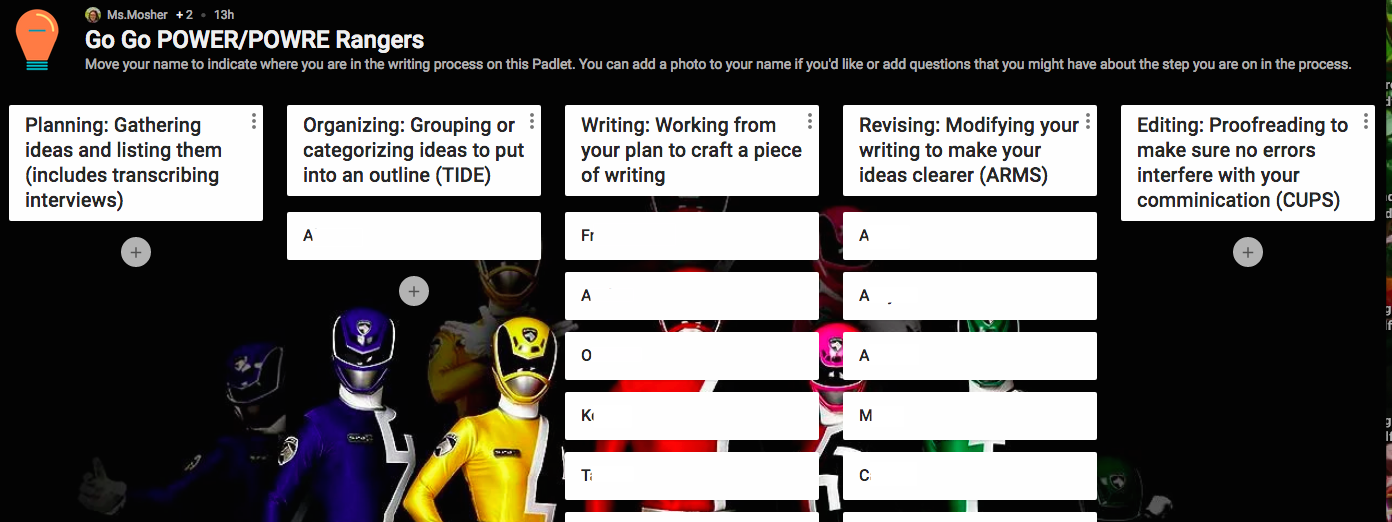
Here’s where technology becomes more helpful, at least in some sense. In general for this year I had envisioned interactive bulletin boards: Parking lots for questions, shelfie walls with information about independent reading progress, a wall where we track out movement through the writing process. I also knew exactly how each board would connect to the idea of building relationships and creating the kind of classroom environment I wanted. Knowing that I’d be in someone else’s space, I had planned to rotate them as necessary. My saving grace: Padlet and my school’s LMS.

Padlet "Bulletin Board" for the moveable classroom.

I’ve gone Padlet crazy in the past month and a half. Padlet is, essentially, a digital wall or bulletin board where you can post ideas, files, and work collaboratively. I’ve used it many times before. I’ve created word sorts, used it for collaborative planning before shared writing, and, in a non-school use, to plan a trip to San Francisco. It seemed like the perfect tool for an interactive bulletin board. Kids could create posts to share information, they could comment on each other’s work (and we could work on digital citizenship!). We’re tracking independent reading and we’re tracking writing. Embedding the media into our LMS allows me to have it visible to students, and allows me to easily give feedback through rubrics, in addition to the comments I make on individual posts.

They made the Power Rangers connection. Hooray for student voice.

So far the kids are engaged, and rather than being a substitution for a traditional bulletin board, which is what I was initially looking for, it is an the tech is an augmentation of the interactive bulletin board. I’m definitely more engaged than I would be with a traditional interactive bulletin board. I’ve even created one for Romeo & Juliet (our next unit) where students can make connections between characters to help them understand who is who (something that’s been an issue for kids every time I’ve taught the text).

Anchor Charts

This is the one I still haven’t figure out. Anchor charts should be up on the wall so they can be referred to frequently. We come back to them and review them. Students can look at them while doing work. I have a few ideas. Perhaps ThingLink? I know I can embed them in my LMS, but will they be as visible when the students need them?

Any ideas? How do you deal with bulletin boards and anchor charts when you’re working in other people’s classrooms?

Teaching in Other People’s Spaces # 1: Classroom Seating & Set-up

Teaching in Other People's Spaces Part 1: Classroom Seating & Setup

I’m teaching English again for the first time in a while. Two years ago I cotaught with my friend and colleague Drew Murphy, but it’s been six years since I’ve had an English class all to myself. This year’s teaching doesn’t have much in common with previous years. The last time I taught English solo it was a totally different curriculum, at a totally different school, and with a totally different population of students. But it does have one major thing in common: I’m teaching in someone else’s space. Actually, I’m teaching in more than one someone’s space. This has posed a number of challenges both for the kind of classroom environment I want to create for my students and in terms of every day logistics, from classroom seating to anchor charts to setting routines for instruction.

I assumed since schools are frequently challenged for space, other people must have written about this. I asked Google. Shockingly, Google found nothing relevant (this could mean this series of posts will have a serious SEO challenge, or it’s just me and it means everyone will find me!) So here is the start of a series on how to teach classes in other people’s spaces. First up, classroom seating and set up.

Challenge: Arranging Spaces

I am currently teaching in two different classrooms. Thankfully, both of the teachers have been open and welcoming to me and my class. However, they each have a completely different size and shape. They have completely different classroom seating and furniture. The teachers in each room are teaching completely different subjects have completely different styles.

Classroom seating in a 5th grade math/science room

One is a 5th grade math and science classroom. It has soft, warm lighting and big windows that look out onto the river. Orange node chairs are arranged in a circle, and there’s a comfortable couch in one corner for independent reading. There is no teacher desk, just a stool next to a low cabinet that the teacher uses as a work station as needed.

The other is a health classroom where primarily 7th-10th graders have class. Folded up tables are pushed up to one side of the room. When unfolded and set up, the tables barely fit all of the students. Chairs are arranged in a circle to facilitate discussion, but don’t have a writing surface attached like the chairs in the other room. A large teacher’s desk dominates one corner of the room.

The bigger challenge was in the second room, where we would have to set up the room in a configuration where everyone could see the board, and everyone had space to write and take notes. We also had to do it as quickly as possible. And I had to run from a meeting on the other side of the building. Depending on which class it is, tables might be set up, and they might not be. This is a lot of variables for me, and definitely a lot of variables for a class of 22 eighth graders. We established a routine. If tables are not set up, they would take care of arranging them. Which has worked out well. I’m still trying to figure out the best configuration for the tables so that everyone has space. But we’re (slowly) getting there.

Challenge: Creating a Proactive Classroom Seating Plan

The set ups of the two rooms are so vastly different, so it was difficult to assign student seats. And in my experiences doing it before, doing so ended up being confusing for the students and for me. So I decided to let it go. We had a conversation about the responsibility of being an 8th grader. I told them that they were allowed to choose their own seats, but with the caveat that they needed to make good decisions about where they would work best. I had to set clear expectations for what “working best” looked like. There also had to be clear consequences for not working well. The biggest issue with setting expectations and agreements was not having wall space to hang up the agreement (see next week’s post for more on that topic).

So far, this is working for us. Reminders to students to sit where they can focus have been helpful, although I’ve had to be creative with how to work around not really having space to post agreements. So far, I’ve set an expectation and they’ve met that expectation. I am worried about the students who have preferential seating as an accommodation. However, we sit in a circle most of the time and my instruction isn’t all that teacher directed. But I do need to be more aware of those students as I’m teaching.

Have you ever had to teach in another teacher’s space? How did you work with other people’s set ups and classroom seating plans?

Next time: The challenge of not being able to have bulletin boards and anchor charts.

Coteaching: What’s Going Well

I have my first semester of coteaching under my belt. So far, I think Drew and I are doing really pretty well. We’ve been navigating communicating and coplanning, and it feels like we have a good balance in the classroom. We both have our own areas of expertise and, I think, we’re becoming better at balancing those. There are, however, still areas we need to work on. I’m going to start with our stars (the things we do well) and follow up with a post about our next steps and how we’re going to improve.

Communication

The biggest issue people encounter in coteaching tends to be navigating the collaboration and communication piece. Drew and I have the advantage of requesting to work together to pilot a coteaching program where a Special Educator works with a General Educator, so we were both on board with the idea of coteaching and knew we had similar visions and a desire to work together. This is something a lot of coteachers don’t have. I know other special ed teachers who get thrown into classrooms with general ed teachers who don’t want them there. We also weren’t totally on our own in establishing a cotaught class. Our colleagues Pooja and Emily have already done great things coteaching as English and ELL teachers, so there were plenty of places to get advice.

We’ve become better at reading each other and are able to discuss things when one of us is uncomfortable with a strategy or technique the other wants to do. I know when to pull back or slow down when trying to infuse explicit strategy instruction or another technique, and I think Drew knows when I’m starting to feel uncomfortable with the more (as I call them) “loosey goosey” aspects of Readers’/Writers’ Workshop.

Coplanning

While I think there are things we can do to make our coplanning time more efficient, we’re generally doing a good job of always planning together and setting out a schedule for the week. We make sure to keep that time sacred and not schedule other meetings. The agreements and discussions we had before school started about how we wanted to structure our planning time were really useful, as was this planner from the book The Teacher’s Guide to Inclusive Education (Hammerkin, 2007). It helps keep us organized and on task.

Trust

There is an ease in how Drew and I interact in the classroom, and this seamlessness has helped out students to see us both as the teachers in the classroom. Not a teacher and an assistant. Not a boss and a supervisee. That’s partially because we have trust. We trust each other enough to try new things and fail. We’re willing to make mistakes, and know we’ll be corrected kindly. This trust is what makes our partnership work. We’re really lucky that we were able to choose each other for this work, but just because we chose to coteach, doesn’t mean we would be ready to be vulnerable. The biggest thing we did to foster this was talking things out at the beginning of the year: How we wanted the class to run, what we wanted things to be like. But we also shared who we are outside of school: talked about our likes and dislikes, shared pictures of our cats. And knowing each other better, both our school and out of school personas, really helps us to be open with each other. Because of the trust we’ve established we know it’s ok to say “I’m not ready to try that yet” or “I don’t understand” and knowing that the other person will still accept and work with us.

Of course, we’re not perfect. In my next post I’ll share our goals for the end of the school year and how we want to improve our practice.

Have you ever cotaught? How did you work together to establish a strong coteaching relationship?

How Shakespeare Helped Me Get My Groove Back

How Shakespeare helped me get my groove back.
He totally is…

This school year brought a lot of new responsibilities and a lot of changes to my position. I was sharing a room. I was doing more math intervention, which is an interesting challenge, but definitely isn’t my strength. I was teaching a pull-out intervention class to 5th graders. Fifth graders are cute, but definitely not my favorite grade. I felt like I wasn’t making progress with any of my students. I could feel myself slipping into a pattern with my math interventions where I would learn about new strategies for math intervention, try them once or twice, and then slip back into what I was used to (yes, I am absolutely a Conscious Stage teacher when it comes to math intervention). I knew it was happening, but felt powerless to stop the cycle. For the life of me, I couldn’t figure out the best way to manage the behaviors of my 5th graders–all of whom had different needs, both academically and social-emotionally–and it was definitely making it difficult to deliver appropriate interventions. They weren’t making progress and I was worried I wasn’t supporting them.

I just felt frustrated and stuck.

I was also coteaching for the first time. I liked my time in the classroom and I love my coteacher Drew. But the unit we were working on at the beginning of the year wasn’t something either of us was really excited about and neither of us felt like we had a voice in the planning process. Honestly, I wasn’t sure what we wanted out students to know, understand, and do, and was just doing my best to infuse appropriate writing skills instruction into the unit.

And then, Shakespeare showed up. Specifically, Romeo and Juliet. Drew had done a Folger Ed workshop (taught by another amazing colleague, Gina) over the summer and was really excited to teach Shakespeare through performance. I was nervous. Because, you guys, R&J is really dirty. And we’re teaching 8th grade English. I also had to unexpectedly fly solo for the intro lesson. I was terrified.

But it turned out great:

And all of a sudden, I was feeling that high that comes from a great lesson with a room full of engaged students.

I stood in class trying to keep a straight face as kids began asking questions like “Mr. Murphy, what’s a maidenhead?”

Or:

“When he says ‘thrust maids to the wall’ he means…”

“Exactly what you think he means.”

“Ohhhhhhh…”

And then started having amazing, deep conversations about the role of women during Shakespeare’s time and how awful it was that Samson and Gregory weren’t really worried about raping Montague women, but were terrified of getting into an argument with Montague men. Because the second one is the thing that will get them hung.

They were interested and excited. And so was I.

They were engaging in close reading of Shakespeare without eye rolling.

They were on their feet and acting and directing.


Up on our feet performing and directing Shakespeare

And I was walking into school with a much more positive outlook. I was looking forward to English class, to planning with Drew. I was even looking forward to grading paragraphs about Romeo and his take on love in Act 1.

Now I’m even ready to dive into researching math interventions and trying out new strategies for my 5th graders. It’s amazing what one unit can do.

Have you had a time when you felt burned out and like you weren’t accomplishing what you wanted to in the classroom? How did you get your teaching groove back?

Self-Care: Crying In Your Car Is Not Enough

Cat assisting with self-care
My cat is a champion of my engaging in self-care, sitting on my grading when she feels I’ve spent too much time doing that and not enough time letting her sit on my lap.

Working with teachers who are in their first year of the NYC Teaching Fellows program this year has really highlighted for me the importance of self-care for teachers–especially new teachers. A couple of them brought up the NPR Ed piece called “Hey New Teachers, It’s OK to Cry in Your Car,” which is a terrible title. It did, however, have a lot of good advice for first year teachers regarding self-care.

That made me think: If I could travel back in time ten years and give advice to myself as a first year teacher, there are a few things I would make sure I did during my first year of teaching instead of spending the time up until February break skipping the self-care strategies and throwing myself into work. I dealt with my stress through a combination of long showers, Two-Buck Chuck, crying on the A Train, and ice cream. That obviously wasn’t sustainable.

Only take home as much work as you can feasibly do in 2 hours or less

It takes time to calibrate this, but it’s really important. Carting more work than you can do back and forth from school each day makes you feel unsuccessful and frustrated. It might actually take the first two or three months of school to figure that out, but once you do, set that boundary and stick to it. Even before you figure out where that boundary is, set a timer and don’t work past that.

Get enough exercise

Seriously. Start an exercise routine: biking, running, yoga, Pilates, swimming, CrossFit, mall walking, martial arts. It doesn’t matter what. Just do it. For me it works especially well if I exercise between then end of the school day and starting my grading or planning.

Sleep

Set yourself a bedtime and stick to it. Really. It doesn’t matter how much grading you have. Unless you’ve decided to…

Make time to spend with friends

My first year of teaching, I sometimes got so wrapped up in work (or feeling stressed about work) that I forgot to see my friends. That made me feel disconnected and lonely, and it caused me to get even more wrapped up in all of the negative things about my first year. Make a monthly date with a close friend and stick to it. I still do this with my friend Kate.

Just because you can be in the building until 7 PM…

Some schools kick you out, others don’t, but set yourself a curfew and don’t stay past a certain hour. I had a key my first year. It was bad. Some of us work best if we take a break between school and doing more work, some of us don’t. Either way, set a time when you’re going to stop doing work and go out or change gears.

Read

Yes, of course, read articles in professional journals and the books you’re teaching to your class, but also make sure to read books that are for you. Books that remind you of what you love about reading, and what you’re interested in outside of school. Develop a readers’ life apart from the books that you’ll recommend to your kids.

Eat good food

Learn a couple of simple recipes, or get a crockpot and make yourself good, healthy food for your lunches and dinner. Don’t live off of takeout just because you’re busy.

Find your flow

Resurrect a hobby you let go of or learn a new skill: knitting, gaming, bread making, canning, sewing, painting, dancing, making music, photography, martial arts, running. Whatever it is that helps you to really be in a state of flow, do it. Schedule time for it. Make it a priority. Share it with your students.

Let go of your mistakes

The most important piece of advice from that NPR segment that I would reiterate to new teachers (and have tried to reinforce to my first year Teaching Fellows–I’m forcing them to read this for their last class. I’m hoping they’ll tell me if I did it enough): I’m still in touch with kids I had my first year of teaching, and they’re not  scarred for life by the myriad of mistakes I made during that first year. Just to be clear: I made A LOT of mistakes during my first year I run into them around the city in all sorts of unexpected places. I’m friends with a few of them who are in their 20s on Facebook. I get emails from some who are in college. They’re all OK. Even the ones I worried wouldn’t be OK.

But I don’t have time for self-care…

Make the time. I’ve been telling my 8th graders all week that winter break is a great time for a reset. It can be a great time for a reset for teachers too.

How do you engage in self-care? If you don’t think you are yet, how will you make it a priority in the new year?

New Beginnings

I finished my first week of school. Every year brings a number of new beginnings, but this one is coming with a lot of changes. And I’m excited about all of them.

New Room
New beginnings: Changes in Room 470
Same room number, but wait until you see the inside…

It looks like the same door as last year (with an added name. We’ll get to my new teammates later), but when you open it up and look inside (I got a picture before the blinds and clock went up, but you get the idea):

New beginnings: Same room, twice the size, new furniture.

Looks a little bit different than last year, right? The school knocked down a wall between my room and an office next door and we ordered all new furniture. We put a lot of thought into colors, the types of chairs (they’re really hard to tip back on, but when you lean back on the chair, the back leans a little bit and the seat slides forward), the table, our desks. It’s an amazing space. As one of my little M1s (5th graders) said: “Your room is so small, but it has everything!” What I’m most excited about though, is the Idea Paint. The tables and the wall that you can’t see in this picture are all painted with Idea Paint, so most of the surfaces in our room are whiteboards! Students can work out math problems on the table or jot down notes and ideas. It’s also a much brighter and friendlier space than last year.

New Colleagues

I’ve mentioned my colleague Pooja Patel before. She and I have presented together before and teach sections of the same course at Teachers College and now we’re collaborating as Middle School Learning Specialists. I can’t even begin to tell you how excited I am. It’s really exhilarating to work with a colleague who both challenges me and helps to build my ideas. Collaborating with someone in a new way comes with challenges, but I can’t wait to see what the year has in store for us.

New Roles

There’s a lot of exciting stuff happening this year in the evolution of my job. The two biggest are the expansion and formalization of instructional coaching as part of my job duties and the addition of a co-taught English class to my teaching duties. Last year, not much was done in the way of introducing the coaching role that the learning specialists were taking on. The rest of the faculty didn’t know what we were doing and didn’t really understand what coaching was. This year, our roles are being introduced right from the beginning. And we’ve already started working on building relationships with teachers and introducing our new roles (thanks to a brilliant suggestions from Pooja and some amazing baking by my friend Amy’s bakery).

The treats and the welcome notes that accompanied them seemed to be a big hit.

I’m also excited to be co-teaching an English class with my colleague Drew Murphy. It’s my first time co-teaching for an entire year. I’ve done units of study or helped introduce specific literacy skills, but I’ve never been a full-fledged co-teacher. I spent a lot of time this summer refreshing things that I had learned in my Special Ed coursework, reading books, and thinking about how things will work.

I’m also teaching a new teacher ed course this year. This time it’s a course about teaching reading to adolescents with LD. I’ve done two classes so far, and I’m enjoying it so far.

How was your first week back? What new beginnings are you excited about this year?