Summer Homework: Reconnecting with Optimism

Practicing self-care first so I can practice optimism this coming school year
Starting by practicing self-care first so I can practice optimism this coming school year

I’ve finally started my (self-assigned) summer homework. It took almost a month of reading books just for the sheer pleasure of reading, knitting, running, bike riding, pie baking, and relaxing on the beach for me to feel ready. By the end of this school year I was definitely feeling depleted and burned out. I actually missed most of the last week of school because I was so sick. My body basically yelled at me and told me to lay down and not move for a while.

During the last two months or so of school I could feel my fuse getting shorter, my focus getting weaker, and my ability to “leave it at the door” becoming almost nonexistent. I was frustrated by a lot of things both in and out of school. The specifics aren’t really what’s important. However, I spent most of the year focusing on the fact that things I had no control over were disrupting my work with students. When we get to that point, it’s easy for teachers to into a spiral of “everything is terrible” and to not embrace the kind of optimism that will help us to change the things we can control. This can wear us down and lead to burnout.

Choosing Optimism

Deliberate Optimism in the wild

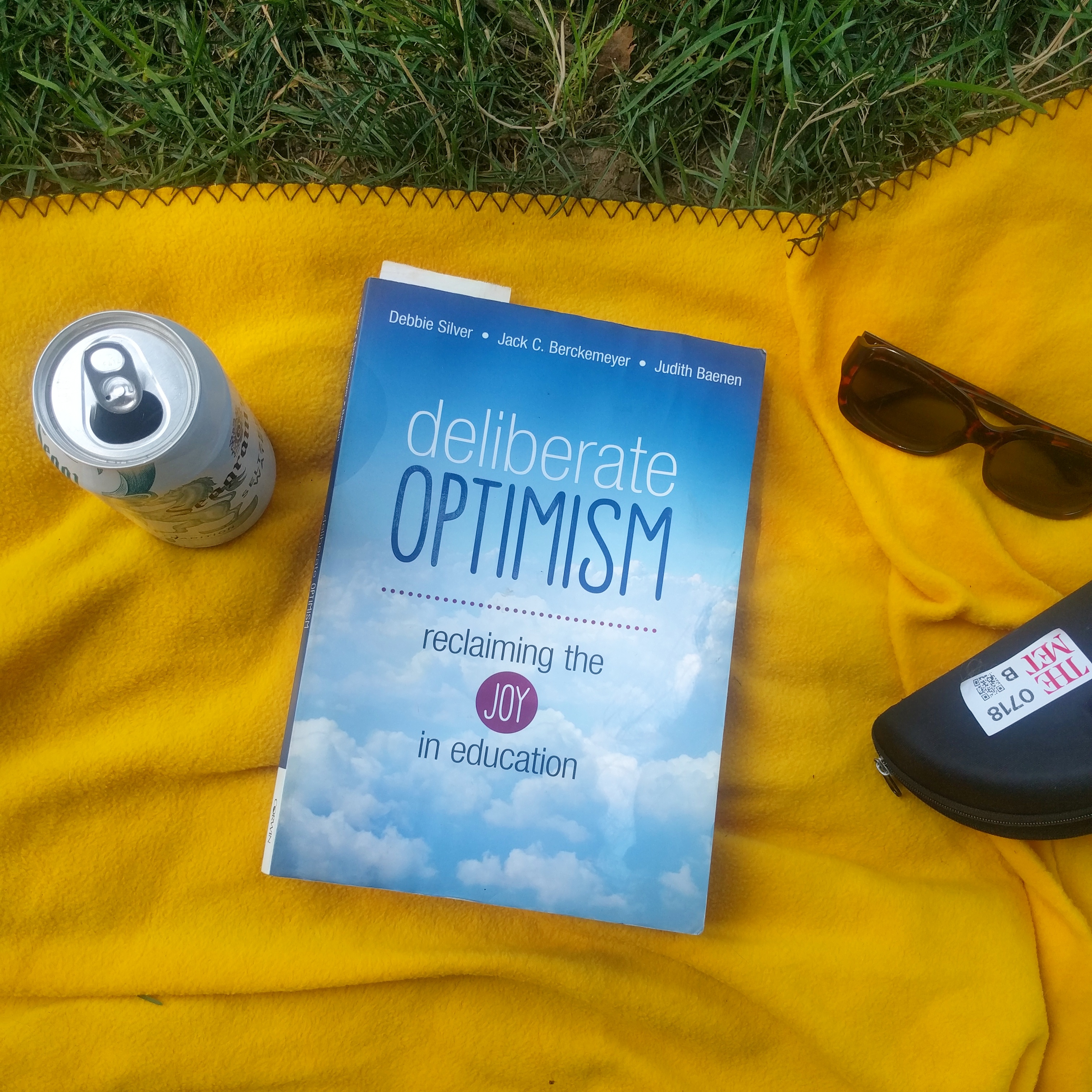
I decided my first book that I would read for the summer would be Deliberate Optimism: Reclaiming the Joy in Education by Debbie Silver, Jack C. Berckemeyer, and Judith Baenen (Corwin, 2015). I picked up the book at AMLE this past October after hearing Dr. Silver speak. She was funny and engaging, so I picked up the book I knew it was something I needed to read. Even in October of last school year I could feel myself heading for burnout (this was probably a really bad sign). I picked it up again because I knew the book would help me figure out how to get out of the funk I had been in. It might also help me figure out where I could take action and what I could do better next year.

What I Learned About Optimism

Daria & Aunt Amy: My anti-optimism heroes

When I was in high school and through college my favorite television show was Daria. It might still be one of my favorite shows (I’ve rewatched it–it holds up). I identified with her cynicism. I still identify with her a bit (now I probably identify more with Aunt Amy, I’m in my mid-30s, after all). Optimism is hard for me. I didn’t just cultivate cynicism in adolescence because I thought Daria was an excellent role model. Cynicism is somewhat in my nature. However, I can get on board with the way the authors define optimism in this book.

I like that the authors define optimism as a choice (or a series of choices). Even more importantly, they differentiate between optimism and deliberate optimism. Deliberate optimism is different from the “peppy cheerleader” image of optimism I have in my head. The authors define deliberate optimism as having five principles:

  1. Gather as much information as possible before acting or reacting. Get that information from a variety of sources.
  2. Figure out what is beyond your control. Strategize how to minimize the impact of things that are beyond your control on your life.
  3. Figure out what you can control and look for ways to maximize your power in these areas.
  4. Actively do something positive to achieve this goal.
  5. Take ownership of your plan and take responsibility for your choices. (Silver, Berckemeyer & Baenen, 2015)

As someone who really likes clearly laid out procedures, I love this list. These are things that I can do. And the authors explain is great detail how to achieve each one. Yes, this is definitely a self-help book for teachers (and my inner Daria is inclined to mock such things). And, yes, these are things that I already know I should do. But I definitely needed the reminder this year, and know I might need it again. The idea that all of us have things that are within our control and can make actionable goals to change things within that sphere is powerful.

Throughout the remainder of the book, the authors apply these principles to various areas of teaching: interacting with colleagues, building relationships in school with both students and colleagues, creating a positive school culture, and self-care. These explicit connections to struggles that we all have at school make the principles in the book feel easier to take on. And I think I’m ready.

How I’ll Implement Deliberate Optimism

I have a few close friends at work that I’m going to reach out to. I’m going to ask them to read the book as well so we can support each other in implementing the five principles, and call each other out when we’re not disrupting our old patterns.

My biggest goal for this year is going to be to differentiate between what I can and can’t control, and then focus on the things that are within my control. I got too hung up on what was beyond my control this year, and it made me, if I’m totally honest, not a great teacher or a great colleague sometimes. I didn’t like it and tried to change things, but didn’t know how. Now that I have a plan, I’m confident I can keep things on track.

Deliberate Optimism: Should You Read It?

Definitely. If you’re a teacher who’s feeling a bit overwhelmed or burned out this summer or gets stuck focusing on things that are beyond your control, this book is definitely for you. A caveat though: Two of the three authors describe themselves as humorists, and my inner Daria was doing a lot of eye rolling at some of the jokes. They kept the somewhat heavy subject matter a bit lighter, but they weren’t really my thing. That said, the book offered easy to follow, concrete advice about how to bring joy back into your teaching practice. We could all likely use a bit of that.

How will you bring deliberate optimism into your practice next school year?

Back to School: August Is the Longest Sunday

Heading back to school after all of this summer...
Some of my summer adventures: Wedding at the Cathedral of St. John the Devine, Measure for Measure in Brooklyn Bridge Park at sunset, the cat helping with my new sheets, Coney Island, a trip to Abbot’s Frozen Custard, the cat helping to unpack the CSA share (or trying to eat the lettuce), Mexican takeout for the 4th, knitting while waiting in line for Cymbeline tickets (Shakespeare in the Park), street art and a fancy pedicure.

There’s this narrative about teachers and the end of summer.

That we’re just as sad to go back to school as the kids are (another narrative we maybe need to think about).

That we’re dragging ourselves out of bed.

That we’re dreading the first day of school.

That our lives are so much better over the summer without our students and our colleagues.

Kind of like this comic that a friend posted to my Facebook wall:

you have to your a teacher
I tried to find where this image came from to attribute it, but all I have is Facebook.

I’m not going to lie, I enjoyed waking up at 8 instead of at 5:45, going for runs in the morning, reading in the park, cooking a leisurely lunch. I liked having time to indulge my non-teacher-related passions (knitting, reading books written for adults, starting to train for a half marathon) and to engage in professional learning. And I, admittedly, was annoyed when I walked into Target in early July and saw back to school displays up. But just because I enjoyed the summer doesn’t mean I’m not excited to go back to school. And I think that’s the problem with our narrative. It doesn’t have to be one or the other, and when we focus on the not wanting summer to end, we’re missing something.

I can enjoy my vacation time, even relish doing a different kind of teaching, having a different schedule and the ability do laundry in the middle of the day on a weekday when no one else is in the laundromat and go to Trader Joe’s when the line is almost guaranteed to be short. I can even be sad to see it go and wish I got one more trip to the beach or one more uncrowded trip to the laundromat. That doesn’t mean that I don’t enjoy my work, and it doesn’t mean I’m dreading going back. In fact, I’m pretty excited to head back to school tomorrow. I’m excited to see my colleagues, to plan for student learning, to jump in with both feet and try out everything I learned this summer. Neither one negates the other.

A friend of mine referred to August as the longest Sunday night. And I have to say I agree. The end of summer comes with everything that the end of the weekend does: excitement about starting something new, anxiety about both starting something new and sleeping through your alarm clock, a little sadness about having less free time, the desire to have a long, leisurely lunch or brunch before you’re back to oatmeal for breakfast at 6:30 and a salad for lunch 11:30, a brain spinning with new ideas and new things to try.

Todd Whitaker says that if we want to work in a positive place we need to celebrate the Mondays. That means we also need to celebrate the first day back for faculty when the summer finishes. Tonight is the end of my long Sunday, and tomorrow morning, I intend to celebrate my Monday. Will you join me?

Adventures in Teacher Education

Teacher education: Student feelings about assessment
My students share their experiences with assessment during one of our initial classes.

I spend most of my time teaching middle schoolers, but I’ve moonlighted in teacher education for nearly 6 years. I started out teaching one course in the program where I got my Master’s degree. Then I was presented with a new opportunity to participate in teacher education. A professor at another local university reached out to me and asked if I was interested in teaching a 5 week summer course in assessment for Special Education over the summer. The course was for students in an alternative certificate program here in NYC. I was thrilled to try something new, but there were challenges that I hadn’t anticipated. Working in a different kind of teacher education this summer really challenged a lot of beliefs and assumptions that I had about education. Particularly the idea that learning is scalable.

Learning is scalable is one of the CGC principles that really resonated with me. What it means is that our beliefs about teaching and learning for children in a classroom should be able to scale up to a whole school level, to professional development (and, by extension, teacher education), and even to how we run our schools. In theory, if I truly believe that learning is scalable, the same beliefs about education should apply whether I’m working in a middle school or in teacher eduction.

I know that with my middle schoolers I believe that work should be able to be revised as many times as possible until a student demonstrates the knowledge, skill, or understanding that I’m expecting. Basically, I believe in mastery grading and not punishing students for taking longer to understand things than their peers. I don’t really believe in penalizing students for late work, but I found myself more frustrated with graduate students who turned work in late without an email or a request for an extension. I found myself feeling that I shouldn’t be offering students the opportunity to rewrite things because they should “know how to do this by now.” I found it really hard to reconcile my belief that graduate students should possess a particular skill set with my belief in everything above. Was it my responsibility to teach them those things? Or, did they need to ask questions, pull themselves up by their bootstraps, and figure it out. Did I really believe, as my Ed Psych professor in college said, that in “grade school you have teachers who teach, and in college you have professors who profess–get used to taking in information and figuring things out.” When I really examine my beliefs, I don’t believe that at all. But I also am not sure I have the time to teach them all of that.

A summer course means less time. It means less time to revise work, so that means less time for students to “get” everything before the end of the term. There is also less time for questions and discussions about assignments, and fewer assignments. There’s less time for me to write substantial feedback on the assignments I do get, so there are fewer assignments. There’s also less time for student-professor contact outside of class. I hope I did a good job of building relationships with these adult students, but I’m not sure.

If I teach this course again, I want to make sure I spend more time getting to know my students. I also want to spend more time practicing what I preach: using formative assessments to figure out what skills I need to teach before a major assignment is due. And now that I’ve taught the course once, I’ll be better able to adjust assignments and content to make time.

What are your experiences with teacher education, either as a student or as an instructor?

Self-Regulation Strategies in the Classroom

Self-regulation strategies: Positive self-talk
Positive self-talk, and important part of self-regulation. Source

One of my goals for this summer that I wrote about in my first post was to look for ways to expand my use of self-regulation strategies in my classroom next year. This summer I’ve been doing a bit of reading and exploring about that topic and thinking about how to include more of it in my class.  And, as I discussed in last week’s post, I think that confusion and struggle with material can be productive, but only if we have really taught our students how to work through that confusion. Teaching self-regulation strategies is a good way to do this.

What is Self-Regulation?

Self-regulation is our ability to manage ourselves: our bodies, our emotions, our focus and our attention. When reading about self-regulation, the first thing that usually pops into my head is “This sounds like executive functioning”, and they are related.  In order to self-regulate, we need to rely on and coordinate a number of executive functioning skills. Self-regulation is how we actively control our behaviors and our emotions. I wanted to get a better idea of what teaching self-regulation entails outside of reading and writing, so I read the book Self-Regulated Learning for Academic Success by Carrie Germeroth and Crystal Day-Hess, which I picked up at ASCD in March. It’s a good, quick read (only 45 pages) that gives a great overview of self-regulated learning and provides usable strategies.

SRSD for Reading and Writing

When I talk about self-regulation, I’m generally talking about Self-Regulated Strategy Development (SRSD). I have been using these strategies for writing since graduate school. I’m a big believer in the power of SRSD. I’ve seen how well they work with students of all ability levels. It’s also a strategy that’s been researched quite well. I even include it as a part of my graduate course for reading teachers. I don’t have the time or the space here to give SRSD it’s due in explaining it, but check out Think SRSD for a full explanation and free resources or the book Powerful Writing Strategies for All Students. There are two components of the program that I really want to discuss: goal setting and positive self talk, because these are the aspects of SRSD that I want to try to pull into other parts of my teaching practice.

Goal Setting

Goal setting is a key component for SRSD and something that Germeroth and Day-Hess focus on as an important skill to teach to middle and high school students. When student are trying something new or working on something that is difficult for them, goal setting helps to break tasks down into manageable chunks and helps them focus their attention on one area in need of improvement (it also helps the rest of us in every day life, from work related tasks, to things we do for pleasure). When we set goals and reflect on our progress toward them, we are able to create action plans to help us achieve these goals. If we use SMART goals (Specific, Measurable, Achievable, Relevant, and Time-bound), we can even graph our progress toward a goal.

With my M1 (grade 5) group last year I had students with a number of different writing needs. I could rarely teach whole group lessons. So I had them self-assess their writing (with frequent modeling and scaffolding from me), and then set one goal for themselves helped me to teach them appropriate strategies and develop interventions to help them reach their goals. When I created graphic organizers for them based on our SRSD mnemonics, I always included a line for a goal, I always asked them to rewrite it at the top of their rough draft, and there was always a line for their goal on the revising and editing checklists that we used, so the goal was always in mind. They tracked their progress both through graphing progress–we decided together what a strong example of what they were trying to do would look like, an “almost there”, and a “keep trying” so they could rate their own performance–and through an online writing portfolio that we created using Google Sites, where they reflected on their progress and then created new goals. This worked really well, and I’d like to do this again if I have a group that needs writing intervention. What was key, though, was explicitly teaching them the learning skills that they needed, or helping to teach the missing skills they needed in order to achieve these goals. Making the process of achieving the goal transparent is what made the learning relevant and what helped teach them why it was important to set goals.

I’d like to spend more time with goal setting this year and use it for areas other than writing. I think it will help students to understand the purpose of the interventions we do and take more ownership of their learning. While we set goals last year, I think aside from that M1 group, I didn’t do a good enough job of keeping the goals at the forefront of what we were doing–we discussed them at the beginning of the school year, and maybe set new ones at the midpoint, but we didn’t really go back and revisit as often as we should. I’d like to use more goal setting sheets like these. And perhaps make a classroom display about goal setting where we could share our goals. I think I’d like to keep progress personal though. Otherwise it feels too much like a data wall to me. I also want to publicly acknowledge when students have made progress. It’s a tricky spot and I’m still working through it.

Positive Self-Talk

Part of the goal of any special education program should be teaching for independence and generalization of strategies. I’ve noticed in the past year that I’ve been at my school that most of the students I teach have a lot of trouble with positive self-talk and without positive self-talk, it’s hard to get through those times where we’re stuck working toward our goal or when something is just difficult or confusing. They do well when taking tests in my room when I can remind them that they have the strategies to tackle a tough math question, but they have difficulty with that internal monologue that successful problem solvers have–positive self-talk. That positive self-talk is what helps to get students through to their goal–what they need to say to themselves to remind themselves to use the strategies they’re learning. I really liked the idea below that was tweeted by someone participating in an SRSD workshop with Think SRSD in Tennessee.

Self-Regulation Strategies: Positive Self-Talk
Image from @lookforsun on Twitter

I’m wondering if this is a better way to go–rather than publicly tracking progress toward the goal, maybe we can surround the posted goal with speech bubbles filled with the positive self-talk the student needs to engage in to help achieve the goal. I like that it helps to focus the students on the process of achieving a goal. The outcome is important, but what I’m really trying to teach them is how to set a goal, create a plan to achieve it, apply strategies, and then persevere to achieve the goal. I could even apply technology…maybe use Aurasma to connect their goal to video or audio clips of the student or someone that they consider a cheerleader or supporter in their life reminding them of their positive self-statements. That way the positive self-statements that connect with the goal aren’t static things on my wall, but living things they can take with them.

Doing more to really teach and model how to engage in positive self-talk to get through tricky spots in reading and writing, through difficult math problems, or while test taking is going to be one of my teaching goals for next year. It’s so important and I have such a hard time doing it. Modeling it often feels fake to me, and I’m not sure why. I use positive self-talk all the time. When I’m at work, at the gym, knitting, trying to execute the perfect lattice-top for a pie. I think the times I was most successful in doing this last year was when before I modeled using positive self-talk in academic settings, I talked about how I use it outside of school. We talked about planks. (Somehow, I always come back to Pilates, don’t I?)

Planks are hard, but the only time they’re impossible is if you spend the entire time telling yourself that you can’t do it. I talked about doing plank, why it was hard, and how it became easier when I stopped focusing on what I couldn’t do, and focused on telling myself that I could do it, and if I fell down, I told myself it was OK and that I could try again. Then we all did it. For most of my students, the idea that we need to be kind to ourselves when we’re doing something difficult and that positivity well help us to persevere really stuck. There are others that I still need to figure out how to reach. Even with the explicit connection to how we all use positive self-talk outside of school–“Do you always do every trick in skateboarding perfectly the first time? What do you do when you fall?”–they’re still not making the connection. These are the kids I’m still working on figuring out how to reach.

What’s Next?

I spent the some time this summer looking at other ways to include self-regulation strategies, particularly positive self-talk and goal setting, in other areas of my instruction. I just finished reading an article by Bell & Pape published in Middle School Journal (2013) that’s all about using self-regulation strategies in the math classroom. I’d really like to start using it more with the students I’m working with in math, and I’m hoping to convince some of the math teachers to integrate it into their classrooms too. We’re using Bridges in M1 math this year, and they actually have posters with problem solving questions to ask when you’re stuck. I love that idea, and would like to put those in my room too. I think that both goal setting and positive self-talk will be really beneficial for the students that I work with in math. Most of them have experienced so much failure and have such a negative view of themselves as math students, that small successes and little bursts of positivity can have a huge effect.

The real struggle, however, is getting other teachers on board. Teaching kids these strategies in the bubble of my intervention room is fine, but if I want them to apply the strategies elsewhere with any sort of consistency, I need other teachers to see the value of the work I’m doing with these kids. To encourage them to use their positive self-statements, to understand the goals these kids are working toward and really celebrate their progress. But how to do that? It can be overwhelming for a classroom teacher with little experience dealing with students with disabilities to keep all of this in mind, and I want to be a supporter rather than piling one more thing on their plates. We all want the best for our students and I need to figure out a way to make it easy for teachers to incorporate these ideas and support the students I work with.

How do you incorporate goal setting and positive self-talk into your classrooms? Any advice for coaching/consulting in these tough situations?

Deadlines

Deadlines
Image by Dan4th Nichols via Flicker

I have a self-imposed deadline for completing posts for this blog (as suggested by Kristy when she did my blog design). The idea is that I work on a post throughout the week, revise and edit them over the weekend, and then publish bright and early Monday morning. Clearly, that didn’t happen this week. I have what I hope is a great post that I’ve been working on. But haven’t really found the time to get it done. Why? Deadlines.

It’s summer, but I feel like I have so many deadlines. They’re everywhere. They’re looming. And most of them are self-imposed, yet somehow firm. And then it’s nearly August. Summer is almost done…What? I have so much left to do! Books to read, classroom design to finalize, a closet to reorganize…And all of the things with real deadlines.

  • Not self-imposed (or not entirely): I have to finish the handouts and slides for the workshop I’m doing next week. Which is sold out. We were worried there was no way we’d get the minimum 25. Technically, everything is done. But, in my typical fashion, I’m obsessing about it not being perfect. Especially since people I know have told me they’re coming. I know not working on the last few things, which will take a half hour at the most, is not helpful. And I’ll do it. But even though there are exactly three things I need to do, I feel a bit like this (warning: the cartoon is just a graph, but it does use some bad language). I’ve become even more detail focused because people I know keep telling me they’re coming. Why are friends watching your presentation more stressful than strangers?
  • Last week, after I got back from Miami, I decided that I was going to make a dress to wear to Kate’s wedding, which is this weekend. This is also almost done. But I’m really not sure why I decided that this would be a good idea. Granted, this is a soft deadline. If I don’t finish, I pick up a sundress on my way to Grand Central on Friday and that’s that. The wedding is on a farm. But if someone wants to come over and help with alterations (hard to do when you live alone and don’t sew quite enough to justify a dress form), let me know.
  • Speaking of Kate’s wedding, most of my weekend and the early part of the week was spent being stressed about how I would get there (deadline: figure out how to get to Kate’s wedding before you actually need to be there). Most of the people I know who are going to the wedding have moved out of NYC, so catching a ride with someone wasn’t working. And apparently every rental car agency in Brooklyn or in the Hudson Valley is closed on Sundays for the summer. Really? It did all work out. Enterprise in Poughkeepsie has a kiosk at the Metro-North station. OK…that one’s checked off, but definitely a deadline that affected the others.
  • Summer Throw Down. It was supposed to be fun to set goals and read books. But I’ve read five (due to a couple books that I thought would be good, but ended up being a bit of a struggle to get through). And my goal was 10. And July is almost done. Sigh.
  • Baby shower gifts. Everyone is pregnant. Slight hyperbole. I know three people who are expecting. And, of course, I feel like I need to knit gifts for all of them.
  • The CSA vegetables. They’re starting to feel like a deadline (you’ve got to eat or freeze them before they go bad). Especially the zucchini…
  • All of these things.

I should probably stop writing this (which is well past its deadline and probably more a means to procrastinate than actually productive) and get to editing, pinning, sewing, reading, emailing, sweeping up all of the fabric scraps, getting new vacuum cleaner bags so I can get all of the little bits the broom misses…You get the idea.

How do you deal with deadlines? Do they stress you out or do they motivate you?

If as an adult with fairly well-developed coping skills I feel this way about deadlines, how must our students feel? What can we do to help them develop the skills they need?

(And I’m seriously excited for a weekend of celebrating on a farm, whatever I happen to be wearing for that celebration–clearly, I need a break.)

Summer Sabbatical (Not Just Vacation)

Last Summer at Long Bech, photo by Samantha Mosher
I may get a view like this occasionally, but most days I’ll be hard at work.

As a teacher you always hear from friends, family, and even complete strangers you just happen to be chatting with at a gym or at a barbecue: “Wow. A teacher’s summer vacation. That must be really nice. It must be your favorite part of the job.” I think it’s this misconception about teachers’ summer vacation that lead Justin Tarte to post this, which I adored. It got me thinking, do we as educators need to reframe how we talk to others about summer vacation? We know all the time we spend prepping and learning for, or just plain sitting and thinking or daydreaming about, our next school year. All the time we spend learning both teaching skills and content that we’ll pass on to our students, or having experiences out in the world that we can turn into amazing classroom experiences for our kids. Teachers’ summer vacations aren’t vacations. They’re sabbaticals, where we learn and grow as professionals and prepare for the next school year. I think the point Justin Tarte was making in his post is that sometimes we focus on the other benefits of summer vacation, rather than the other aspects and it could give others the wrong impression.

This teacher's summer vacation means fresh baked scones for breakfast
ah, the luxury of baking scones for breakfast

And, you know what, I’m not ashamed to admit that  teachers’ summer vacations are nice. I can wake up when my body tells me it’s time, instead of when my alarm starts blaring around 5:30 AM. I can exercise more frequently, and have the occasional leisurely breakfast (like the one to the right) or go wait in line for Shakespeare in the Park tickets, and maybe, like Justin Tarte suggested, I guilty of talking about those things and giving others the wrong impression of what teachers do in the summer. I definitely spend a good portion of my summer, like most teachers, working. It may not be the same summer camp and summer school jobs I took early in my career to make ends meet, but I am working nonetheless. It is different work than during the school year, but it’s good work and necessary work.

Most teachers love to learn, and during the summer I get to indulge my inner learner full-time. Don’t get me wrong, during the school year I am constantly learning from my colleagues, from my students, from research I’m doing to improve my own practice, but summer moves at a different pace and my learning can be more self-directed and I have the time to follow all of those ideas down various rabbit holes where I don’t have the time to go during the school year.

I generally set goals to keep myself on track. This summer I’m hoping to take my professional learning–my summer sabbatical–to new places by becoming a more connected educator, both through this blog and through other platforms like Twitter. But in addition to the blogging and tweet-chatting I really hope to:

Read all of the books I bought at ASCD 2014 (and then some)
Summer reading
All of the books…

I have quite an ambitious list. I don’t know if I’ll get through them all, but I’m excited to try. The first set on my list are:

  • The ASCD Aria Self-Regulated Learning for Academic Success by Catherine Germeroth and Crystal Day-Heiss. I’m a big fan of the SRSD writing approach and want to start including more self-regulation work in my classes across subject areas (and especially in math).
  • Memory at Work in the Classroom by Francis Bailey and Ken Pransky: Memory is often an area where students who I teach struggle, and I always feel like I don’t have enough strategies for them. I’m hoping this will help me.
  • Close Reading of Informational Texts  by Sunday Cummins: I’ve been reading a lot about the potential close reading has for improving reading comprehension with struggling students and I’m hoping to add more of it to my practice next year.
Learn a lot about curriculum design at the CGC conference

I was really excited when my principal selected me to be one of the school’s representatives at the Common Ground Collaborative‘s conference in Miami in July. This group includes teachers and administrators from international schools who are working to create a more inclusive, understanding-based curriculum. I’m even more excited now that I’ve started doing some of my homework.

Rethink my classroom design

This past school year was my first year at my school. I didn’t love the way I ended up setting up my small intervention classroom/office. I’m not sure if it’s conducive to the type of work I want to do with students (and I certainly am not set up to store all of this).

Make the two day summer workshop happen!

My friend and colleague Pooja Patel and I proposed this idea last year (well, Pooja came up with the idea and asked if I was interested and then let me propose it with her): to run a summer institute for teachers who are graduates of our program to summarize the latest research and methods in literacy instruction, assessment, and intervention. And over a year later, it has been brought to life: Cutting Edge Reading & Writing Instruction for Teachers. If you’re in NYC in late July, you should come.

Rethink the sequence and delivery of the curriculum for my graduate class

This is going to be a process. Class doesn’t start up again until January, but I really want to get my students thinking more diagnostically and using more observational data to decide where to go next in their interventions. I’d like to spend some time chatting with other teacher educators and reflecting a bit more on what worked and what didn’t this past year. May was not a time when this could happen, but June and July are.

Of course, I may get to a beach and I’m definitely headed out of town for a wedding or two and to visit family. Maybe I’ll take a few hikes and knit up some sweaters for the fall, but I can’t wait to start my summer sabbatical and engage in some professional learning.

How do you use your summers? Any interesting professional learning lined up?