Coteaching: What’s Going Well

I have my first semester of coteaching under my belt. So far, I think Drew and I are doing really pretty well. We’ve been navigating communicating and coplanning, and it feels like we have a good balance in the classroom. We both have our own areas of expertise and, I think, we’re becoming better at balancing those. There are, however, still areas we need to work on. I’m going to start with our stars (the things we do well) and follow up with a post about our next steps and how we’re going to improve.

Communication

The biggest issue people encounter in coteaching tends to be navigating the collaboration and communication piece. Drew and I have the advantage of requesting to work together to pilot a coteaching program where a Special Educator works with a General Educator, so we were both on board with the idea of coteaching and knew we had similar visions and a desire to work together. This is something a lot of coteachers don’t have. I know other special ed teachers who get thrown into classrooms with general ed teachers who don’t want them there. We also weren’t totally on our own in establishing a cotaught class. Our colleagues Pooja and Emily have already done great things coteaching as English and ELL teachers, so there were plenty of places to get advice.

We’ve become better at reading each other and are able to discuss things when one of us is uncomfortable with a strategy or technique the other wants to do. I know when to pull back or slow down when trying to infuse explicit strategy instruction or another technique, and I think Drew knows when I’m starting to feel uncomfortable with the more (as I call them) “loosey goosey” aspects of Readers’/Writers’ Workshop.

Coplanning

While I think there are things we can do to make our coplanning time more efficient, we’re generally doing a good job of always planning together and setting out a schedule for the week. We make sure to keep that time sacred and not schedule other meetings. The agreements and discussions we had before school started about how we wanted to structure our planning time were really useful, as was this planner from the book The Teacher’s Guide to Inclusive Education (Hammerkin, 2007). It helps keep us organized and on task.

Trust

There is an ease in how Drew and I interact in the classroom, and this seamlessness has helped out students to see us both as the teachers in the classroom. Not a teacher and an assistant. Not a boss and a supervisee. That’s partially because we have trust. We trust each other enough to try new things and fail. We’re willing to make mistakes, and know we’ll be corrected kindly. This trust is what makes our partnership work. We’re really lucky that we were able to choose each other for this work, but just because we chose to coteach, doesn’t mean we would be ready to be vulnerable. The biggest thing we did to foster this was talking things out at the beginning of the year: How we wanted the class to run, what we wanted things to be like. But we also shared who we are outside of school: talked about our likes and dislikes, shared pictures of our cats. And knowing each other better, both our school and out of school personas, really helps us to be open with each other. Because of the trust we’ve established we know it’s ok to say “I’m not ready to try that yet” or “I don’t understand” and knowing that the other person will still accept and work with us.

Of course, we’re not perfect. In my next post I’ll share our goals for the end of the school year and how we want to improve our practice.

Have you ever cotaught? How did you work together to establish a strong coteaching relationship?

How Shakespeare Helped Me Get My Groove Back

How Shakespeare helped me get my groove back.
He totally is…

This school year brought a lot of new responsibilities and a lot of changes to my position. I was sharing a room. I was doing more math intervention, which is an interesting challenge, but definitely isn’t my strength. I was teaching a pull-out intervention class to 5th graders. Fifth graders are cute, but definitely not my favorite grade. I felt like I wasn’t making progress with any of my students. I could feel myself slipping into a pattern with my math interventions where I would learn about new strategies for math intervention, try them once or twice, and then slip back into what I was used to (yes, I am absolutely a Conscious Stage teacher when it comes to math intervention). I knew it was happening, but felt powerless to stop the cycle. For the life of me, I couldn’t figure out the best way to manage the behaviors of my 5th graders–all of whom had different needs, both academically and social-emotionally–and it was definitely making it difficult to deliver appropriate interventions. They weren’t making progress and I was worried I wasn’t supporting them.

I just felt frustrated and stuck.

I was also coteaching for the first time. I liked my time in the classroom and I love my coteacher Drew. But the unit we were working on at the beginning of the year wasn’t something either of us was really excited about and neither of us felt like we had a voice in the planning process. Honestly, I wasn’t sure what we wanted out students to know, understand, and do, and was just doing my best to infuse appropriate writing skills instruction into the unit.

And then, Shakespeare showed up. Specifically, Romeo and Juliet. Drew had done a Folger Ed workshop (taught by another amazing colleague, Gina) over the summer and was really excited to teach Shakespeare through performance. I was nervous. Because, you guys, R&J is really dirty. And we’re teaching 8th grade English. I also had to unexpectedly fly solo for the intro lesson. I was terrified.

But it turned out great:

And all of a sudden, I was feeling that high that comes from a great lesson with a room full of engaged students.

I stood in class trying to keep a straight face as kids began asking questions like “Mr. Murphy, what’s a maidenhead?”

Or:

“When he says ‘thrust maids to the wall’ he means…”

“Exactly what you think he means.”

“Ohhhhhhh…”

And then started having amazing, deep conversations about the role of women during Shakespeare’s time and how awful it was that Samson and Gregory weren’t really worried about raping Montague women, but were terrified of getting into an argument with Montague men. Because the second one is the thing that will get them hung.

They were interested and excited. And so was I.

They were engaging in close reading of Shakespeare without eye rolling.

They were on their feet and acting and directing.


Up on our feet performing and directing Shakespeare

And I was walking into school with a much more positive outlook. I was looking forward to English class, to planning with Drew. I was even looking forward to grading paragraphs about Romeo and his take on love in Act 1.

Now I’m even ready to dive into researching math interventions and trying out new strategies for my 5th graders. It’s amazing what one unit can do.

Have you had a time when you felt burned out and like you weren’t accomplishing what you wanted to in the classroom? How did you get your teaching groove back?

Leveraging 1:1 Laptops for Assistive Tech

Leveraging 1:1 Laptops for Assistive Tech

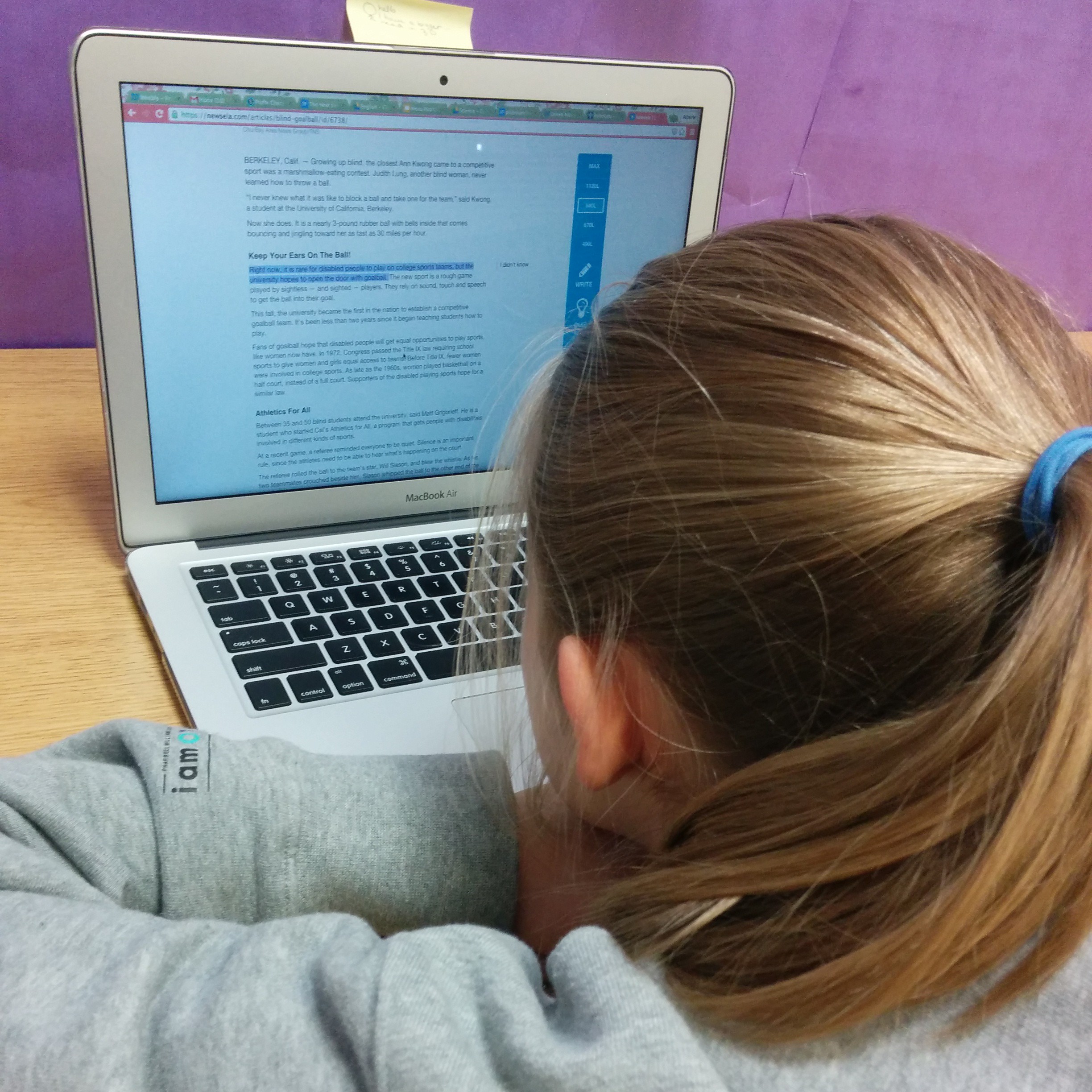
Assistive tech is a huge topic. We can find all sorts of solutions for students: “no-tech”, low-tech, or high-tech, ranging from free to prohibitively expensive. The best assistive tech tools, though, are the ones that students can transition with and that will lead to independence. In special education and intervention, our goals are almost always transfer and independence. When we start leveraging the technology and resources that are already in a student’s possession, we can encourage that transfer. I’ve found a number of tools that have worked well for my students (generally students with mild to moderate LD) that are either built-in accessibility features or free apps or plug-ins. So far they’ve been working really well for us. These are a few of the tools we’ve been using for reading and writing. In a future post I’ll talk about some organizational tools and some other accessibility features and apps.

(Note: These are just things that are currently working in my classroom. I’m getting no compensation of any kind from any of these programs. I’m just sharing what’s working of my students and for me right now)

Assistive Tech for Reading

There are two different options we’ve been using for text-to-speech in order to assist students who have reading difficulties. One is a Chrome plug-in called SpeakIt, and the other is just the accessibility feature found in Acrobat Reader.

Speak It

SpeakIt is a Chrome extension that reads text on websites, including within Google Drive. It’s free and easy to use. Students can easily customize the reading voice, which includes options that are much more natural sounding and more fluid than the ones available through the accessibility features within Chrome. It is also available as an iOS app as well. Students have really enjoyed using this app to help them access more difficult texts on websites that have been assigned for class reading, when doing research online, and, I think the best application we’ve found, to have their written work read back to them in Google Docs. This is actually a use that was discovered by a student. We had been talking about how important it is to read your own writing. Realizing that he often missed his own mistakes, this student decided that he would use the extension to have his computer read his writing to him, and then used what he heard to correct commonly confused words and other spelling and usage errors. It was pretty amazing. The one limitation of this extension is that it doesn’t read PDFs that are embedded into websites (like those on our school’s LMS), so those need to be downloaded and read to the student using Adobe Reader.

Acrobat Reader

The other program students have been using, Acrobat Reader, has accessibility features that will read the text of a PDF document (as long as it hasn’t been uploaded using a scanner or camera to PDF app). Students can have an entire document read to them, or select particular sections the voice is definitely not as natural sounding as the voices in SpeakIt, but it works. The only issue I can see is with reading academic texts. For example, one of my students used the text-to-speech function to help him read a textbook entry about the beginnings of Islam. The program had more than a little difficulty with non-English words, but the 7th grader I was working with had enough background knowledge from class to figure out that the pronunciations weren’t correct. It’s not as good as using a program like Kurzweil or Read & Write Gold, but it’s free and a great way to test out if this type of assistive tech will be useful for a student.

Assistive Tech for Writing

My students generally have pretty good keyboarding skills, and we’ve done a lot of work on organization and planning this year, but they really struggle with editing their own work, particularly when it comes to commonly confused words. While text-to-speech is quite helpful for many of them, speech-to-text is a bit too much support. As a group, my students have been very excited by the Chrome extension, Ginger.

Ginger

Ginger is not your typical spell checker. It looks for commonly confused words (like homophones or words with very similar spellings), and even makes suggestions for comma usage and grammar. It is a Chrome extension and can also be downloaded as a keyboard app for Android and iOS, as well as desktop version that integrates with Word. Unfortunately for us, it’s only available for PC in that form. I’ve found it to work much better than the spell-check that is integrated into Chrome. It has the option to correct one word in the sentence, the entire sentence, or ignore the suggestions. AND I can tell Ginger that, yes, my last name (or other words that I use frequently that spell-checkers don’t recognize, like “metacognitive” or “multisyllabic”) is indeed spelled correctly. And it will remember. Which is not just amazing for me, but also for my students who are from around the world and often have names that aren’t recognized by spell-check (and, being middle schoolers, are often offended by this). I also like that it highlights possible errors in blue, rather than with a red underline, which seems to make my kids anxious (especially if they experience a lot of difficulty with spelling). It’s not perfect, but I’ve found its suggestions to be much better than most. It’s great for when we’re working on our digital portfolios in Weebly. What’s not great is that it doesn’t seem to work within Google Drive. Students can copy and paste their text into a Ginger window, but most of my students aren’t going to take that step (mostly because they’re worried that they’ll accidentally delete the entire thing). I would love it even more if we could integrate it with one of the word processing programs (Word or Docs) that we already use.

What programs to you use to assist your students with reading and writing?

The Dream of Differentiated PD

The problem with traditional PD--why we need differentiated PD
From Jen Henga via Flicker

I think the thing that stuck with me the most when I went to CGC was the idea that everyone learns. And everyone means everyone–students, teachers, administrators–we’re all learners. To me, the CGC principle that learning is scaleable is the most important one for me this year in my new role as Instructional Coach as well as Learning Specialist. I think that trying to develop differentiated PD for the faculty is one of the most important things I can do this year to ensure that everyone learns, both because I’m modeling what I want teachers to do and because I want teachers to get what they need from PD and find it useful. So I sent this out into the Twitterverse:

Crickets.

I can’t believe that no one is trying this. It could be I didn’t use the right hashtags. It could be that I tweeted at the wrong time of day. Maybe I need to follow some of Matt Renwick’s tips here. But I came up with nothing. So I’ve been muddling through on my own, and there are a couple places where I’m still stuck.

Readiness: How Do I Know What They Don’t Know?

I work with people who come from a wide range of backgrounds and experiences. They’ve been teaching anywhere from a couple of years to a couple of decades. They have various comfort levels with differentiation and various opinions on whether or not it even has a place in our school. I’ve used a variety of different tools to try to get at this, but I’m always left with the following questions:

  • How easy is it for teachers to be vulnerable with their colleagues and admit they don’t know?
  • If part of the purpose of preassessment is to preview and maybe show learners that they have something to learn about the topic, how do you make sure that people who may see themselves as knowledgable (but may not be) feel neither talked down to or threatened?

When I tried to create a preassessment questionnaire for my last PD session, one colleague gave me the feedback that it was “too intense and detailed” and might “scare people off” or make the “feel threatened”, another colleague gave me the advice that it didn’t cover enough and really wouldn’t give an adequate preview of what people would learn. I ended up not handing it out, leaving me feeling unprepared and like I wasn’t modeling what I wanted the staff to do.

I think today this might be more successful. I used exit tickets from our last session to group people by interest. We’ll see how it goes.

Interest: How Do I Keep Things Relevant?

I’m pretty good at helping teachers develop differentiated units and projects, but there are definitely areas that are outside my comfort zone and knowledge, most specifically subjects outside of the MESH (Math, English, Science & Humanities) or core subject domains. I’m not sure what to do that will be relevant to disciplines like PE, Art, and Music,, and sometimes Modern Languages, but I do want to make sure these teachers feel included and like a part of our professional learning community.

Things I’m trying this year:

  • Flexible groupings: grade levels, subject areas, general interests.
  • Using teacher-leaders from those disciplines to act as leaders or experts in small groups.
  • Talking to these teachers: what do you want? What can I do to make this relevant?

The thing is though, I’m still up against years of these teachers feeling not included or marginalized, and that’s the added piece here that I’m really not sure how to deal with.

Taking Risks

So trying all of this means I’m taking some risks with how I’m structuring PD. Some of them may fail, and I’ll reflect from them and learn from them. However, I’m worried that by taking those risks and failing to get it right I might make people feel like their time is being wasted. And we all know how happy teachers are when their time is being wasted (we’ve all been there and been really angry about it). So how do I find the balance between taking risks with how I’m delivering PD and playing it safe with my use of my colleagues’ time? I wonder if this is why so many schools and districts stick with the “sit and get” model of PD. People may not always enjoy it, but they’re not complaining too much.

Any thoughts? If you lead PD at your school, how do you approach these situations?

Tests, Tests, Tests

Tests, Tests, Tests
Students working on their tests in the Learning Lab.

We’ve hit that point in the year when the first units are starting to wrap up and all of my students are starting to panic about tests. Most of them have no reason to panic: They know what they need to do, but they have some sort of test anxiety. Many students, however, don’t really know how to study, which increases this anxiety. They spend most of their time working on what they already know how to do and not enough working on what they don’t know. Most likely they do this because they’re just not sure how to study what they don’t know or understand.

This year I decided to try to explicitly teach these skills, starting with knowing what to study. I created a study guide for the students in my learning support class. It’s essentially a self-assessment rubric that lists the various topics on the test and allows students to sort themselves into one of three categories: Got it!Working on it!, or I need more practice. Each category is defined (see below–it’s not pretty, but it did the job). What made me really excited was that when I shared it with the general ed math teachers, they all chose to use it with their classes.

Once the student completed the form, we looked at the areas that they thought were the weakest and created plans for how they would study. My original idea was to have them actually make a plan using their studybook or a calendar with activities they would do in order to study for each of the concepts they were unsure of, but it became clear pretty quickly that my students we they not sure what to study, they also weren’t sure how to study. We had to do a lesson about how to study, and how to study for math tests in particular.

We discussed that the best way to study for math was to practice doing problems that are similar to what will be on the test and discussed places to find questions with answers (our textbook being the main source). The other important piece was making sure to refer to notes and other sources either while completing a problem (if you are having difficulty remembering the steps) or after completing a problem. Because note taking is another area we’re working on, I created these checklists to help students practice.

Practice for tests with checklists

I laminated copies of the checklist for each student so that they could use a dry-erase marker to check off the steps as they completed them. As they worked with the checklists, they became more confident in their abilities and were able to practice the steps of the process. Eventually, I’d like to get them to the point where they can make their own checklists from their notes, but before that can happen we need to work on note taking skills.

The last step in this whole process is going to be reflection. Once students have taken the test, they will be allowed to do corrections. I created this test corrections sheet and shared it with the math teachers.

I like this test corrections sheet because it asks students to think about what might have gone wrong during an assessment, whether it is careless errors or really not understanding a concept or a process. I’m hoping that this will help us with reteaching and intervention, and that maybe we can offer students another opportunity to show what they know after reteaching in the form of a retest or another assignment.

How do you teach study skills? What do you do about test corrections or retakes? What opportunities do you offer students to demonstrate mastery of a topic after the assessment is done?

Why My Pilates Instructor Should Run Our Differentiation PD

Pilates as Differentiation PD?
It’s really hard to find images of Pilates classes that aren’t all uber-fit white ladies. This is the best I could do, doesn’t entirely match the spirit of my post, but you take what you can get sometimes…Source

I enjoy all sorts of exercise: biking (outdoors and spin classes), running, strength training, yoga, hiking, dancing…but Pilates always scared the crap out of me. More than biking in Manhattan. During rush hour. Why, you ask? One word: Teaser.

That’s not entirely true, but that is one exercise that I found quite intimidating. Pilates just seemed like something that my body would not be able to do. I didn’t think I was strong enough. I have a really hard time with spatial relationships and visualization, so when someone describes what I’m supposed to do in words, I have a really hard time figuring out (1) what I’m supposed to do, and (2) how to get my body to do it. Also, whenever you see people doing Pilates they complete things so effortlessly that it’s intimidating. They just float. It’s like some sort of magical power. Pilates seemed nearly impossible to me. Plus, I really don’t like doing things I’m not already good at (yes, I know, I’m working on it). I was never doing it. No way.

Then, about a year and a half ago, I hurt my ankle. I don’t know how I hurt my ankle. The best I can figure it’s one of those injuries that mostly happens to New Yorkers. You’re wearing heals on the subway, heading home from work. The car stops suddenly. Physics happens. The subway and your firmly planted foot stop moving, but the rest of your body keeps going for a bit, somehow straining a ligament or a tendon. And then you are in pain. Forever. Because there’s no way to avoid walking or stairs when you have no car and live in a 5th floor walk-up in Brooklyn.

My doctor told me to rest it, to ice it, to wrap it.

I begged for a boot at least, so people would offer me a seat on the subway.

My doctor told me to rest it, to ice it, to wrap it, and to wear my hiking boots or invest in a pair of Dansco clogs.

I asked when I would be able to exercise again.

My doctor told me  I could do core work on the floor, or seated strength training. And once I had a full week where I could comfortably put weight on my foo use an exercise bike, do yoga, or do Pilates. Aquacise was also an option.

I thought Pilates? Hell. No.

Once I could put weight on my foot, however, I really wanted to get out and exercise, so I tried it. And it was hard.

But the instructor, she was amazing. She was helpful, encouraging, and it occurred to me later, the best differentiator I’ve ever met. She does all of the things that I hope to get teachers I coach to do and that I strive to do better myself. This is why–no offense to Bill and Ochan Powell–I think my Sunday afternoon Pilates instructor, Nathalie, should lead our next differentiation PD. Or maybe she should just come and do a class with the faculty and really model good differentiation.

This is either the best or the worst idea I’ve ever had, but since it will likely just float around as an idea in cyberspace and never come to fruition, we can leave that part ambiguous. I am, however, going to enumerate her qualifications below.

She always does a preassessment and engages in formative assessment throughout the lesson

Every week Nathalie walks into the class and asks a few quick questions to get a sense of who her students are and what they need, something we as classroom teachers should be doing as well. Maybe not in the exact same way

  1. Is anyone new to Pilates? (What’s your experience, skill, or content knowledge with what I’m about to teach you?)
  2. Does anyone have any injuries? Had abdominal surgery? Anyone pregnant? (How will I need to modify things for you based on your particular needs?)
  3. Everyone’s feeling OK? You guys look tired/happy/content. (Anything else going on that’s going to make today difficult for you?)

During the lesson, she watches us perform movements and stops to explain how and why things work, how to do the movement correctly, or how to modify the movement as necessary.

Preassessments and other forms of formative assessment are so important for differentiation. It’s how we know how to differentiate. Sure, we all have things in our toolbox that we can pull out to differentiate reactively during class, but preassessments help us to differentiate proactively. During the lesson, ongoing formative assessment in the form of observations can help us to provide additional differentiation.

She gives instruction in a variety of ways

Each time she asks us to do a movement or a series, Nathalie gives the instructions orally, sometimes explaining in two different ways. She also models the movements in two different ways. Once modeling what it looks like laying on the ground, and then frequently a second time offering an “aerial view” while standing.

As classroom teachers we should always be presenting information in a variety of ways in order to reach all of our students. Making this a habit is one simple way to support everyone in the class.

She offers adaptations and modifications of activities

For nearly every movement, Nathalie offers several ways of completing the movement. The movements are different based on your skill level, your body type, any injuries you may have.

However (and even more important, I would say)…

She never refers to a modification as easier or harder and never privileges one way of doing things over another

This is the thing that finally convinced me that Nathalie was one of the best differentiators I had ever met was this: every time she demonstrates a modification she lets us all know one important thing: the modification makes the exercise work for your body. She tells us several things

  • Modification doesn’t make it easier: It makes it so your body can complete the exercise and benefit from it. Which, yes, does feel easier to you that the original exercise, but makes if feel about the same to you as the “typical” person doing the unmodified move.
  • Modification doesn’t make it less work.
  • Modifications are explained completely and we all know why we should choose them. I don’t do my hundreds with my legs straight in the air because I’m trying to make it easier or I’m lazy, I do it that way because I have a tendency to to have a lot of tension in my neck and shoulders, whereas the guy next to me always does modified hundreds with his knees bent because he’s a runner and has really tight hamstrings. And someone else is doing modified hundreds because she’s had a C-section. No one really needs to know why each of us selects what we did but us. But having the instructor explain the exercises and the work that’s involved in each modification creates a safe space for us to all do what we need.

As teachers sometimes we unintentionally value one form of work over another (I know I’ve been guilty of it–love to analyze, but really struggle with creative assignments, so sometimes I don’t work as hard at creating them. I’m getting better about it now that I’m aware of it) and set a classroom climate where students feel like choosing that isn’t the one that the teacher clearly values or is deemed the “normal” or “right” way to complete the assignment isn’t OK. If we value all ways of completing assignments and make sure that the work is different, not easier or harder, or better or worse, our students will see the work in the same way. Normalizing the fact that all brains are different the same way Nathalie normalizes the fact that all bodies are different creates the type of classroom where students thrive and learn.

She doesn’t let us get away with slacking–she pushes us toward growth and celebrates it

Yes, Nathalie differentiates and offers modifications, scaffolds, if you will, for those of us who may have been at a lower level of readiness when we started the class, but she observes and assesses (see point #1) and then encourages us to try something new. She doesn’t let the scaffold become a crutch, or let us define ourselves by needing a particular scaffold. She’ll tell us to try a different modification or without a modification if she sees that we are doing really well and should challenge ourselves more. Then, whether we succeed or fail, she applauds us for increased strength, for trying something new, or just for smiling through it all.

As classroom teachers we need to know when to push our students to try something new and different, and when it’s OK for them to stick with activities they feel comfortable with. We need to be aware of growing skill levels and help guide students to choices that will make work a bit more challenging for the student, or when to pull back our scaffolds a bit to promote growth. We also need to celebrate growth and trying new things.

In conclusion, Nathalie should run a Pilates class during our differentiation PD

So, if the higher-ups at my school are reading this, I think our August differentiation PD should include a Pilates class from Nathalie where we can all experience differentiation and gain some empathy for our students who might be out of their comfort zone in a traditional classroom setting. If they’re anything like me, school was always a place where I felt pretty comfortable and I was pretty good at it (that’s part of why I elected to go back there full time for my career). For me, Pilates took me outside of my comfort zone, and really highlighted for me what good differentiators like Nathalie do. And even though I always knew differentiation was important and it was something I valued as an educator, this is the first time I was really cognizant of benefitting from it. I’d like other members of our faculty to experience that as well.

And just in case you were wondering, all that differentiation worked. I can totally do Teaser now. I may not float completely effortlessly yet, but I’m going to get there.

Where else in the world outside of K-12 education do you see excellent differentiated instruction?